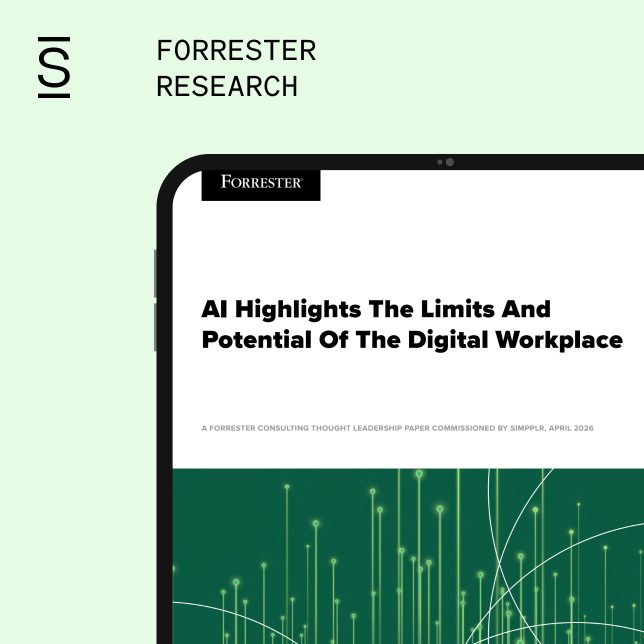



Enterprise AI is moving fast, but results aren’t keeping pace with investment. A 2026 commissioned study conducted by Forrester Consulting on behalf of Simpplr uncovered a foundational problem that better models alone won’t fix. Fragmented data, lack of governance, and disconnected systems are limiting what AI can do, and addressing them starts with rethinking the foundation of the digital workplace.
New Forrester research reveals AI’s limits and potential in the digital workplace
New Forrester research reveals AI’s limits and potential in the digital workplace
The findings arrive at a moment when enterprise AI spending is at an all-time high and expectations are running well ahead of reality. Organizations are deploying AI tools across functions and discovering that the technology performs only as well as the environment it operates in. Disconnected systems, immature governance, and scattered organizational context give AI little to work with. The initiatives that follow tend to underdeliver, not because the models are wrong but because the foundation isn’t ready.
The study surveyed 310 senior IT leaders at the director level or higher across North America and the United Kingdom, all responsible for digital workplace, employee experience, and AI strategy at organizations with 1,500 or more employees. Their responses point to structural barriers that not only slow AI down today but will also get harder to address as adoption grows.
Productivity is driving enterprise AI investment
When IT leaders talk about what they want from AI, the conversation keeps coming back to how work gets done. Improving speed and agility and increasing employee productivity — each cited by 65% of respondents — rank among the top outcomes driving investment, alongside improving customer experience (68%).
Revenue growth ranks considerably lower, with only 43% of respondents citing its importance in investment decisions. This isn’t because it doesn’t matter but because leaders see it as something that follows when the operational fundamentals are working.
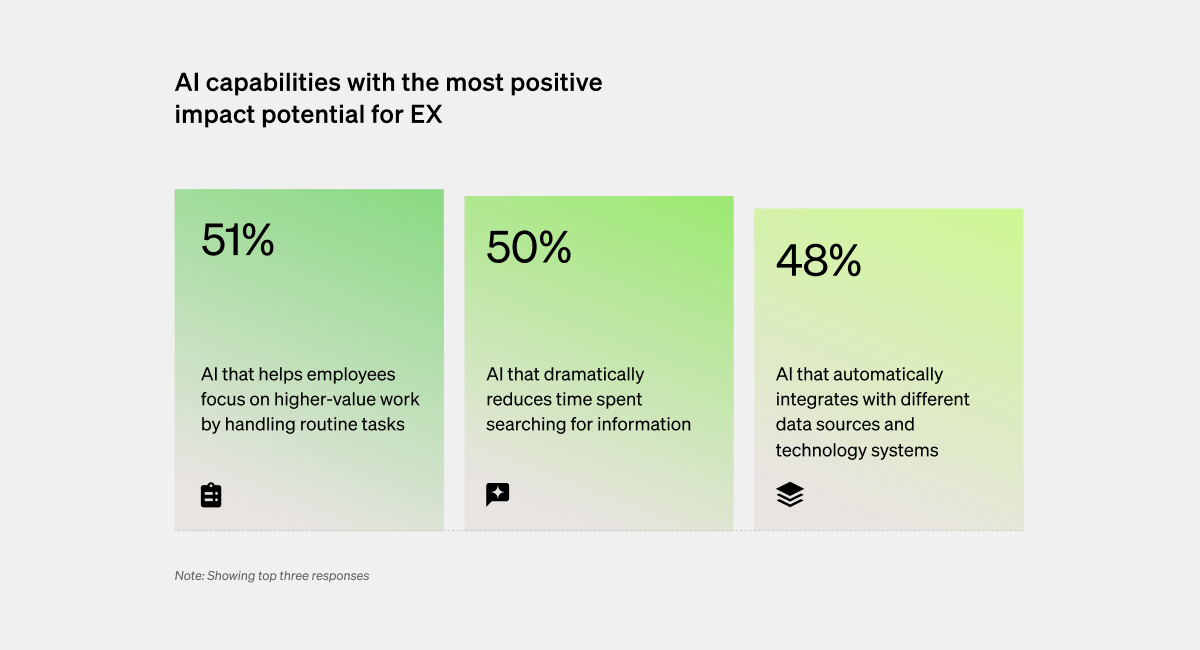
That framing shapes how organizations are approaching AI deployment. When asked which AI capabilities would have the greatest positive impact on employee experience, leaders pointed to outcomes that are concrete and measurable.
The top three AI capabilities expected to have the greatest impact:
- 51% say AI that handles routine tasks, freeing employees to focus on higher-value work
- 50% say AI that dramatically reduces time spent searching for information
- 48% say AI that automatically integrates with different data sources and technology systems
These are the specific, measurable improvements IT leaders are being asked to deliver, and they set the bar for what AI investment needs to clear.
Fragmented systems are limiting AI effectiveness
The most consistent finding in the research is also the most consequential: AI performs only as well as the data and knowledge it can access, i.e., garbage in, garbage out. When that knowledge is scattered across disconnected systems, AI lacks the organizational context it needs to produce reliable results.
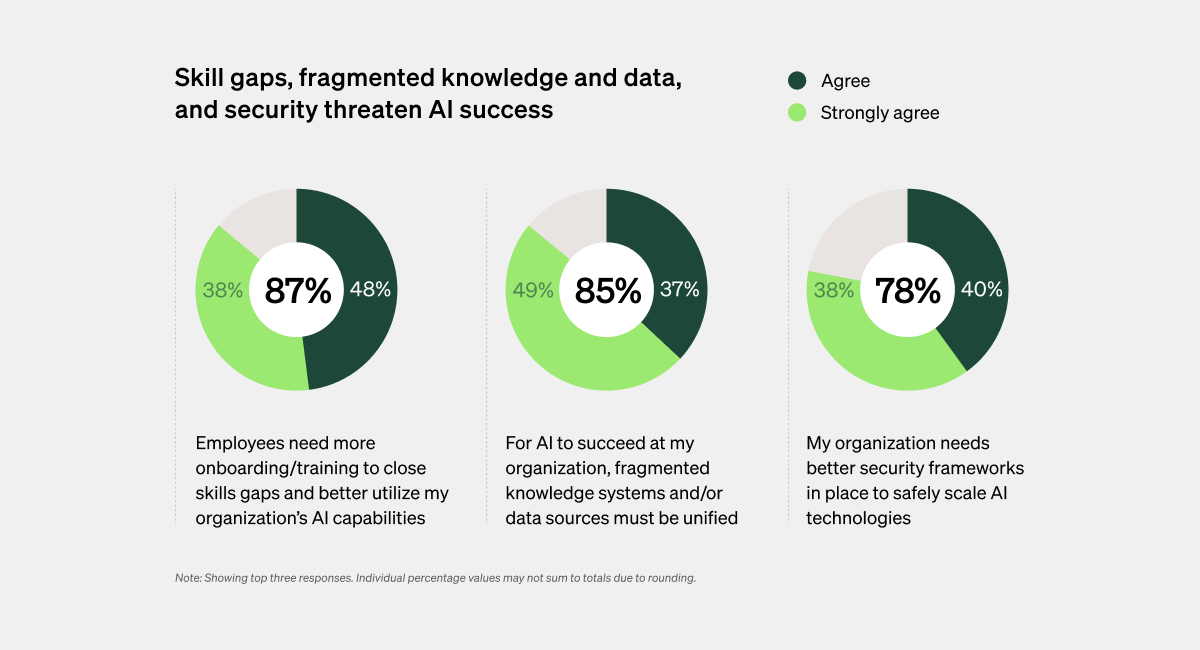
85% of respondents agreed that fragmented data sources and knowledge systems must be unified for AI to succeed, and 45% of those who had experienced AI underperformance said missing organizational context was the primary cause.
That’s a significant finding. Organizations are investing heavily in AI capabilities while the underlying environment those systems depend on remains fragmented. The models aren’t failing — the foundation is. And the problem doesn’t get easier with time. A full 83% of respondents expect the unification challenge to grow more difficult as more AI applications are layered on top of existing infrastructure.
Deploying more AI tools without addressing fragmentation only makes the experience worse for users, which can have an adverse effect on user adoption and productivity. The organizations that will see returns on their AI investments are the ones that treat data unification and knowledge consistency as prerequisites to deployment.
The most important metrics are the hardest to move
What makes this particularly acute is that the KPIs organizations use to measure AI success are the same ones they find hardest to move.
Improved productivity is the top-tracked metric — 76% of respondents are measuring it — but it’s also the one most in need of improvement for AI initiatives to be a success, according to 72%. Employee satisfaction with AI capabilities and AI product utilization follow the same pattern: heavily tracked, consistently underperforming.
That gap reflects what happens when AI is deployed into environments that lack the necessary organizational context and knowledge consistency. Productivity improvements don’t materialize from tools alone. They require AI that can reliably surface the right information, reduce friction in workflows, and operate across systems without breaking down at the boundaries. That requires a foundation most organizations don’t yet have.
Governance gaps are stalling scale
Governance is what determines whether AI moves from scattered pilots to an enterprisewide strategy. Most organizations surveyed understand this. The foundational intent is there, but execution is where organizations are getting stuck.
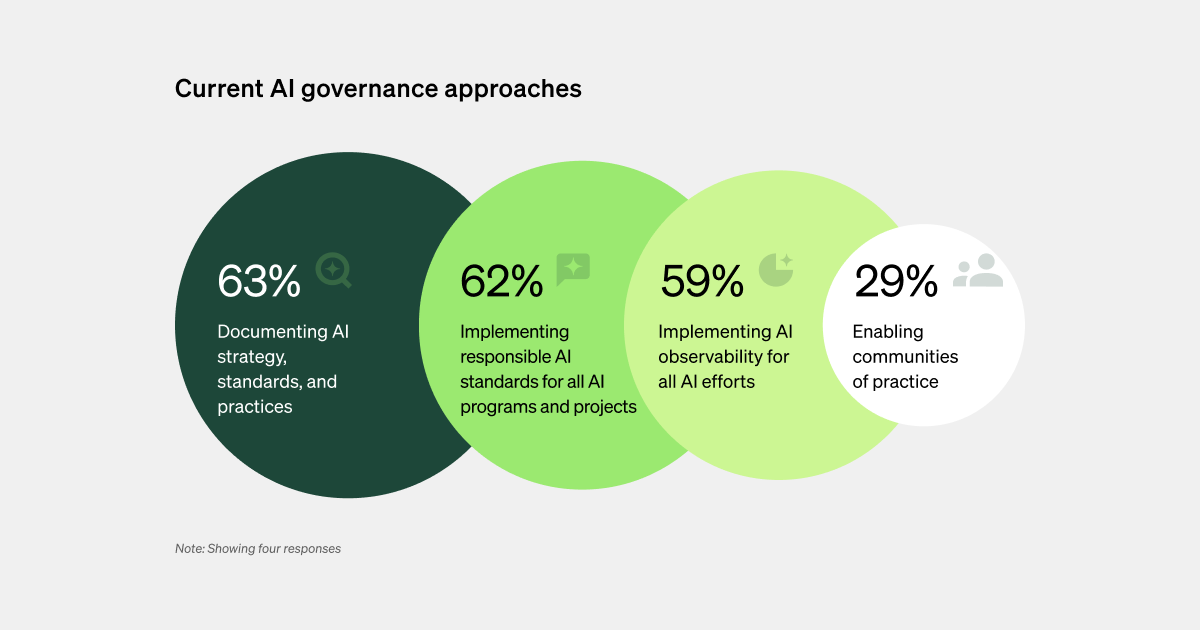
Current governance approaches among respondents:
- 63% are documenting AI strategy, standards, and practices
- 62% are implementing responsible AI standards
- 59% are implementing observability across AI efforts
Knowing what good governance looks like and being able to implement it are two very different things. The capabilities leaders are most excited about — end-to-end service automation and automatic cross-system integration — require mature identity management, access controls, and agentic governance frameworks that most organizations haven’t built yet. Without those foundations, scaling AI safely remains out of reach.
The workforce dimension is just as significant. Only 29% of respondents said their organizations have established AI communities of practice — structured groups for sharing knowledge, standards, and emerging governance approaches across teams. Without learning mechanisms in place, governance programs will continue to lag behind deployment ambitions.
87% of respondents agreed that employees need more training to better use AI capabilities
Governance programs that exist only on paper can’t scale AI. The organizations making real progress are the ones treating governance as an operational discipline, building the people, processes, and institutional knowledge to back it up alongside the technical infrastructure.
Security concerns are slowing deployment
Governance tells organizations how AI should operate. Security determines whether it can.
As AI moves toward enterprisewide deployment, nearly half of respondents (49%) identified security and access control risks as their top operational challenge — the single most cited concern in the survey. And 78% of respondents said better security frameworks are a prerequisite for scaling AI safely.
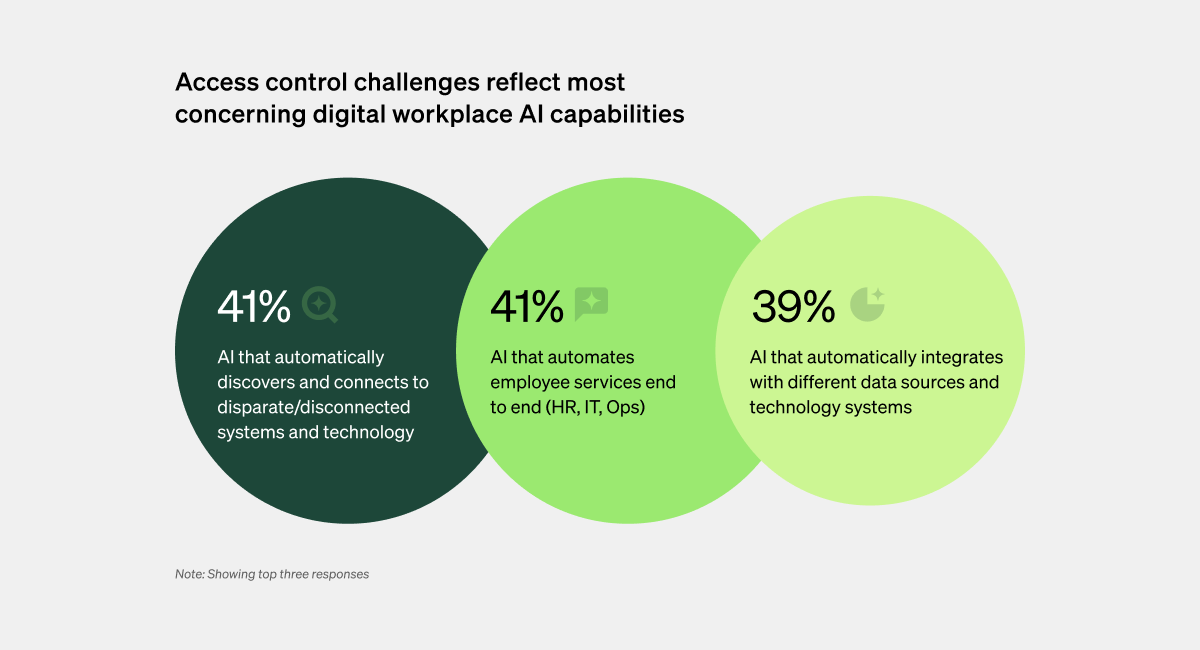
The concern sharpens around the capabilities organizations want most. Surveyed leaders are most excited about end-to-end service automation and automatic integration across systems. But those are also the ones that raise the most serious questions around access control.
41% of respondents expressed concern about both AI that automatically discovers and connects to disparate systems and AI that automates end-to-end employee services
For IT leaders, this is a central point of tension: The capabilities with the highest potential value are the same ones that expose the most significant security and governance gaps. Organizations that haven’t yet built mature identity management and access control frameworks around agentic AI are taking on risks they may not have fully accounted for.
The case for a unified digital workplace foundation
Despite the challenges the research surfaces, AI deployment isn’t slowing. Three-quarters of respondents expect their AI deployments to grow up to 20% over the next one to two years. Another 20% expect increases of over 20%. Organizations will scale AI, but the issue is whether the foundation will be ready when they do.
Most respondents are looking to AI-powered digital workplace platforms as the answer to the fragmentation problem. Three-quarters expressed interest in adopting one, and nearly a quarter already have. The expected benefits — increased productivity, operational agility, and improved employee experience — map directly to what IT leaders said they were investing toward in the first place.
The research points to a consistent conclusion across every finding: AI performs best when it works from unified knowledge, consistent governance, and organizational context. Fragmented environments produce fragmented results, regardless of how capable the underlying models are.
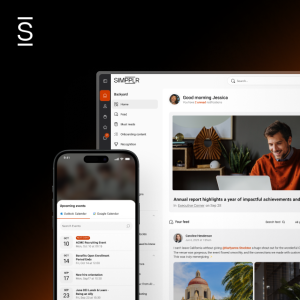
Simpplr’s AI-powered employee experience platform addresses fragmentation at the foundation. It brings together enterprise knowledge, communications, and workflows across connected systems so AI operates on a consistent, permission-aware foundation. For IT leaders trying to move from scattered pilots to enterprisewide deployment, that unified foundation is where the work starts.
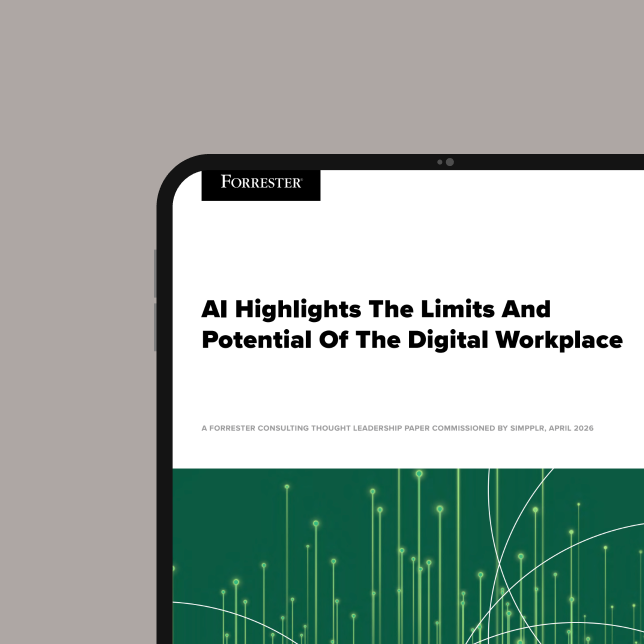
Access a complimentary copy of the survey findings in the study, AI Highlights the Limits and Potential of the Digital Workplace.
Ready to find out how Simpplr can reduce the fragmentation of your digital workplace? Request a demo today.
Watch a 5-minute demo
See how the Simpplr employee experience platform connects, engages and empowers your workforce.
- #1 Leader in the Gartner Magic Quadrant™
- 90%+ Employee adoption rate
Graphs based on 310 NA and UK decision-makers at the director level or higher in IT responsible for their organization’s digital workplace, employee experience, and/or AI tools or technology strategy. Source: Forrester’s Q1 2026 AI For Digital Workplace Technology Survey [E-66449]