





The global economy is powered by frontline and deskless workers. They operate facilities, move goods, deliver healthcare, maintain infrastructure, and serve customers. They are where strategy becomes reality.

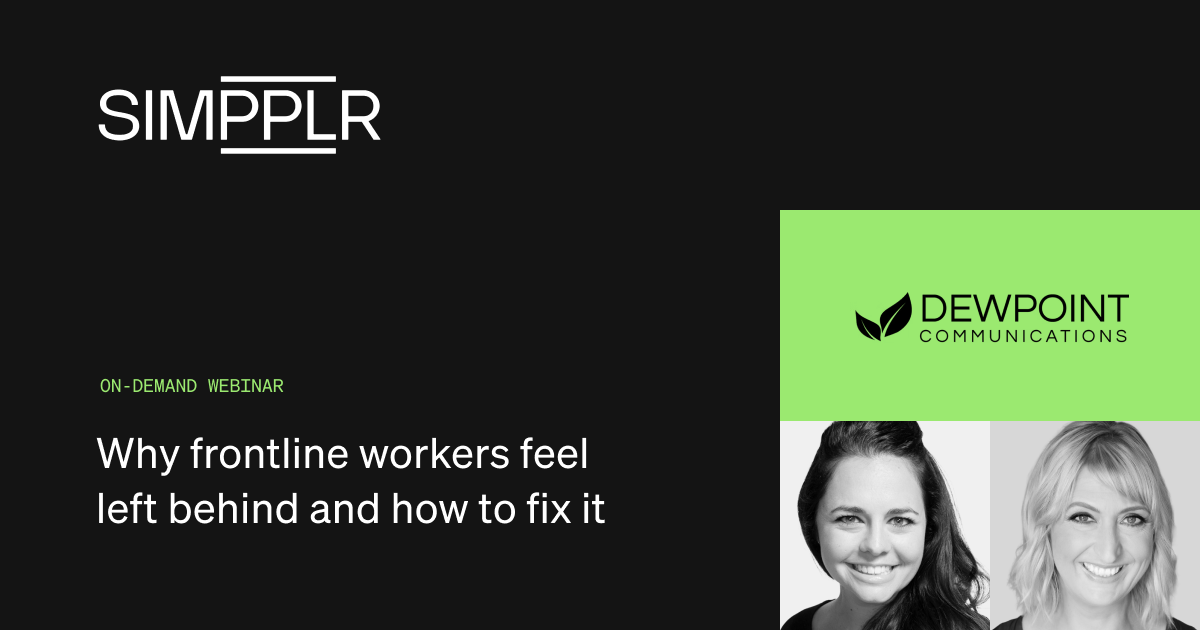
Why frontline workers feel left behind — and how to fix it
Why frontline workers feel left behind — and how to fix it
Table of contents
And yet, according to research cited in Dewpoint Communications’ Connecting the Frontline report, which spans 18 industries and sectors in North America, most of them aren’t well-equipped to understand the business strategies and transformation programs they’re tasked with implementing.
Connecting frontline workers is a growing business imperative
Poor information access and frontline friction cost US organizations more than $80 billion annually in lost productivity. Globally, worker disengagement drains $8.9 trillion from the economy each year, according to Gallup.
84% of leaders recognize Internal Communication’s impact on talent attraction and retention, and 81% are clear on the connection to the bottom line (Simpplr 2025 State of Internal Communication and Intranet Technology).
Highly engaged teams demonstrate 23% higher profitability than their less engaged counterparts. When engagement, clarity, and trust improve across frontline workforces, the impact is significant. When they deteriorate, the cost to a business can be catastrophic.
Current demographic pressures make this problem increasingly urgent. In some fields, there are simply not enough skilled frontline workers to fill positions that currently exist, let alone the jobs that will be created as more factories are built and transformation programs accelerate.
BlackRock, the world’s largest asset management firm, considers the dangers so imminent they’ve recentlydonated $100 million to help train electricians, HVAC technicians, plumbers, and ironworkers.
Technology will not easily replace tradespeople and many other skilled frontline professions. Companies are competing for workers who do not currently exist in sufficient numbers. Organizations that fail to communicate with and engage their frontline workers effectively face an existential threat — losing the talent war just when they can least afford to.
In Dewpoint’s research, the Communication leaders whose executive teams described frontline communication as “critical” or “important” consistently rated their own organizations’ execution as “poor,” “fair,” or “good” at best. That gap between stated priority and actual investment is where businesses jeopardize talent strategies, transformation momentum, and operational excellence.
Improving communication with frontline workers represents a significant competitive advantage for businesses that get it right — and a meaningful risk for those that don’t.
Frontline workers are knowledge workers, not just implementers
One of the most consequential misconceptions Dewpoint Communication’s research reveals is also the most persistent: that frontline workers are there to execute decisions made elsewhere.
In reality, these are the people who understand supply chains, customers, equipment, and site conditions often better than anyone. They experience the impact of strategic decisions first and detect friction long before it appears in performance dashboards.
When communication flows primarily in one direction, organizations lose access to that intelligence. In the absence of two-way communication and feedback loops, adaptation slows and the strategy-execution gap widens.
90% of organizations say success depends on empowering frontline employees to make autonomous decisions (HBR).
But workers cannot make good decisions without understanding strategy. And they can’t contribute intelligence without the structured communication and engagement mechanisms required.
Connecting the frontline is not merely a nice-to-have culture initiative; it determines whether change efforts gain traction or meet resistance.
In customer-facing industries like retail and hospitality, frontline and deskless workers are also the face of the brand and provide a human experience no marketing campaign can replicate.
Three structural reasons organizations keep getting this wrong
Strategy is communicated, but not contextualized
Organizations are often able to “cascade” or “disseminate” announcements to frontline workforces effectively. However, they are generally far less successful at translating those announcements into what they mean for specific roles, shifts, and operational environments.
Frontline workers frequently report receiving information without sufficient explanation of how it affects their work. Over time, that damages confidence in leadership decisions, weakens alignment, and erodes trust.
Alignment is much more than a one-time announcement. It’s an ongoing dialogue that creates context and meaning that ultimately informs day-to-day behaviors and actions on the shop floor, building site, or in a patient’s room.
Managers are saddled with excessive frontline communication responsibilities
Frontline managers may be the most trusted source of information for the people they lead, but they are also managing staffing shortages, operational targets, compliance requirements, and increasingly complex reporting systems — as well as leading teams often working in high-risk environments.
Dewpoint’s research explains that many managers and site supervisors are treated as “communication channels” responsible for cascading uncontextualized corporate information on top of their existing duties.
75% of managers report being overwhelmed by the growth of their job responsibilities, and 73% do not feel equipped to lead organizational change (Gartner).
Piling communication responsibilities onto already overloaded managers without the right tools, support, or cocreated approaches degrades both the manager experience and the frontline connection. When managers lack time, clarity, or support, alignment becomes inconsistent.
Technology solves the access problem, not the alignment problem
According to Simpplr research, 55% of organizations still rely on fragmented systems. While modern mobile-first digital employee experience apps have expanded what is possible in frontline communication, access alone does not create understanding.
Dewpoint’s research reveals that companies seeing success in tech-enabled connection with their frontline workers are taking the time to understand their needs and preferences — what would make their jobs easier and more meaningful — before building or procuring a platform or solution.
However, great technology is only part of the answer to solving frontline challenges. It isn’t a substitute for leadership clarity, listening, or strategic communication design.
What effective frontline communication really looks like
Across Dewpoint Communications’ research, the organizations closing the frontline gap share three success factors.
When aligned, these produce consistent results:
- Clear and consistent leadership commitment to creating and delivering an excellent frontline workforce experience
- Managers enabled, empowered, and resourced to contextualize and localize corporate information and strategy — as well as provide feedback that represents the voice of the employee
- Digital tools designed around frontline workflows rather than corporate assumptions
Organizations getting this right are not necessarily those with the most advanced technology. They are those that view frontline connection and engagement as foundational to performance — and that have shifted communication from a downstream distribution function to something that shapes how decisions are made and how change is navigated.
Frontline workers are already doing the work that drives performance. The question is whether the organization is equipping them with the context and connection needed to do that work well.
Frontline Worker Communication FAQs
What is frontline worker communication?
Frontline worker communication refers to the strategies, channels, and tools organizations use to share information with — and receive it from — employees whose roles are not desk-based. It encompasses operational updates, safety information, strategic context, two-way feedback, and engagement. Effective frontline communication treats these workers as knowledge workers, not just implementers.
Why do frontline workers feel disconnected from company strategy?
Strategy is frequently cascaded as announcements rather than contextualized for specific roles and environments. When communication flows only in one direction and managers are not equipped to interpret and localize information, workers receive the message without the meaning. Dewpoint Communications’ research consistently surfaced this as one of the most persistent structural failures in frontline communication.
What is the ROI of improving frontline employee communication?
Globally, worker disengagement costs the economy $8.9 trillion annually, indicating an opportunity for improved productivity, performance, and innovation through improved communication.
Dewpoint Communications is the leading expert that future-focused companies trust to deliver best-in-class strategic internal communication support. Headquartered in Boston, the firm supports global clients through strategic consulting, research, and advisory services.
Download Dewpoint’s full report for detailed findings: Connecting the Frontline: Current Trends, Challenges, and Strategic Opportunities in Workforce Communication.
Read to see how Simpplr can help you reach and engage your frontline workforce? Request a demo today.
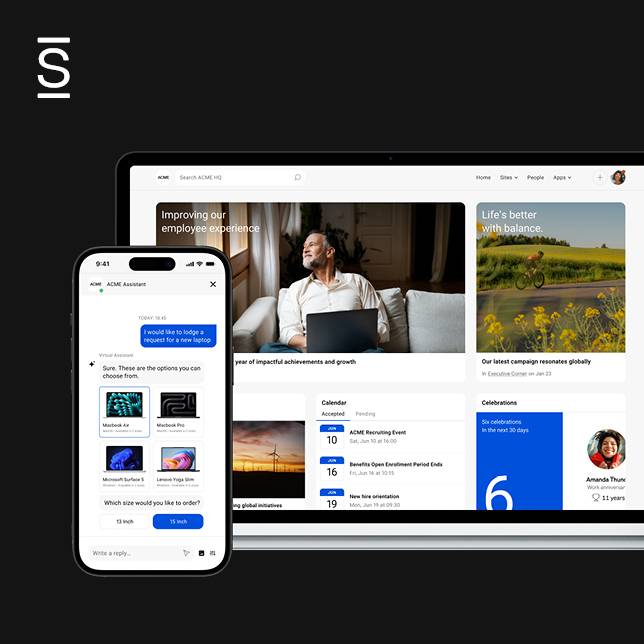
Watch a 5-minute demo
See how the Simpplr employee experience platform connects, engages and empowers your workforce.
- #1 Leader in the Gartner Magic Quadrant™
- 90%+ Employee adoption rate