





Making AI work for people: a practical guide to people-centered AI adoption for IC teams
Lead AI adoption as organizational change — not a tech rollout. Learn how to build employee confidence, capability, and trust through structured, people-centered implementation.
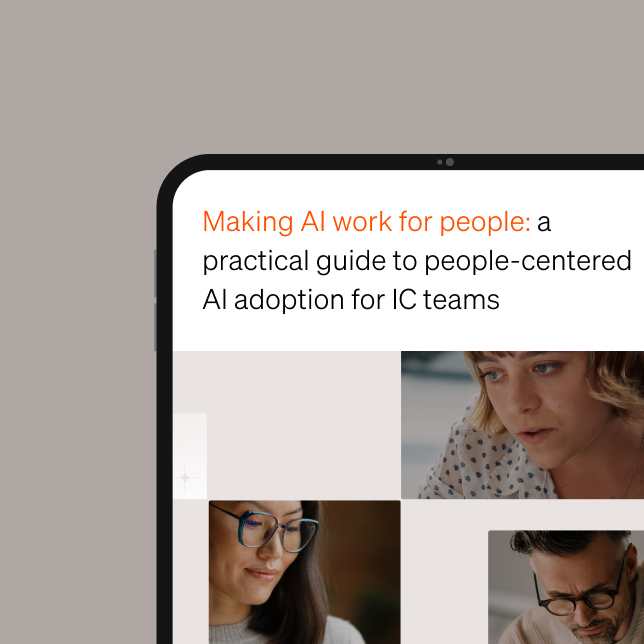
Download the ebook to get:
- Why AI adoption fails when treated as a technical upgrade (pp. 3-4)
- How to balance leadership enthusiasm with employee concerns (pp. 6-9)
- How to establish responsible AI foundations before scaling (pp. 10-13)
- A four-step framework for building confidence and capability (pp. 14-18)
- Metrics that measure trust and readiness beyond just usage (pp. 19-21)
SNEAK PEEK
Internal comms is uniquely positioned to lead AI adoption
Most organizations roll out AI tools without redesigning workflows, building confidence, or addressing employee fears. The difference between success and failure in implementation is people-centered change management.
Shape narratives that build trust
When AI is introduced without clear context, employees fill communication gaps with assumptions about job security and relevance. Set the narrative early by explaining what AI does, why it matters, and how it supports work rather than replaces it.

Follow a framework designed for IC practitioners
AI adoption often stalls when teams move straight from announcement to rollout without a shared path forward. Use a proven four-stage framework to guide teams from understanding to implementation to sustained adoption, in coordination with HR, IT, and Risk.

Codesign guardrails before tools spread unchecked
Deploying AI tools before establishing clear guidance and policies increases risk for the company and uncertainty for employees. Bring stakeholders together to implement responsible AI guardrails that reflect real work and address genuine concerns.

Measure what truly matters
in AI adoption
Usage data alone doesn’t show whether people feel equipped to use AI effectively or whether the tools are genuinely improving work. Measure readiness, capability growth, and operational impact to show whether adoption is improving work and building trust.