



The fundamentals of internal communications haven't changed. Employees need clarity, context, and trust. But the environment around those fundamentals has shifted considerably. For many IC teams, the gap between what’s expected of them and what they’re equipped to deliver has only increased.
Top trends in internal communications: AI, trust, and the rise of strategic IC
Top trends in internal communications: AI, trust, and the rise of strategic IC
Table of contents
AI is accelerating what’s possible while simultaneously generating new anxieties about job security and authenticity. Leadership trust is under sustained pressure. Managers — long the unofficial backbone of organizational communication — are overwhelmed. And while IC’s influence on business outcomes is increasingly recognized, many teams are still figuring out how to measure and demonstrate it in terms the C-suite cares about.
Five interconnected trends are defining internal communications right now. None of them are entirely new, but all of them are intensifying: the transformational role of AI, trust in leadership, the role of managers, employee well-being, and the strategic value of internal comms.

Trend #1: AI transforms what’s possible in internal comms
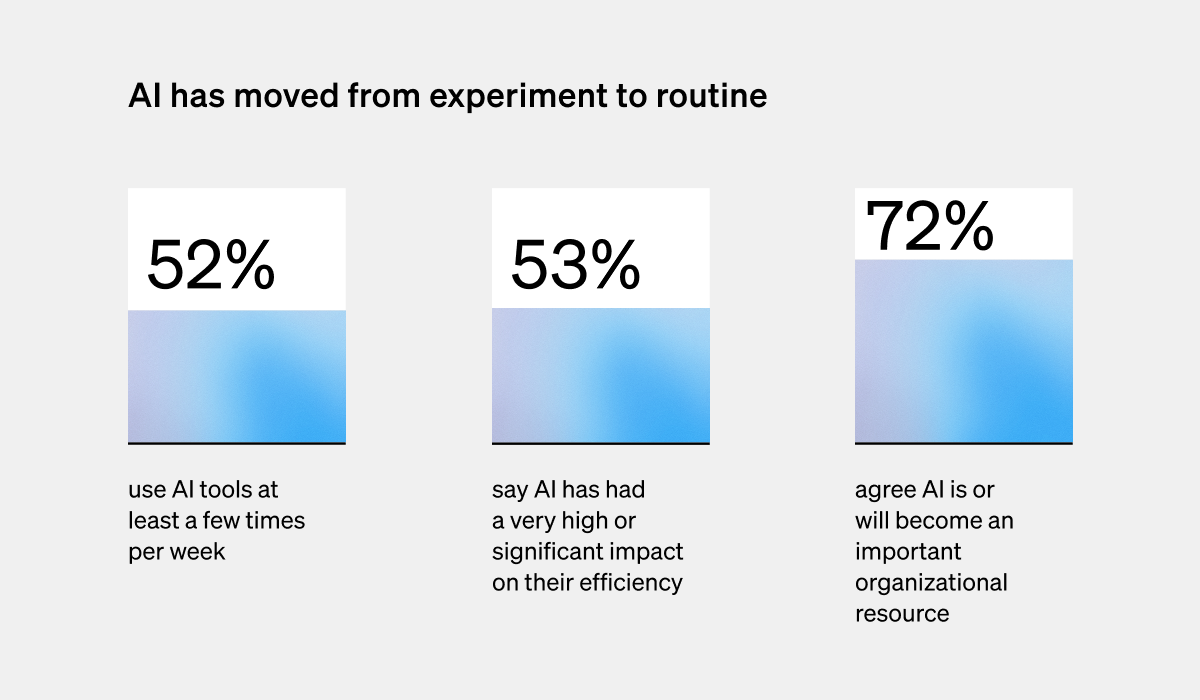
AI has moved from experiment to routine for internal communicators, and the role has expanded beyond usage. IC teams are now active participants in how AI gets adopted across the enterprise.
52% of IC practitioners now use AI at least weekly, 53% report it has had a very high or significant impact on their efficiency, and 72% agree that AI is or will become an important resource within their organization (Simpplr 2026 State of Internal Communications).
Most common gen AI use cases include:
- Researching information
- Capturing and summarizing meeting notes
- Content generation
- Fact-checking and brainstorming
- Summarizing complex content
What AI is changing
The clearest impact is on content creation. AI speeds up drafting and rewriting communications, which means more content gets produced with less effort. Beyond efficiency, AI is also influencing how communicators think and plan, not just how fast they produce.
Among IC professionals using AI tools, The highest-impact areas are content strategy (49%), planning (48%), and channel strategy (41%).
For IC teams that have historically been underresourced, that kind of compression — from brief to draft, from data to insight, from meeting to summary — has real value.
What AI isn’t changing
Speed and scale are only part of the story. What AI can’t replicate is human judgment and cultural awareness — knowing how a message will land with a specific workforce at a specific moment.
Organizational tone, editorial point of view, and the ability to recognize when something is technically correct but will feel wrong to employees all remain firmly human. The IC professionals getting the most from AI are using it to move faster on execution while keeping their hands on the decisions that require those kinds of insights.
Trend #2: Trust in leadership is eroding
Employee trust in senior leadership has taken a sustained hit. Words like “disconnect,” “distrust,” and “misalignment” have increased significantly in employee reviews in recent years, according to Glassdoor. Roughly 80% of leaders believe their communications are clear, while only around 50% of employees agree, according to HR Executive.
The difference between how leaders perceive their own communications and how employees experience them is striking. That gap can only close with better, more authentic communication.
What authenticity in leadership looks like
Employees can tell the difference between a leader who has been briefed on key messages and one who is speaking from their own perspective, and they respond very differently to each. Think about how a major restructure announcement lands. The version that resonates most rarely comes from a polished statement that has been through five rounds of legal review. It’s the town hall where the leader admits what they don’t yet know.
86% of leaders believe transparency builds trust, according to Deloitte. And transparency correlates with stronger retention, engagement, and performance.
In an environment shaped by AI adoption and ongoing organizational change, employees also want clarity about decisions and how those decisions are being made.
IC’s role in rebuilding trust
IC has a direct role in coaching leaders toward communication that feels genuine and stays consistent with what employees experience. That means helping leaders find their own voice rather than refining the messaging they’re handed.
Transparency about organizational strategy, including the uncomfortable parts, builds more durable trust than carefully curated positivity. When employees understand the reasoning behind decisions — even ones they don’t agree with — they’re more likely to stay engaged.
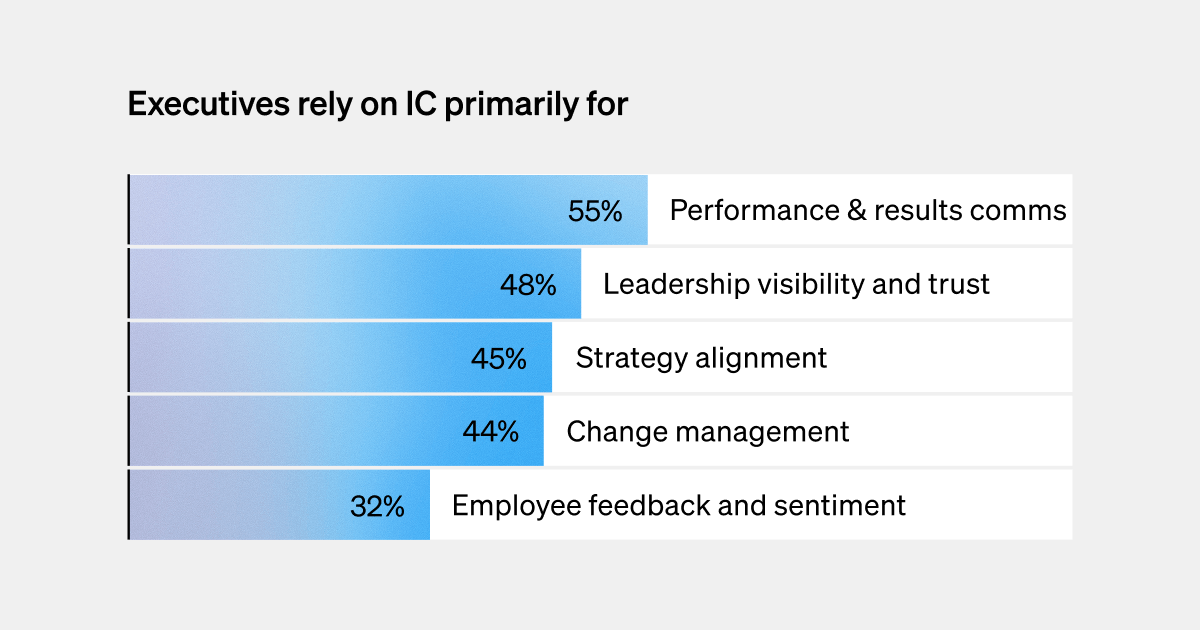
Simpplr research shows that leaders rely on their IC teams for exactly these reasons. Internal comms is central to performance and results communications, leadership visibility and trust, and strategy alignment.
Trend #3 Managers are overwhelmed and it shows
Employees consistently rate their direct manager as their most trusted source of organizational information. That makes managers the most important channel in any IC strategy — and the current reality particularly concerning.
Managers account for 70% of variance in team engagement scores (Gallup).
The middle management crisis
Managers are expected to translate executive messages, address team-level concerns, and sustain engagement, often on top of workloads that have grown as organizations have reduced headcount and absorbed roles. The informal work managers have always done to contextualize and translate executive messaging is no longer sustainable when they’re operating at capacity.
This has a negative downstream impact. Nearly half (46%) of employees don’t feel their manager listens to them or understands their jobs, according to a 2025 Predictive Index survey. This isn’t because managers don’t care but because many don’t have the toolkits to have productive conversations.
Enabling managers as communicators
IC is well-positioned to close this gap. The most effective interventions are practical ones.
These interventions include:
- Talking points and FAQs delivered before key announcements so managers aren’t left to interpret messaging independently
- Dedicated manager communication channels that reduce noise and present only the most relevant information
- Feedback loops that let managers flag what their teams are asking, which gives IC what it needs to produce useful content
Managers don’t need to become communications professionals. They need enough context, delivered at the right time, to have credible conversations with their teams. That’s largely an IC problem to solve.
Trend #4: Well-being has become a business imperative
Well-being has moved well beyond the remit of HR. When employees are anxious — about job security, AI, workload, or the pace of organizational change — that anxiety shows up in engagement, productivity, and retention. It also affects how well any other communication lands, making it harder for even well-crafted messages to cut through.
Employee disengagement costs the global economy $8.9 trillion annually — roughly 9% of global GDP (Gallup).
The current work climate
Rolling layoffs and AI-driven job anxiety have created an ongoing undercurrent of fear in many organizations. Stress that cascades from managers affects team dynamics, and employees who survive rounds of cuts face burnout. Younger employees, particularly Gen Z — considered the most burned-out generation — and millennials, are rejecting always-on work expectations and setting clearer boundaries in ways organizations can’t ignore.
Where IC fits in
The organizations making real progress on well-being aren’t the ones running the most campaigns. They’re the ones where leaders communicate honestly about difficult topics and where stated values are visibly reflected in everyday decisions. IC has a direct role in making that connection.
How often employees hear from their organization, and what those communications ask of them, is itself part of the well-being picture. An IC calendar that adds to information overload — even with the best intentions — can work against the very engagement it’s trying to build. Reducing volume and increasing relevance is as much a well-being intervention as it is a communications strategy.

Trend #5: IC is under pressure to prove its strategic value
For years, IC has been evolving from order-taker to strategic advisor within their organizations. The function now has a data-proven impact on key business outcomes, including revenue, retention, and productivity, which is exactly what the C-suite now expects.
89% of executives say IC efforts should be measured in business terms like productivity or revenue, with 64% saying “yes, definitely” to the question (Simpplr State of Internal Communications 2026).
The proof that IC drives those outcomes is already there. IC professionals also rate their function’s impact on business-critical outcomes highly across the board.
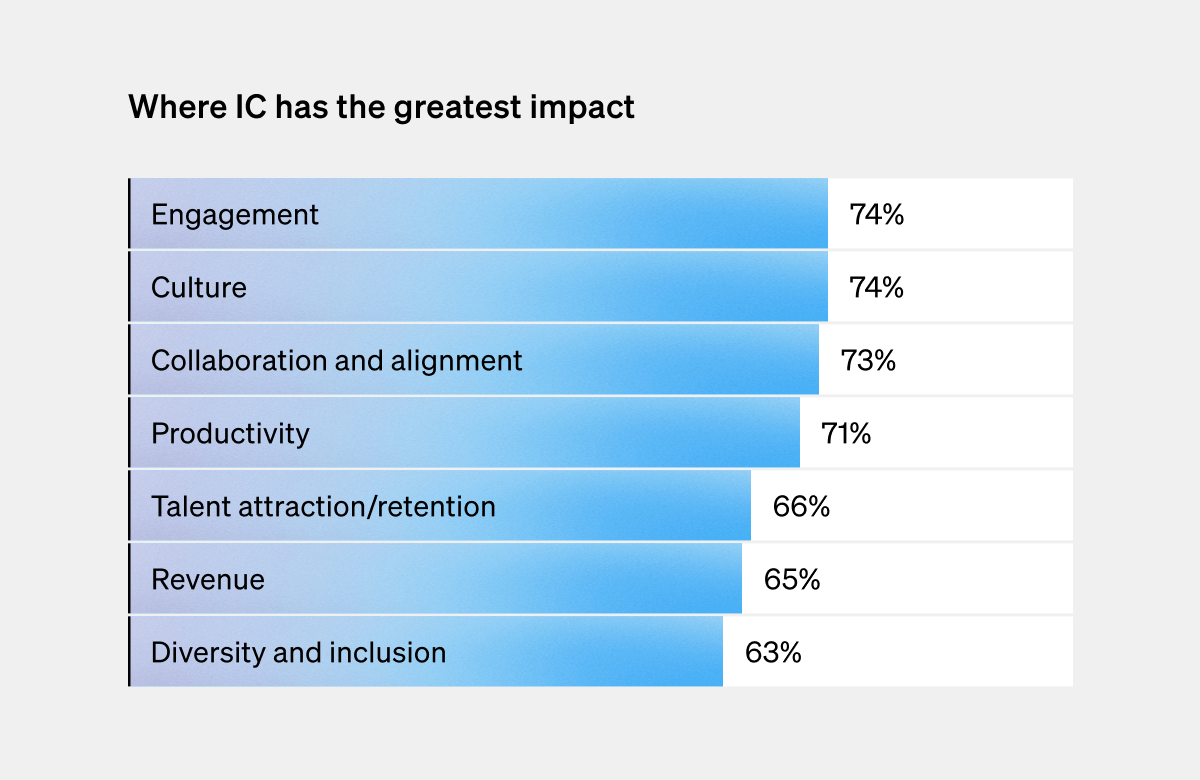
The challenge is that measurement practice hasn’t kept pace. Many organizations still rely on indirect indicators — reach, sentiment, engagement surveys — rather than metrics that connect communication activity to business outcomes. A quarter of organizations don’t measure IC’s impact on revenue at all. Nearly 1 in 5 don’t measure productivity impact.
31% of IC professionals cite difficulty quantifying impact as a top frustration (Simpplr State of Internal Communications 2026).
The IC functions gaining ground as strategic advisors are building clearer measurement frameworks and expanding their data literacy. And the teams closing these gaps share a few traits. They’re involved in planning conversations before decisions are made. They’ve built genuine advisory relationships with senior leaders. And as noted earlier, nearly half are now involved in AI rollouts — an expansion of IC’s organizational footprint that brings real influence alongside real accountability.
Change management remains the skill IC professionals most want to develop, yet 61% of functions have no formal change communications framework, according to Gallagher’s 2026 Employee Communications Report. The functions building that infrastructure now are the ones that will be positioned as genuine advisors when the next wave of organizational change arrives.
What comes next for IC
The five trends covered here are collectively doing something significant: They’re raising the floor on what IC is expected to deliver. AI literacy, measurement credibility, leadership coaching, manager enablement, well-being awareness — none of these were core IC competencies a few years ago. They are now or are quickly becoming so.
The functions that will thrive are those that treat this moment as a structural shift rather than a list of new priorities to manage. That means building the skills, relationships, and infrastructure that let IC operate with genuine organizational influence and shape how the organization communicates at every level.
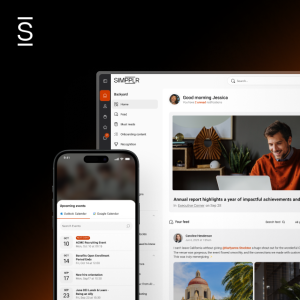
Simpplr’s AI-powered intranet is built for exactly that kind of IC function — one that needs to personalize at scale, demonstrate measurable impact, equip managers, and listen to employees in ways that go beyond open rates.
Ready to find out how Simpplr can help you improve your internal communications? Request a demo today.
Watch a 5-minute demo
See how the Simpplr employee experience platform connects, engages and empowers your workforce.
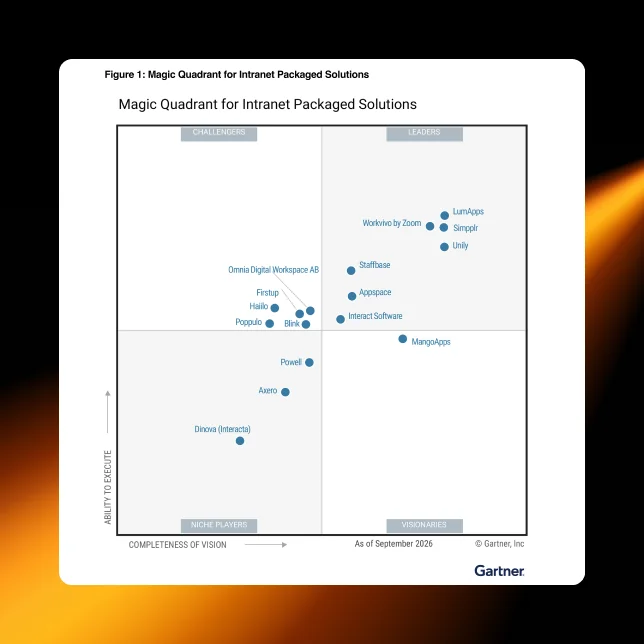
- #1 Leader in the Gartner Magic Quadrant™
- 90%+ Employee adoption rate