



REDWOOD CITY, Calif., April 21, 2026 — Enterprise interest in AI-powered digital workplaces is strong, but deployment is not keeping pace. A commissioned study conducted by Forrester Consulting on behalf of Simpplr finds that three-quarters of surveyed IT leaders are interested in adopting an AI-powered digital workplace platform, but only about 1 in 4 have done so, exposing a gap between ambition and the foundational work required to close it.
“AI is revealing how fragmented the digital workplace is,” said Dhiraj Sharma, CEO and cofounder of Simpplr. “You can’t scale AI if your digital workplace is disconnected. Most organizations are struggling because their knowledge, workflows, and systems were never designed to work together, and layering AI on top of that just compounds the problem.”
The survey captured perspectives from 310 senior IT decision-makers across North America and the UK responsible for digital workplace, employee experience, and AI technology strategy. Their answers point to a foundational problem that better models alone won’t fix.
Fragmented data leads to failed AI
The study found that “poor AI behavior or results often aren’t due to the underlying model but to a lack of organizational context [around it].” “Unified context built on resolving heterogeneous data ecosystems,” it noted, is “nonnegotiable for successful deployment of gen AI and agentic AI.”
Almost half (45%) identified missing organizational context as the main reason AI doesn’t produce the expected results. Most (85%) said fragmented data sources and knowledge systems must be unified for AI to succeed, and 83% said the unification challenge will grow harder as more AI applications are layered on top of existing infrastructure.
Governance is the next wall
Knowing AI needs better governance and being able to implement it are two different things. Most respondents are attempting the basics, with 63% documenting AI strategy, standards, and practices and 62% implementing responsible AI standards.
Execution is where organizations are getting stuck. More than half (51%) said implementing AI observability across all efforts is still challenging, and 48% said the same about instituting new testing capabilities and implementing responsible AI standards.
The problem compounds as AI becomes more capable. The capabilities IT leaders most want — end-to-end service automation, automatic integration across systems — require mature identity management, access controls, and agentic governance frameworks that most organizations haven’t built yet.
As the study noted, “governance determines whether AI can move from scattered pilots to an enterprisewide strategy and approach.” For most organizations, that move is still ahead of them.
Security concerns are slowing deployment
As AI moves from isolated pilots toward enterprisewide deployment, security and access control have emerged as the sharpest operational concern. Nearly half of respondents (49%) identified security and access control risks as one of their top concerns — the single most cited challenge in the survey. More than three-quarters (78%) said their organizations need better security frameworks before they can scale AI safely.
End-to-end service automation and automatic integration across systems raise the sharpest access control questions. Forty-one percent expressed concern about AI that automatically discovers and connects to disparate systems and AI that automates employee services end to end. The aspiration is clear. The infrastructure to support it safely isn’t there yet.
Productivity rather than revenue is the real goal
Surveyed IT leaders are investing in workplace AI primarily for operational reasons — improving speed and agility and increasing employee productivity and effectiveness (65%) rather than driving revenue growth (43%). Most viewed revenue as a downstream result of getting the operational fundamentals right first.
What IT leaders most want from AI reflects this focus. More than half (51%) said AI that handles routine tasks — freeing employees to focus on higher-value work — would have the greatest positive impact on employee experience. Dramatically reducing time spent searching for information ranked second, at 50%.
Leaders look to unified platforms
Most respondents expressed interest in AI-powered digital workplace platforms to address fragmentation and bring knowledge, workflows and governance into a more coherent foundation.
Three-quarters (75%) expressed interest in adopting such a platform; nearly a quarter already have. The expected benefits align directly with IT leaders’ objectives: increased employee productivity (68%), enhanced operational agility (55%), and improved employee experience (55%).
Realizing and scaling the full value of AI in the digital workplace requires a strong foundational framework. Organizations must establish unified data environments, interconnected knowledge systems, well-defined governance structures, and the organizational context necessary for AI to operate effectively across workflows.
With these elements in place, IT leaders can transition from isolated initiatives to enterprisewide deployment, enabling measurable improvements in employee experience, operational efficiency, and overall organizational performance.
Access the research
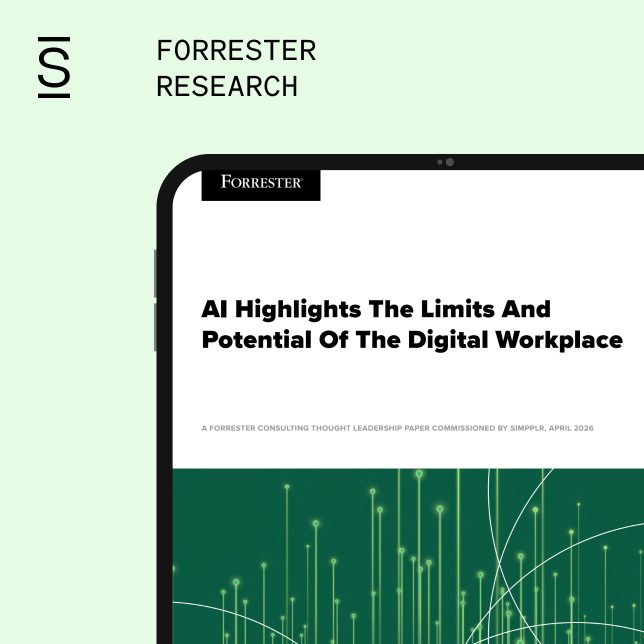
Download a complimentary copy of AI Highlights the Limits and Potential of the Digital Workplace, a commissioned study conducted by Forrester Consulting on behalf of Simpplr.
About the study
Forrester Consulting conducted an online survey of 310 IT decision-makers at the director level or higher in North America and the UK. All respondents hold responsibility for digital workplace, employee experience, and/or AI tools and technology strategy at organizations with 1,500 or more employees. The study was conducted in January and February 2026.
About Simpplr
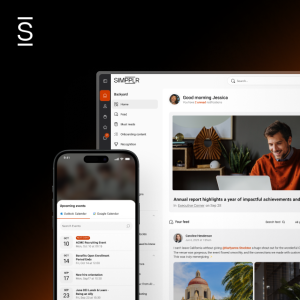
Simpplr is the AI-powered intranet for unifying the digital workplace. It brings people, trusted knowledge, apps, and agents into a coherent digital experience. Powered by a proprietary EX Knowledge Graph, the platform synthesizes signals and context across connected systems to deliver relevant answers and actions in the flow of work, including through Simpplr’s enterprise search and conversational EX agent.
With low-code extensibility and enterprise-grade security and governance, Simpplr is designed to scale across complex organizations. More than 1,000 organizations — including AAA, the NHS, Penske, and Moderna — trust Simpplr to empower a connected, productive workforce. Learn more at simpplr.com.
Contact:
Carolyn Clark
VP, Communications & EX Strategy, Simpplr
[email protected]