




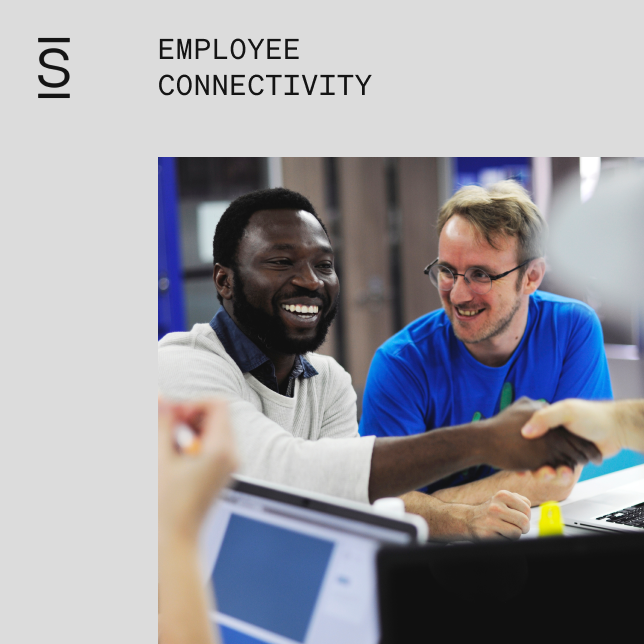
Employee connectivity refers to employees’ connections with each other and with their organization. This can also include the tools and methods used by organizations to promote greater connectivity between employees not just on a professional level, but also on a personal level.
Employee connectivity explained
A Gallup study showed that only about 23% of the world’s workers are fully engaged at work. The effects of this are wide-ranging. Low employee engagement results in lower productivity, which in turn results in slower economic growth.
This speaks to a far larger problem. It is not enough to create communications systems that make it easy for employees to communicate with each other and with their managers. While this is important to ensure that a company runs smoothly, employees who do not feel a sense of belonging and connection with each other will begin to feel disconnected from their colleagues, resulting in low engagement and lower productivity. Ultimately, this is where employee connectivity comes in.
Employee connectivity does not only include providing the necessary tools and platforms for communication (though it is an important part of it). It also includes creating a broader sense of belongingness and unity among employees. This connectivity is not just about fostering physical connectivity (such as providing high-speed internet or the latest communication tools), but also involves fostering emotional connectivity. Higher employee connectivity leads to increased productivity, better collaboration, improved employee satisfaction, and ultimately, a healthier bottom line for the company.
Employee connectivity has gained significance not just in terms of logistical coordination, but also in terms of organizational culture. It has become a critical component of a positive, inclusive, and transparent work culture. Despite its significance, employee connectivity is often overlooked or not optimized to its full potential in many organizations. This guide is a deep dive into understanding employee connectivity and the benefits it offers to both employees and organizations.
Importance of employee connectivity
The way your company treats its employees can have either a positive impact or a negative one. Employees who feel that they are part of a positive culture that fosters connection and a sense of belonging are more likely to be engaged with one another and with their jobs. This results in higher levels of productivity. But what is the flip-side of this? Employees who don’t feel connected to their company and to each other are much less likely to be engaged, and as a result, productivity will suffer.
When employees feel interconnected and can communicate effectively, they will collaborate better, solve problems faster, and work towards common organizational goals more efficiently. Employee connectivity can serve as the foundation for a positive work environment, which, in turn, can lead to increased job satisfaction and higher employee retention rates.
Employee connectivity also helps increase the general ease of knowledge sharing. In all organizations, the free flow of knowledge and ideas enhances innovation and progress. Optimized employee connectivity ensures that valuable insights or ideas are not lost because of communication gaps. Everyone in the organization, regardless of role or position, can contribute their skills and ideas effectively.
The role of technology and leaders in employee connectivity
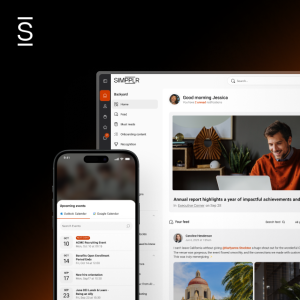
Technology’s importance in enhancing employee connectivity has grown in today’s world as remote work and digital workplaces have become the norm. Advanced communication tools and platforms can bridge the gap between employees, irrespective of their geographic location. There are a number of tools currently on the market (examples include Simpplr Intranet, the Slack messaging app, and Zoom for video calls; these tools and more are discussed in greater detail in this Simpplr article), and they facilitate real-time communication, collaboration, and knowledge sharing, increasing the overall efficiency of the organization.
Besides enabling real-time communication, some connectivity tools also help leaders track and measure employee connectivity. Finding ways to gauge response and ROI is critical. It is not enough to simply implement changes and then move on to another project. This applies to employee connectivity. When changes are made to an organization that enable greater virtual connectivity, leadership must take steps to measure employee connectivity to make sure that these changes are being received well by employees. One example of this is Simpplr’s employee listening service (you can learn more about Simpplr’s employee listening in this Simpplr article). Powered by AI, Simpplr’s employee listening service enables leaders in your organization to track employee sentiment and satisfaction in real time through surveys and sentiment checks (these are just two examples of ways leaders can measure employee satisfaction). By utilizing employee listening to gauge sentiment and satisfaction in real time, leaders can stay informed about how their employees are feeling about their jobs while identifying potential areas of improvement in their communication strategies. By staying dialed in about employee satisfaction and improving overall responsiveness, leaders can develop more personal and improved professional connections with their employees, strengthening overall employee connectivity.
Leaders can and should play an active role in promoting digital literacy in their organization. They can invest in regular training sessions that teach employees how to use digital tools effectively. They can also encourage the use of digital tools through incentives and rewards, making sure that all employees have equal access to these tools.
Building a connected workforce
Cultivating a connected workforce requires strategic planning and consistent effort. It requires the implementation of both technological solutions and cultural practices that foster open and effective communication. Here are some strategies that can help businesses build a highly connected workforce.
Firstly, it is crucial to create an open and inclusive culture where every employee feels valued and heard. This can be achieved by encouraging dialogues, providing regular feedback, and promoting transparency. Inclusive team-building activities and corporate events can also contribute to building stronger interpersonal relationships among employees.
Training for effective communication
For many connectivity tools, employees will have to be trained on them so they can become more comfortable when using them. A number of connectivity tools can be somewhat complicated, and training sessions will be needed so employees can learn how to utilize these tools effectively.
On this front, however, Simpplr services such as employee listening and employee recognition have a major leg up over similar products. These tools are straightforward and easy to use, and as a result, many Simpplr services do not require in-depth training sessions for employees. Simpplr’s knowledge base provides a readily available source of assistance to employees who may have questions. Simpplr tools such as employee recognition are also tailored to encourage and foster greater employee interaction, which further enhance employee connectivity. Employees are encouraged to interact with one another, ask for help, and express gratitude for assistance on projects or for simply being good teammates. These kinds of personal and professional interaction, done through Simpplr’s easy to use tools, greatly enhance employee connectivity.
Conclusion
In conclusion, employee connectivity is a multi-faceted concept that goes beyond just providing the right tools for communication. It requires creating an open and inclusive culture, providing the necessary training, and promoting effective leadership. By doing so, organizations can not only improve their productivity and efficiency but also create a positive and engaging work environment. It is important to note that employee connectivity is not a one-time project but a continuous process that requires constant effort and innovation.
About the author

Anshuman Srinivasan
As a market research analyst, Anshuman is fascinated by understanding how companies can stay competitive and gain an edge in a continuously changing marketplace. He brings research and analysis experience honed by his time in the tech and think tank spheres. He has previously worked in Simpplr’s revenue operations department, working alongside sales and marketing. Having had experiences and opportunities in a variety of areas, Anshuman relishes new challenges and experiences. Connect with Anshuman on LinkedIn.