







Internal communicators used to be seen as the people who sent the emails. They formatted the memos, updated the intranet, and made sure everybody knew about the holiday party. Important work, sure, but hardly an image that necessitated a seat at the executive table. That era is over. Now IC is all about ROI.

The revenue-driving evolution of internal communications
The revenue-driving evolution of internal communications
Table of contents
- 1 How internal communications business impact transformed corporate strategy
- 2 How the most effective teams measure internal communications ROI
- 3 Internal communications budget growth strategies that work
- 4 Building your internal communications business case
- 5 Prove your IC impact and secure your budget
A stunning 81% of IC professionals now link their work directly to revenue generation. Not engagement. Not culture. Revenue. This is the kind of metric that makes executives sit up and take notice.
This transformation didn’t happen by accident. IC teams now prove their measurable value with data: hard numbers, business outcomes, and proven internal communications ROI.
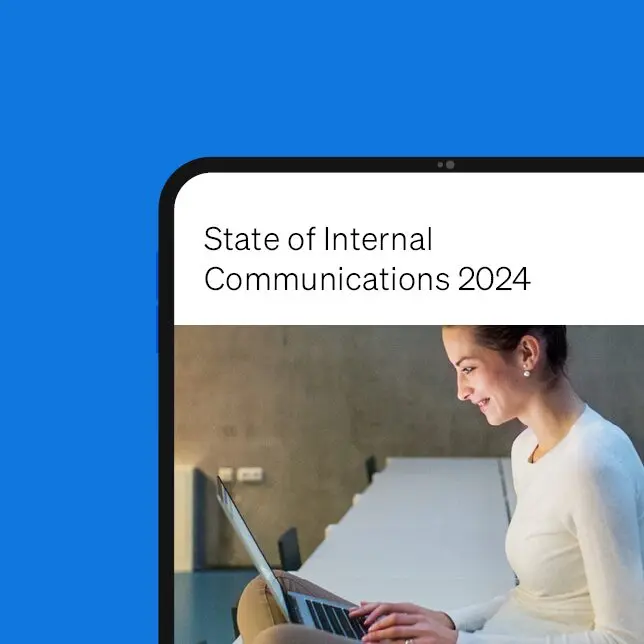
Simpplr’s 2025 State of Internal Communications and Intranet Technology report reveals exactly how the most effective IC teams are making this shift — and what it means for organizations still treating internal communications as a cost center. Here’s what the data shows, and how you can leverage it to create a compelling business case for your own IC function.
How internal communications business impact transformed corporate strategy
Let’s be honest: The image of IC as reactive order takers was never fair. These are culture makers and communication experts. What’s new isn’t the impact but the ability to prove it with data. And that proof is transforming the function.
IC has moved from cost center to profit driver
The perception problem that plagued IC for decades is finally cracking. And the evidence is compelling.
What executives recognize about IC:
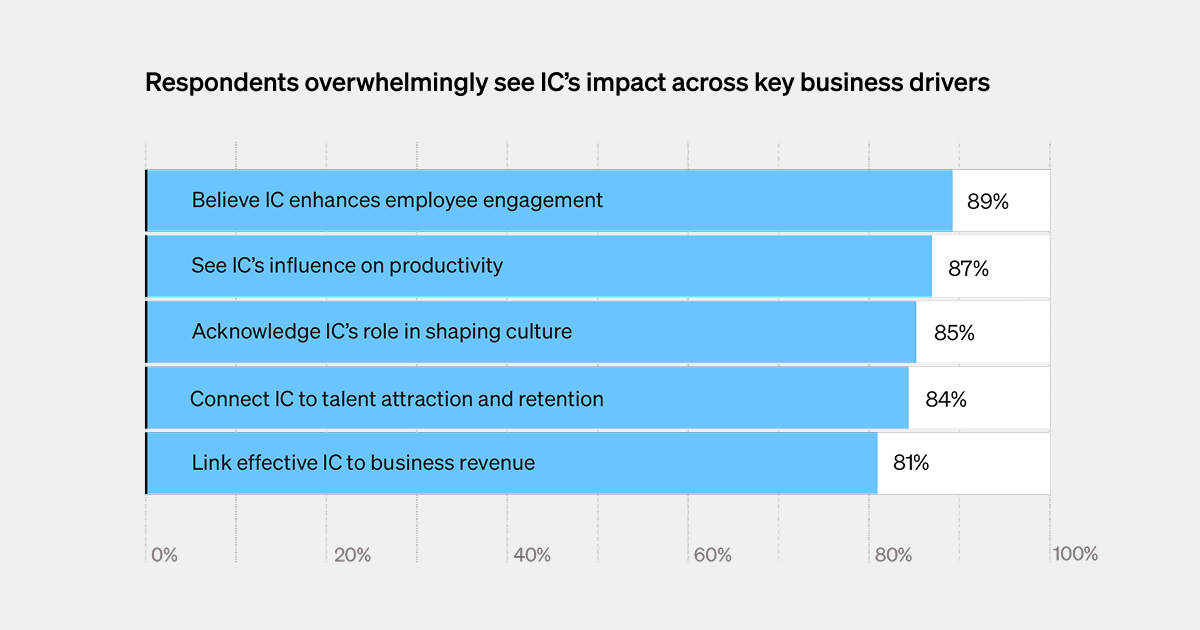
- 89% see IC’s impact on employee engagement
- 87% recognize IC’s influence on productivity
- 85% connect IC to culture
- 84% link IC to talent attraction and retention
- 81% tie IC directly to revenue generation
With employee engagement falling globally for just the second time since 2009, these aren’t nice-to-haves anymore. They’re business imperatives.
But that 81% who link effective IC to business revenue? That’s the breakthrough. It means IC isn’t just reactively supporting the business — it’s proactively driving results.
IC budgets are growing
It’s not just IC professionals themselves who see this value — 79% of executives understand IC’s importance too. Recognition is nice. But budget commitments are better. And the money is following the metrics.
IC budget growth by the numbers:
- 58% of organizations increased IC budgets in 2025 (up from 35% in 2024)
- 38% expect to add IC staff (up from 27% in 2024)
- 47% say leadership consistently does a good job with IC (up from 37% in 2024)
That’s an increase of 23 percentage points in budget allocation in a single year. In an environment where many departments are fighting for flat budgets, IC is seeing sustained investment. Only 6% expect staffing decreases. This isn’t a one-time budget bump — it’s a long-term organizational commitment.
Leadership communication quality is improving alongside the investment: 47% of respondents say leadership consistently does a good job with IC, up from 37% in 2024.
More resources, better executive communications, stronger results. It’s a virtuous circle, and the IC teams who’ve figured this out are pulling away from those who haven’t.

How the most effective teams measure internal communications ROI
The days of reporting email open rates to justify your existence are over. The IC teams proving their value have moved far beyond vanity metrics into territory that actually matters to the business.
Tracking internal communications ROI through business metrics
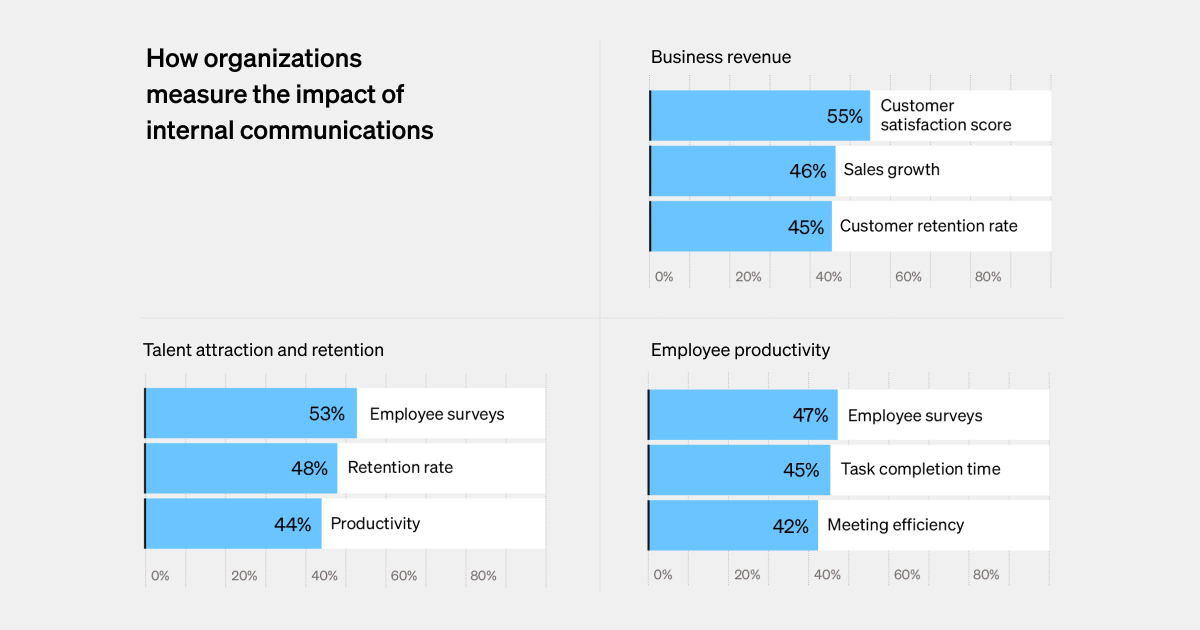
Here’s what’s telling: The most commonly-used performance metric in IC is Customer Satisfaction Score. More than half (55%) of respondents use it to measure IC impact. That means IC teams go beyond tracking whether people read messages to tracking whether engaged, informed employees create better customer experiences.
Organizations track IC’s business impact across multiple dimensions:
- Customer satisfaction scores (55%)
- Sales growth (46%)
- Customer retention rates (45%)
- Employee retention (48%)
- Task completion time (45%)
- Meeting efficiency (42%)
This breadth of measurement represents a fundamental shift. IC isn’t communications support anymore. It’s strategic business infrastructure.
Think about what that means in practice. An IC team tracking customer satisfaction goes beyond message read receipts to whether those employees then turned around and created better customer experiences. That’s the kind of connection that makes a CFO lean forward in a budget meeting.
Advanced ROI measurement frameworks for IC
But IC teams are measuring more than just the breadth of the impact they have — they’re also tracking deeper, more advanced internal communications ROI metrics, such as their direct impact on the employee experience.
Employee surveys dominate the measurement toolkit for both talent attraction/retention and employee productivity. This dual approach — quantitative business outcomes plus qualitative employee sentiment — reflects how far the function has evolved from counting newsletter clicks.
Proving internal communications ROI requires both quantitative and qualitative measurement. Quantitative measurement captures the hard numbers: revenue, sales, retention rates. Qualitative assessment captures what the numbers mean: employee sentiment, cultural indicators, leadership communication effectiveness ratings.
The intranet measurement advantage:
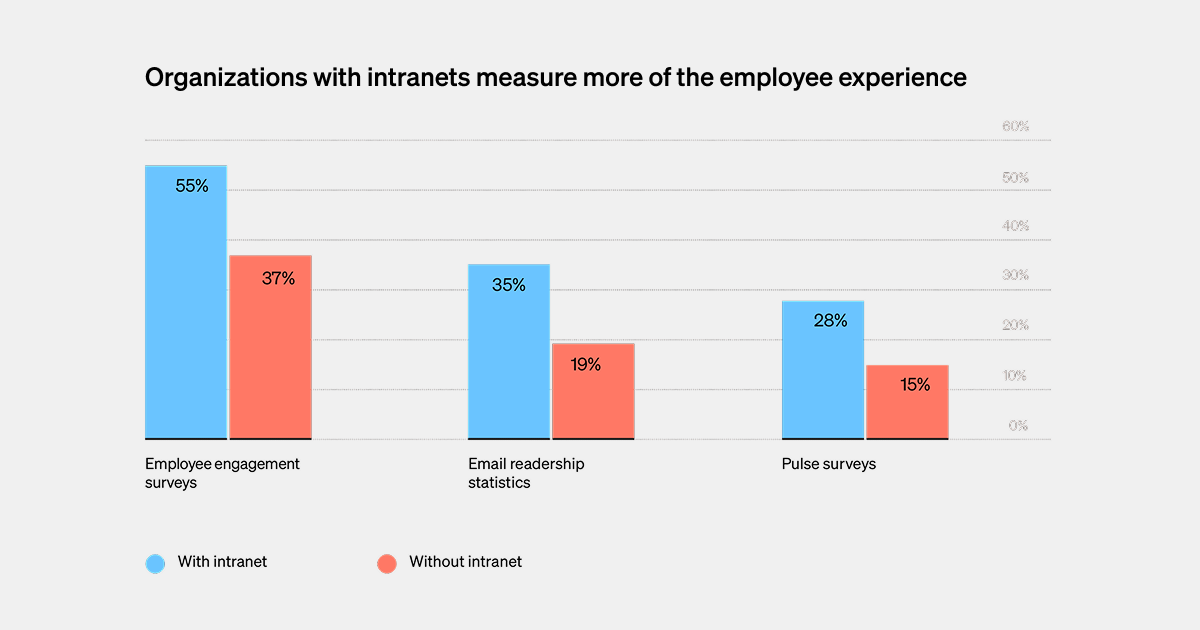
- Organizations with intranets track engagement surveys at 55% vs. 37% without
- Email readership tracking: 35% vs. 19%
- Pulse surveys: 28% vs. 15%
Modern intranet platforms make this comprehensive measurement possible at scale. Add the ability to parse data by role, department, and location, and you’ve got measurement infrastructure that is actually proving internal communications ROI.
The IC teams winning budget battles understand something crucial: Employee engagement and business performance aren’t separate conversations. They’re the same conversation. And the ability to prove that connection with data is what separates strategic IC from tactical communications.
Internal communications budget growth strategies that work
Nearly two-thirds of organizations increased their IC budgets this year. The report doesn’t reveal their exact strategies, but the data shows what IC teams are prioritizing and what capabilities correlate with better performance.
Understanding the budget growth trend
What’s driving this surge? It’s not a sudden fascination with the latest AI tools. Organizations are investing in people, not just technology, as the increase of respondents expecting to add staff this year clearly demonstrates.
This acceleration in both budget and staffing signals sustained organizational commitment. IC has proven its strategic value, and leadership is backing that proof with resources.
The connection is clear: The respondents who link IC’s efforts to increased revenue are likely better positioned to justify their budgets. And those who receive positive executive recognition appear to translate that recognition into tangible support. Recognition without resources is just applause. These teams are getting both.
Resource allocation and investment priorities
So where should organizations focus if they’re seeing budget growth — or building the case for it? High-performing IC teams strike a balance between tools, people, and capabilities.
Technology alone won’t save you, but the wrong technology will definitely hold you back. On the technology front, organizations with modern intranet platforms report better outcomes across every metric measured.
The intranet performance gap:
- 30% with an intranet rate IC as “excellent” vs. 13% without
- Organizations without an intranet are 27% less likely to report IC improvement
- Organizations without an intranet are 19% less likely to say leadership does a good job with IC
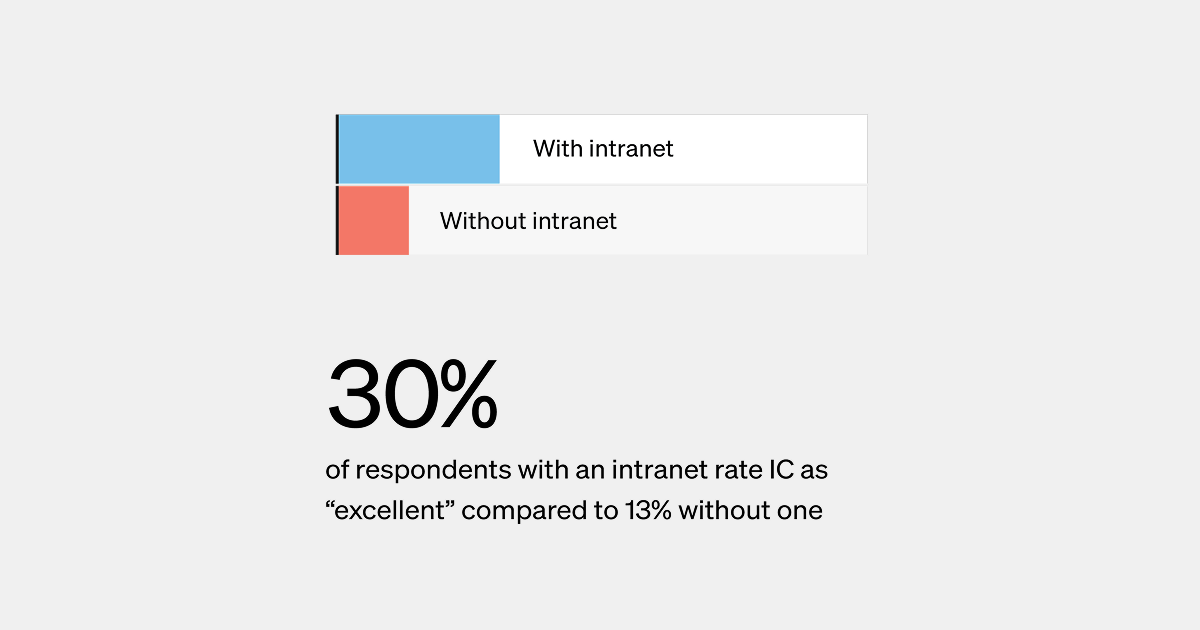
But here’s the key insight: It’s not just having an intranet that matters. It’s having the right one. Modern intranets are built for employee communication, collaboration, and enablement. This isn’t the old-school document repository with last year’s holiday calendar buried somewhere in the navigation. The right platform makes modernization easy and scalable.
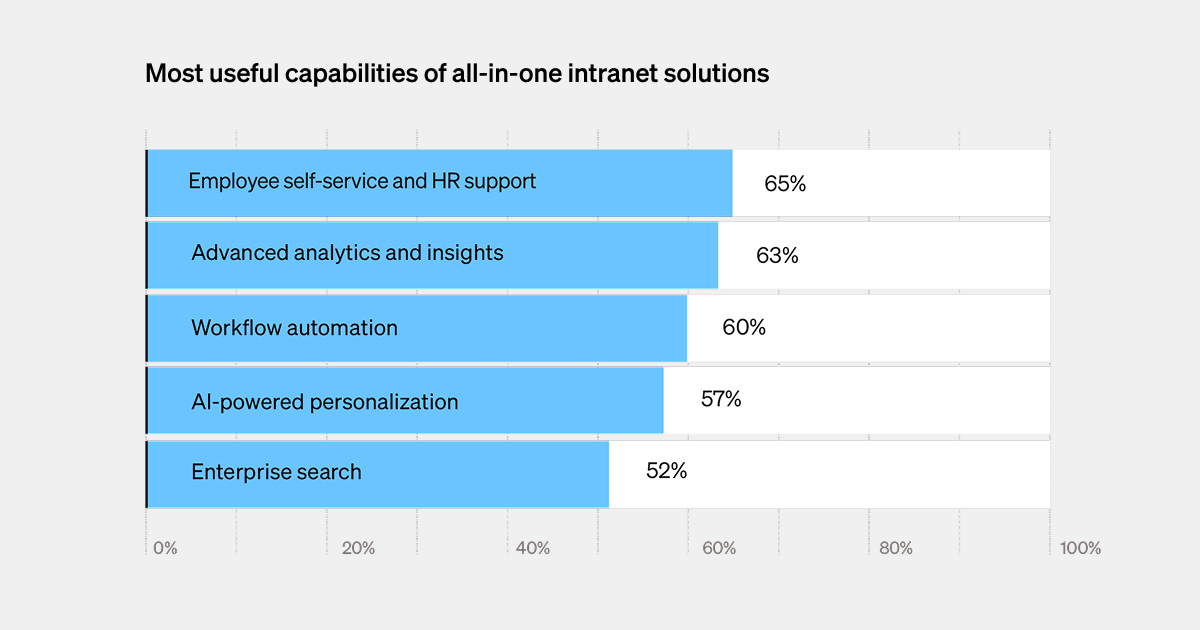
The most valued capabilities in an all-in-one intranet platform include:
- Employee self-service and HR support: 65%
- Advanced analytics and insights: 63%
- Workflow automation: 60%
- AI-powered personalization: 57%
- Enterprise search: 52%
On the staffing side, those 38% expecting to add IC staff aren’t just hiring more writers. The report suggests the need for analytics and measurement capabilities, strategic communication skills, and technology platform management. Data and technology are now central to the IC mission. Your hiring decisions should reflect that reality.
Building your internal communications business case
The research provides compelling evidence for investing in IC, particularly in a modern intranet platform. But data alone doesn’t secure budgets. Here’s how to translate these insights into executive-ready proposals that actually get approved.
Executive-ready business case templates
You can’t convince leadership of where you need to go if you don’t know where you’re starting from. Start with peer benchmarks from the 2025 State of Internal Communications and Intranet Technology report. Where does your IC performance, investment, and technology stack up?
Then calculate your current state versus potential state using the performance gaps you’ve identified. Quantify the impact of those potential improvements on key business metrics, e.g., revenue, productivity, employee retention. Finally, show the payback period for increased investment, along with ongoing returns through a cost-benefit analysis over one to three years.
This framework gives you a comprehensive starting point and charts a clear path to measurable improvement.
Stakeholder-specific messaging
Different executives care about different metrics. Tailor your pitch accordingly.
For your CFO: Focus on the revenue impact of an intranet (67% vs. 54% gap), the productivity gains (78% vs. 63%), and the retention cost savings.
For your CHRO: Emphasize the boost in employee engagement with an intranet (83% vs. 69% gap), the impact on talent attraction and retention, and belief in mission (78% vs. 60%).
For your CEO: Frame the investment in intranet technology as an improvement in competitive positioning, organizational alignment, and strategic infrastructure.
Speak their language with metrics they actually track. Your chances of approval go up dramatically.
Implementation timeline planning
Rome wasn’t built in a day, and neither was a modern IC operation. If there’s organizational hesitation, propose a phased approach that reduces costs and demonstrates value incrementally. Prioritize quick wins to build momentum and buy-in. Pilot programs can create internal champions before a full rollout. Set up measurement checkpoints ahead of time so you have a plan to track results and make adjustments as you go.
Overcoming common objections
Even with clear data, you’ll potentially face skepticism. Here’s how to counter the most common pushback.
“IC metrics are too soft.” Counter with business outcome metrics, not communication metrics. Customer satisfaction, sales growth, and retention rates are hard numbers that appear on financial statements. Reference the 81% of IC professionals who link their work directly to revenue. The soft metrics argument doesn’t hold up anymore.
“Our current system works fine.” Point to the performance gap data: Organizations without an intranet are 27% less likely to report IC improvement and 19% less likely to say leadership does a good job with IC. “Working fine” isn’t the same as “performing well.” Calculate the opportunity cost of underinvestment. What are you leaving on the table?
“Too expensive to implement.” Modern platforms are faster to implement than the legacy perception suggests, reducing total costs. But more importantly, calculate the cost of not having modern infrastructure: lost productivity, engagement gaps, and revenue impact. More than half (58%) of organizations found the budget to invest this year. The cost of inaction is often higher than the cost of action.
“We don’t have the competitive pressure.” Use the performance gap data to demonstrate that organizations without modern IC infrastructure are operating at a measurable disadvantage across key business metrics. That gap widens as AI and analytics advance. The competitive pressure exists whether you feel it yet or not.
Prove your IC impact and secure your budget
The shift is undeniable: IC’s image has moved from a cost center to a revenue driver, and the organizations that understand the ROI of IC are investing accordingly.
But here’s what separates IC teams that secure budgets from those that don’t: They’ve stopped measuring what’s easy and started measuring what matters. Customer satisfaction scores. Sales growth. Retention rates. The metrics that make CFOs pay attention.
The performance gap is already significant. And the IC teams pulling ahead share a common advantage: technology infrastructure built for how they actually work, not bolted together from disconnected tools.
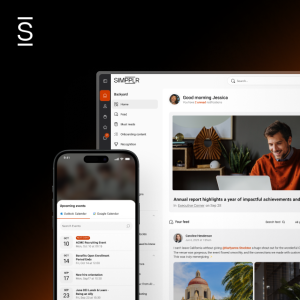
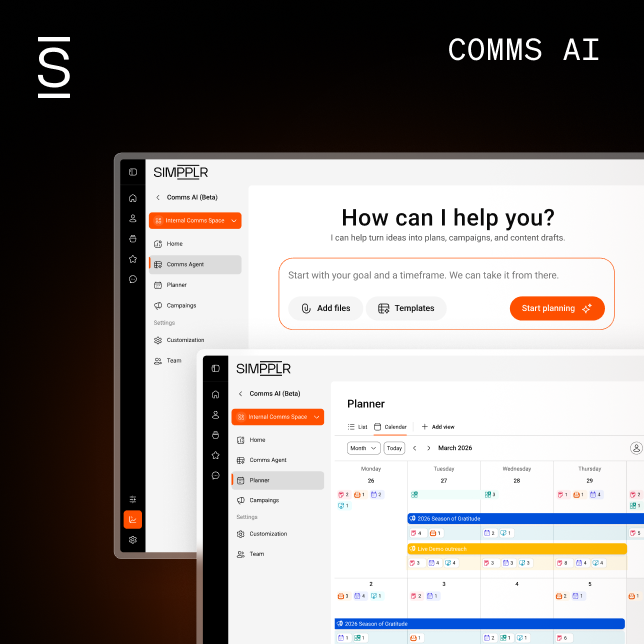
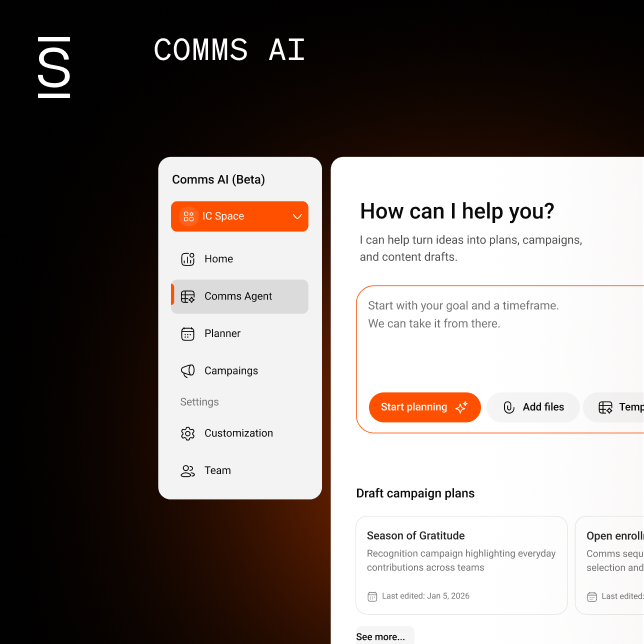
Simpplr’s AI-powered employee experience platform delivers the measurement capabilities that connect IC work directly to business outcomes — the revenue impact, productivity gains, and retention metrics that executives care about. Employee self-service and workflow automation eliminate the administrative drag that keeps IC professionals stuck in execution mode instead of strategy. AI-powered personalization ensures employee communications land with the right people at the right moment.
The organizations investing now are positioning themselves to capture capabilities that don’t exist yet. The ones waiting are betting they can catch up later. The data suggests that’s a losing bet.
Request a demo today to see how Simpplr helps IC teams prove ROI.
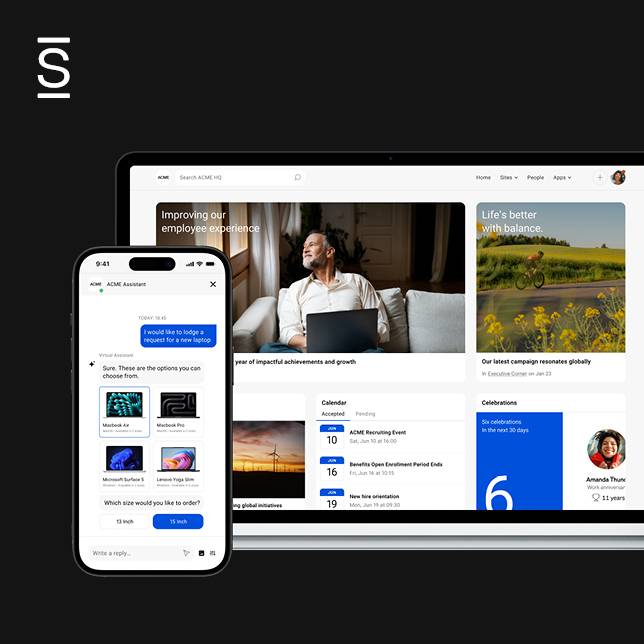
Watch a 5-minute demo
See how the Simpplr employee experience platform connects, engages and empowers your workforce.
- #1 Leader in the Gartner Magic Quadrant™
- 90%+ Employee adoption rate