



Every major technology shift follows the same arc: a Cambrian explosion, then consolidation. Divergence always precedes convergence. And when consolidation comes, the organizations that built the right foundation are the ones that benefit from it.

7 foundational elements for a unified digital workplace
7 foundational elements for a unified digital workplace
Railroads spread across continents with competing gauges and no common standard before consolidating into a few dominant lines. Search engines multiplied before a handful absorbed the rest. Cloud infrastructure fragmented across countless providers before settling into the platforms that now handle 80% of enterprise workloads. The pattern holds across industries and eras.
AI has been in the divergence phase since late 2022. Foundation models, agents, copilots, automated workflows — one for every team, one for every use case. The promise was that more intelligence would mean less complexity. Instead, most organizations got more tools layered on top of the same disconnected architecture that existed before.
The convergence phase won’t happen automatically. It requires a foundation designed for it.
An AI assistant that can’t get access to governed content and that doesn’t understand permissions will orchestrate workflows that employees can’t trust or use. One with no real-time organizational context routes people to outdated resources. AI isn’t the problem. The architecture underneath it is.
These seven foundations are the preconditions for a unified digital workplace — and without them, AI becomes a risk multiplier rather than a productivity layer.
Before intelligence, there must be coherence
Before AI can be useful, it needs a foundation that’s truly unified. These first three elements establish the baseline: connected data, shared context, and persistent memory. Skip them, and every intelligent feature you deploy will inherit the mess underneath it.
1. A connected view of enterprise data
AI depends on governed access to enterprise knowledge and system signals across your digital ecosystem. Without permission-aware retrieval and near real-time trustworthy data, AI increases risk rather than productivity.
Most organizations don’t have a data problem. They have a connection problem. Content lives in SharePoint, Confluence, Google Drive, a half-dozen SaaS tools, and somebody’s desktop folder.
Each system has its own permissions model, its own versioning, its own definition of “current.” Drop an AI assistant on top of that and it will confidently serve up an answer from an outdated policy doc that was supposed to be archived six months ago. The employee doesn’t know the answer is wrong. IT gets the angry ticket.
The fix isn’t adding another connector but building the right enterprise search architecture.
What must be true:
- A unified discovery layer connects content and data across repositories
- Retrieval enforces enterprise permissions at the source level for connected systems
- Real-time data pipelines and signals update continuously to reflect the current state of the business
Get this layer wrong and everything built on top of it — search, recommendations, agent actions — inherits the same gaps.
2. A real-time model of people and work
A unified digital workplace requires more than connected sources. It requires a consistent knowledge graph — a structured map of entities and their relationships across the organization: people, geography, roles, teams, content, relationships, and patterns of work.
But structure alone isn’t enough. Activating this knowledge graph with the right context is what makes relevance precise and guidance usable in real employee situations.
Static org charts don’t cut it. When a field operations employee searches for “safety protocols,” they need the result that applies to their role, region, and certification level — not a generic document that technically contains those keywords.
Without true organizational context — who this person is, where they sit, what tasks they actually do — the best AI degrades into glorified keyword matching.
A knowledge graph is structured and persistent. Context is dynamic and moment-based. Intelligence emerges when the two work together.
What must be true:
- Knowledge graph maps role, department, location, team, and reporting relationships for every employee
- Behavioral signals feed relevance based on what people search for, engage with, and need most
- The model updates dynamically as people move, teams restructure, and priorities shift
Without this, personalization is just targeting. With it, AI can meet employees where they are.
3. A consistent surface wherever people work
A unified digital workplace can’t be confined to a single portal destination. It has to show up where work happens — web, mobile, collaboration tools, and role-specific environments. AI support works only when employees consistently encounter it within their actual workflows.
Every inconsistency trains employees to work around the system rather than through it. Check the intranet on desktop, can’t find the same thing on mobile. Get AI assistance in Teams, but nothing in the field app.
These aren’t minor UX complaints. They’re the exact gaps that drive shadow AI adoption. Employees go rogue because the sanctioned experience doesn’t follow them where they work.
Context and access have to remain consistent across surfaces. Otherwise you’re not building a unified digital workplace. You’re just building a homepage.
What must be true:
- The experience works across web, mobile and embedded surfaces with the same content and capabilities
- Collaboration channels and role-specific tools get full integration into the experience layer
- Context carries across every surface with consistent permissions and personalization
These three elements give AI something coherent to work with. The next question is what happens when intelligence starts acting on it.
Governed, scalable intelligence
With a coherent foundation in place, you can layer in intelligence. But intelligent capabilities need clear guardrails — between recommendation and action, noise and signal, configuration and chaos. These next two elements define how intelligence operates safely within your architecture.
4. Intelligent support that reduces cognitive load
AI agents will increasingly exist across enterprise platforms. But usefulness depends on whether employees can access them safely and in context.
The goal isn’t faster answers. What’s important is helping people navigate complexity without having to become experts in your tech stack.
Think about what employees want. Sales teams don’t want to open Salesforce to find deal information. They want an agent that tells them which deals need attention this week. Product teams don’t want to wade through documentation. They want to rapidly prototype design ideas.
The common thread: People want to get to the right resource, tool, workflow, or support path at the moment they need it — without figuring out which system holds the answer.
That works only when intelligent support operates within clear guardrails.
What must be true:
- Intelligent support reduces noise by surfacing what’s relevant to this employee in this context
- Intent-based routing replaces guesswork navigation so employees reach the right resource faster
- Knowledge and action connect so employees move from information to resolution in one flow
An agent that acts without clear limits will eventually take an action an employee didn’t authorize — updating a record, sending a message, escalating a ticket. One bad experience and adoption stalls across the organization.
5. A modular intelligence framework
Every new AI use case shouldn’t require building from scratch. But that’s what happens when intelligent experiences are hardcoded — one-off logic for one team, custom workflows for another, no reusable patterns between them. The sprawl you eliminate at the foundation layer comes right back at the intelligence layer.
Without modularity and scalability, every department that wants an AI-assisted workflow files a custom-build request with IT.
The marketing team needs a content approval agent. HR needs an onboarding guide. Sales needs deal prioritization. Each one gets built as a one-off with its own logic, its own maintenance burden, and its own governance gaps. IT becomes the bottleneck again — the very problem AI was supposed to eliminate.
Modular intelligence means organizations can configure reusable behaviors and guided experiences inside governance boundaries. Admins build once and adapt by audience, use case and policy — without duplicating logic or losing control.
What must be true:
- Intelligence can be configured in modular, reusable building blocks
- Admins manage controls and approvals, and reuse from a central framework
- Every extension stays policy-bound and auditable as the system scales
Coherent data and bounded intelligence get you most of the way. But neither one scales without the infrastructure to support them.

AI at scale requires interoperability and trust
Intelligence at scale depends on two things: interoperability that reduces friction and governance that builds confidence. Without them, even the best AI capabilities hit adoption walls. These final two elements determine whether your unified digital workplace can actually grow across the organization.
6. Deep interoperability across the digital ecosystem
The unified digital workplace is not a replacement for systems of record. It’s the connective layer that makes the whole stack usable.
Employees shouldn’t need to bounce between six different apps to complete a single task — but that’s the reality in most enterprises today.
The “swivel chair” problem is well documented and still unsolved in most organizations. An HR coordinator processes a new hire across the HRIS, the IT ticketing system, the benefits portal, and three different communication channels. Each system requires a separate SSO login, a separate context, and a separate set of steps. Multiply that across every role and every workflow, and the productivity loss is staggering.
Good interoperability means employees discover approved tools, retrieve what they need and move work forward from one coherent layer.
What must be true:
- Unified discovery spans enterprise tools and sources without forcing employees to know which system holds what
- Permission-aware retrieval and handoffs maintain governance as employees move between systems
- Consistent access patterns reduce friction so completing a task doesn’t require navigating five interfaces
The goal is a workplace where the architecture disappears and people just get things done.
7. Enterprise-grade governance and responsible AI
AI in the workplace scales only when trust scales with it. Governance must apply not just to data access but also to intelligent behaviors, guidance, and agent-assisted interactions. This doesn’t mean slowing down. It means building the confidence that lets you move faster.
Most governance frameworks were designed for a world where humans made every decision and systems followed rules. AI breaks that model.
When an agent summarizes a document, who’s accountable for what it leaves out? When a workflow routes an employee to a resource, what audit trail exists? When intelligent support suggests an action, how does the organization verify it respected policy?
The consequences of skipping governance are already showing up. Organizations have watched employees paste proprietary data into consumer AI tools, seen AI-generated summaries strip critical context from compliance documents, and discovered that automated workflows were routing sensitive information outside approved channels. The risks aren’t hypothetical — they’re incidents that erode the organizational trust you need for AI to scale.
What must be true:
- Permission-aware behavior governs every intelligent interaction across the platform
- Audit trails and accountability extend to AI-assisted decisions and recommendations
- Lifecycle controls and transparency signals give employees confidence in what the system tells them
These seven elements are architectural decisions that point to a specific kind of digital workplace platform.
How Simpplr unifies your digital workplace
Your architecture creates coherence. AI amplifies it.
These foundations directly address the challenges IT leaders face: creating a unified discovery and guidance layer, improving employee productivity by making the right resource accessible at the moment of need, and maintaining governance as intelligent behaviors expand across the organization.
What Simpplr delivers today
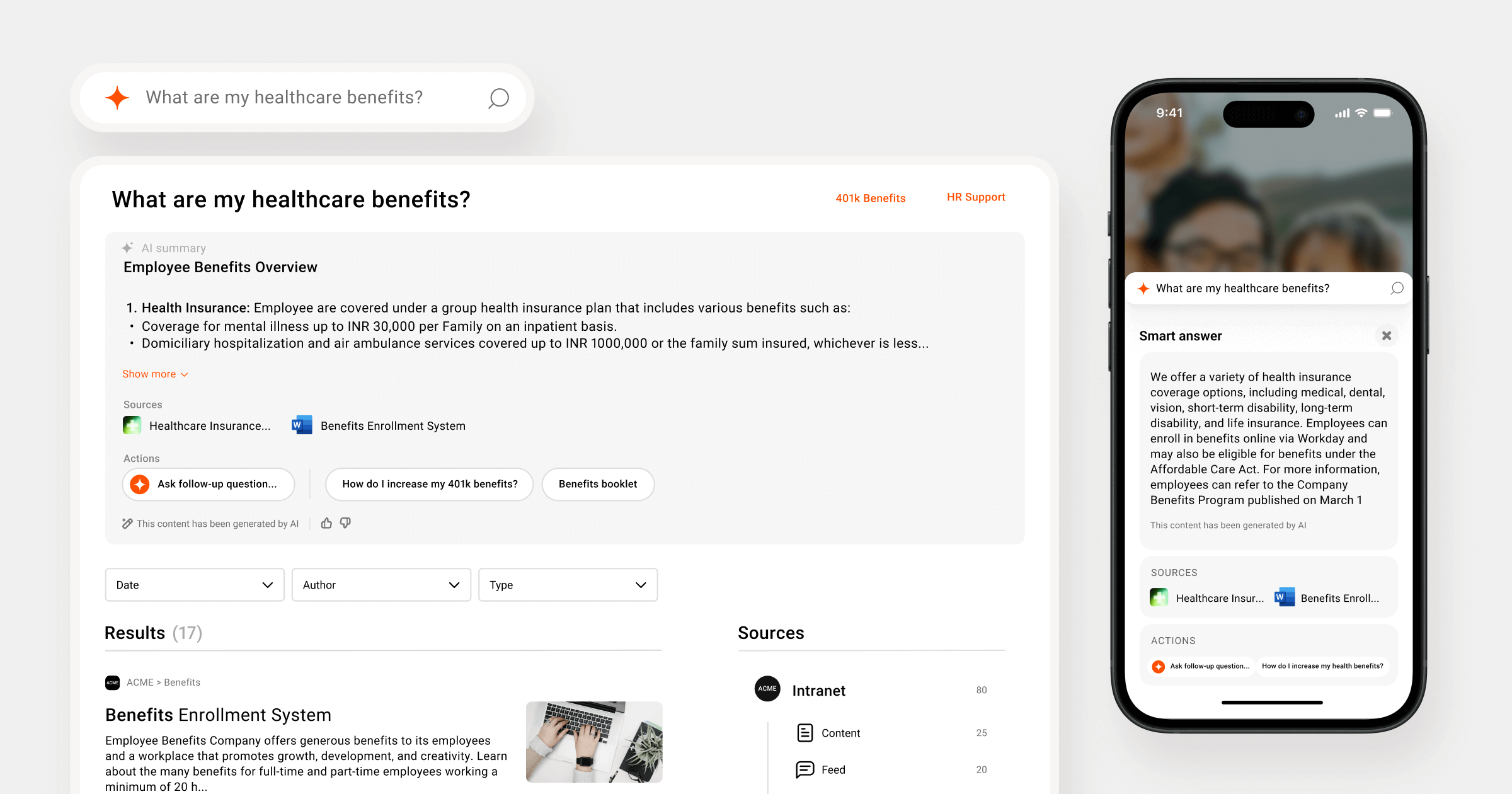
Simpplr provides the foundational architecture these seven elements require:
- Connections to key enterprise content repositories and tools
- Personalization and targeting based on employee attributes and organizational context
- A unified experience across web and mobile
- AI-powered discovery and prioritization
- Admin-controlled configuration of experiences and governance
- Enterprise-grade permissions and controls
As AI capabilities mature and organizations move from information retrieval to agentic workflows, the foundation has to evolve with them.
Where the platform is heading
The platform is moving deeper into each of these areas:
- Richer context models that link people, content, interactions, and events
- More proactive guidance driven by signals and intent
- Composable intelligent building blocks for faster configuration
- Stronger interoperability patterns that reduce swivel-chair workflows
- Governance controls designed specifically for AI-assisted interactions
Simpplr is the unified workplace experience layer where employees discover information, receive guidance, and benefit from intelligent support in context — making your existing architecture coherent and your AI investments effective.
Ready to find out how Simpplr can help you unify your digital workplace? Request a demo today.
Watch a 5-minute demo
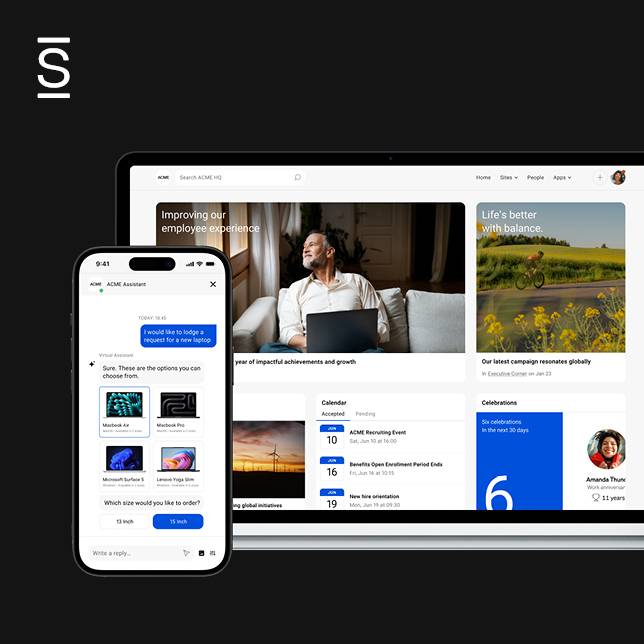
See how the Simpplr employee experience platform connects, engages and empowers your workforce.
- #1 Leader in the Gartner Magic Quadrant™
- 90%+ Employee adoption rate