


A familiar pattern has emerged across enterprises: Employee technology that should simplify work has created layers of complexity nobody can untangle. Every new tool promised to solve a problem, and technically it did. The issue is that employees now spend more time navigating systems than actually working.
The IT leader’s guide to consolidating employee experience technology
The IT leader’s guide to consolidating employee experience technology
Leading IT organizations have stopped accepting this as inevitable. They’re taking a different approach to employee experience technology — consolidating the daily-use systems that sit between employees and their work. The results show up in departmental budgets, employee productivity metrics, and how much time IT teams spend on strategic projects versus operational firefighting.
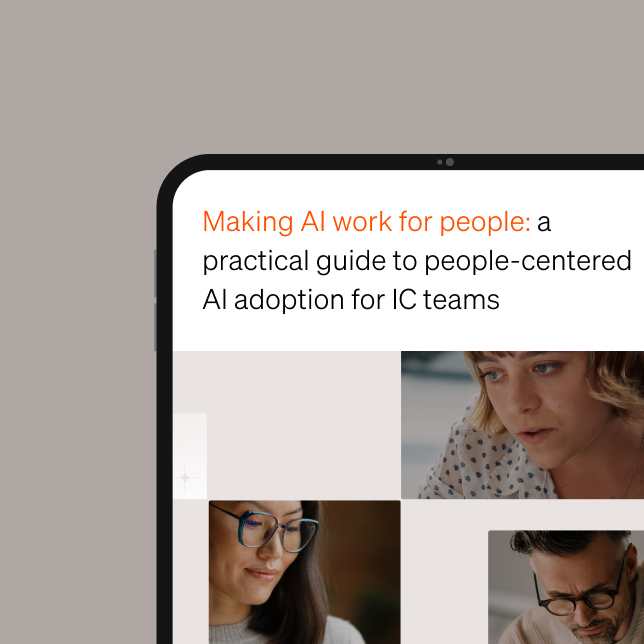
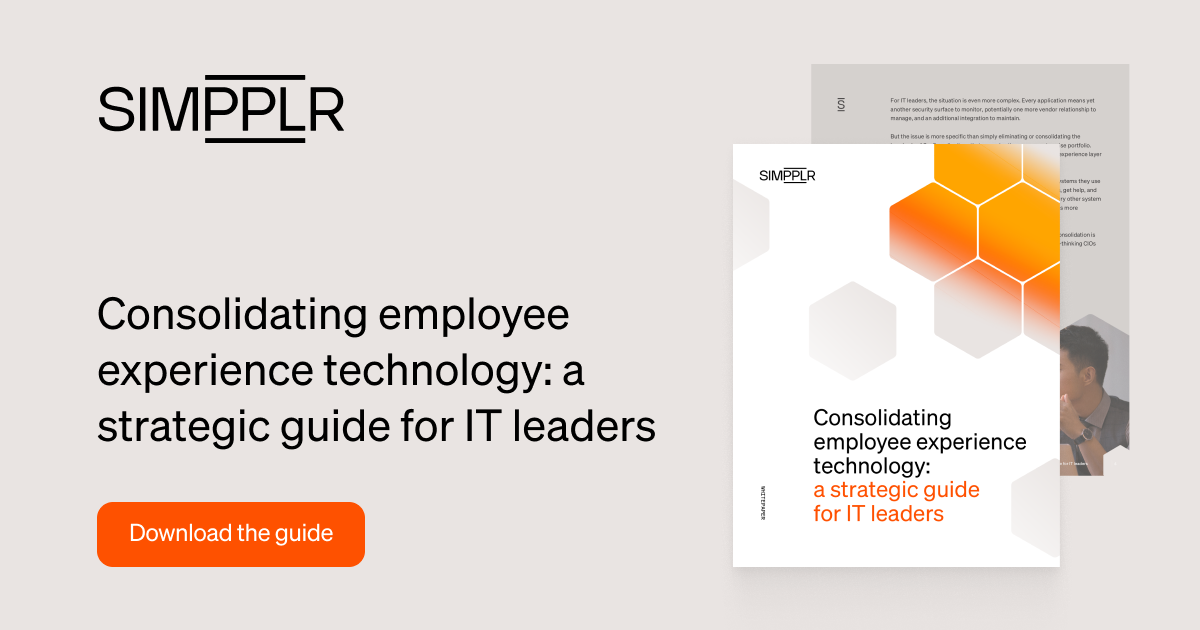
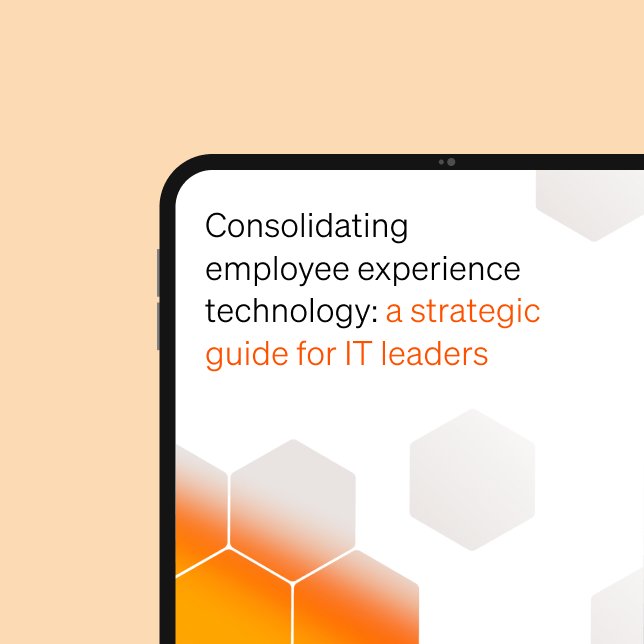
Our new whitepaper, Consolidating employee experience technology: a strategic guide for IT leaders, maps out how organizations are making this shift successfully.
The costs hiding in plain sight
Most IT leaders can rattle off their major software expenses. What’s harder to quantify is the accumulated cost of fragmentation across hundreds of smaller systems and integrations.
Employees lose time every day switching between disconnected platforms. They search across multiple repositories to find information that should take seconds to access. They re-create presentations that already exist because discovery is harder than starting over. They abandon tasks entirely when systems require too many logins or steps.
26% of U.S. workers use 11 or more accounts, resources, tools, and applications each day, contributing to information overload and fatigue.
IT teams feel the pressure differently. Support requests pile up for systems nobody fully owns. Integrations break and require developer time to fix. Access provisioning becomes a full-time job across dozens of platforms. Security audits reveal shadow applications nobody knew existed.
60% of IT teams report having too much manual work that prevents them from taking on strategic projects (BetterCloud 2025 State of SaaS).
Finance sees license costs creeping up across budget lines. Premium features sit unused. Overlapping functionality multiplies across departments. Former employees’ accounts remain active months after departure.
For a 5,000-person organization in which employees spend 15 minutes each day searching for information at an average loaded labor cost of $50/hour, that’s $9.75M annually in search time alone.
These costs compound across three areas: direct spending, employee time, and IT capacity. Understanding the true cost requires frameworks that account for all three dimensions.

What changed to make this urgent
Technology complexity isn’t new. So why are IT leaders prioritizing consolidating employee experience technology now? Four trends converged to shift consolidation from “nice to have someday” to “strategic priority now.”
IT’s role expanded beyond infrastructure. You’re expected to enable digital transformation, not just keep systems running. But operational overhead from managing fragmented systems consumes the capacity needed for strategic work. According to recent industry research, nearly 40% of CIOs now identify their role as strategic, yet the day-to-day reality of managing hundreds of applications makes strategy nearly impossible.
Budget constraints intensified. IT budgets might show modest growth, but that growth often gets absorbed by rising costs across the entire software portfolio. Organizations need to fund innovation while managing increasing expenses. Eliminating redundancy and underutilized licenses creates financial room to invest in what drives business value.
AI governance became mandatory. Most knowledge workers now use AI tools, and many use personal applications that IT doesn’t know about. In fragmented environments, enforcing consistent governance across dozens of systems is functionally impossible. Unified platforms with embedded, governed AI solve this without limiting innovation.
Employee experience affects talent outcomes. When workplace technology frustrates employees daily, they disengage. Research shows this disengagement affects productivity, retention, and ultimately business performance. Technology friction is one factor organizations can directly control.
Each trend reinforces the others, creating mounting pressure for IT leaders to act.
Understanding employee tech consolidation
Employee experience tech consolidation isn’t about ripping and replacing systems. It targets something more specific: the employee-facing layer people interact with daily.
This layer includes the systems employees use to communicate with colleagues, find information, complete routine tasks, get support, and stay connected to company culture. When this layer is fragmented across multiple disconnected platforms, every other system becomes harder to use. When it’s unified, everything becomes more accessible.
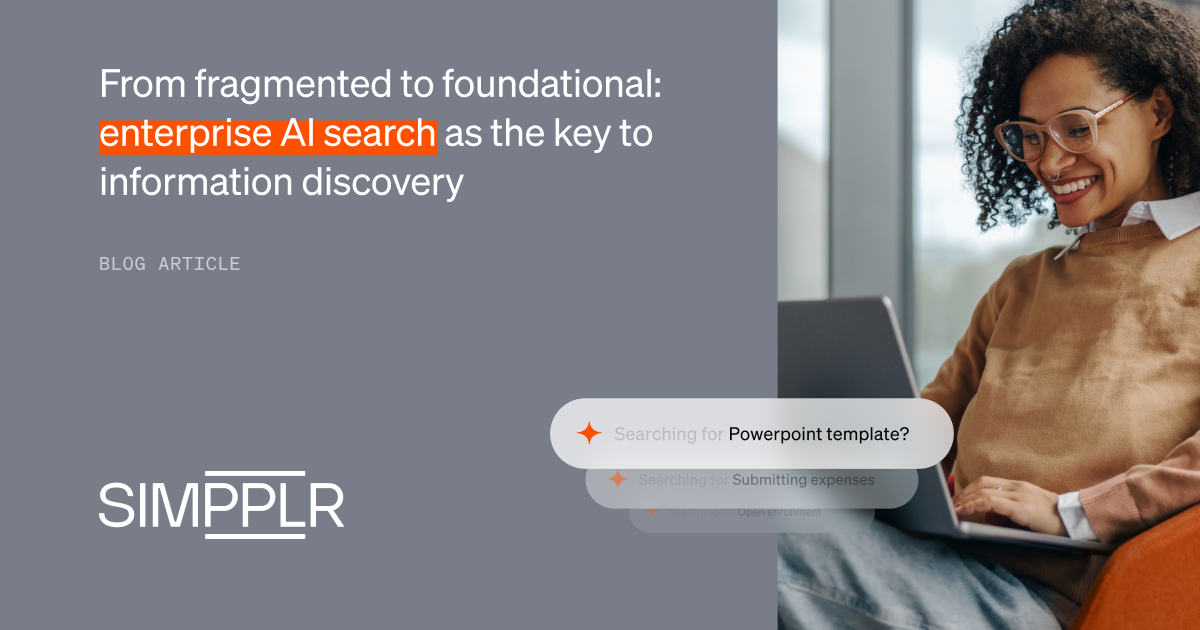
Think of it as a digital front door, the place employees start their day. Your HR system, IT service management platform, and document repositories keep doing what they do well. What changes is how employees access them.
Instead of logging into eight different systems throughout the day, employees work through a unified experience. They can check their schedule, submit a ticket, find a policy, and catch up on team updates from one place. The specialized systems remain in place, but the friction of accessing them disappears.
This approach addresses daily frustration without requiring IT to overhaul functioning systems.
How successful IT teams consolidate employee tech
The organizations succeeding at consolidation follow a systematic approach rather than jumping straight to vendor evaluation.
They start by documenting actual problems, not assumed ones. What makes employees frustrated? Where do they waste time? What workarounds have they built? The answers reveal which capabilities will deliver immediate value and help prioritize implementation.
They audit what they actually have. Most organizations discover they’re managing more systems than they realized, with significant overlap in functionality. The audit also reveals uncomfortable truths about adoption — platforms leadership thinks everyone uses might have negligible traffic.
They distinguish between what needs consolidation and what works fine as-is. Not every system has to be part of a unified platform. Deep specialized tools serving specific functions can remain separate. The focus is on the common layer everyone touches daily.
They evaluate employee experience platforms for genuine consolidation. Many vendors promise unified experiences but deliver bolt-on systems requiring heavy customization. That creates new complexity instead of eliminating it. Successful teams look for platforms that provide consolidation capabilities out of the box.
They build business cases around outcomes. The business case connects to what executives care about: productivity gains, cost reductions, security improvements, and employee experience metrics. Conservative estimates based on specific examples work better than theoretical projections.
They plan for continuous improvement. Implementation includes measuring results and iterating based on actual usage. The goal is steady improvement, not immediate perfection.
Where to start consolidating employee tech
Your starting point matters. Organizations using multiple vendor solutions face different challenges than those with all-in-one platforms or custom-built systems. Each situation requires a different initial focus.
If you’re managing fragmented systems, start with a comprehensive audit. Calculate the total cost including hidden overhead. Compare your current state against benchmark data from similar organizations. Build the case for consolidation using concrete numbers.
If you already have a unified platform, the opportunity lies in optimization. Most organizations significantly underutilize existing capabilities, particularly around targeting, personalization, and analytics. Getting more value from what you have often delivers better ROI than adding new systems.
If you’ve built custom solutions, evaluate whether continued development makes strategic sense. Compare the total cost of ownership — including developer time and ongoing maintenance — against purpose-built alternatives. Sometimes custom makes sense. Often it doesn’t.
If you’re working with limited or no dedicated platforms, address cost and resource concerns directly. Start with a phased approach that demonstrates value before requesting larger investments.
How Simpplr unifies the employee experience
IT leaders face expanding expectations while managing increasingly complex environments. The organizations that put off employee tech consolidation will keep spending capacity on operational overhead while competitors redirect that capacity toward strategic initiatives.
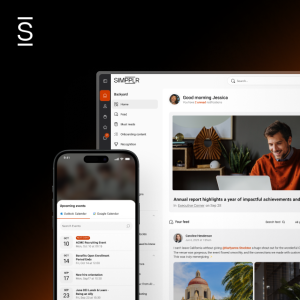
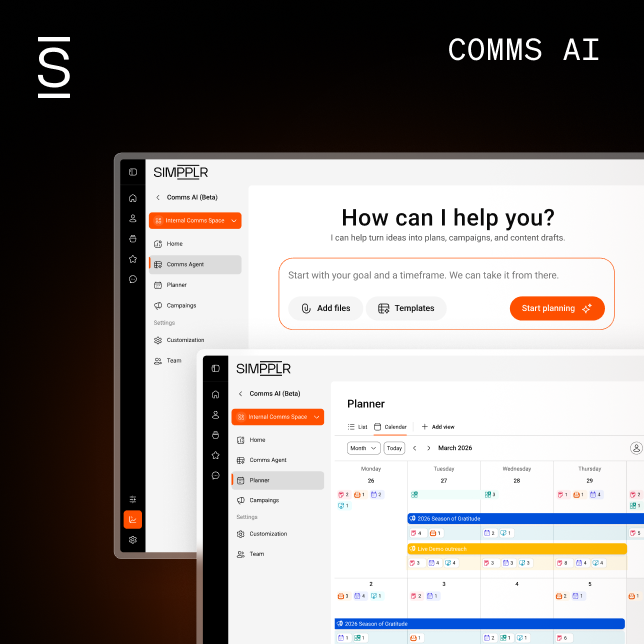
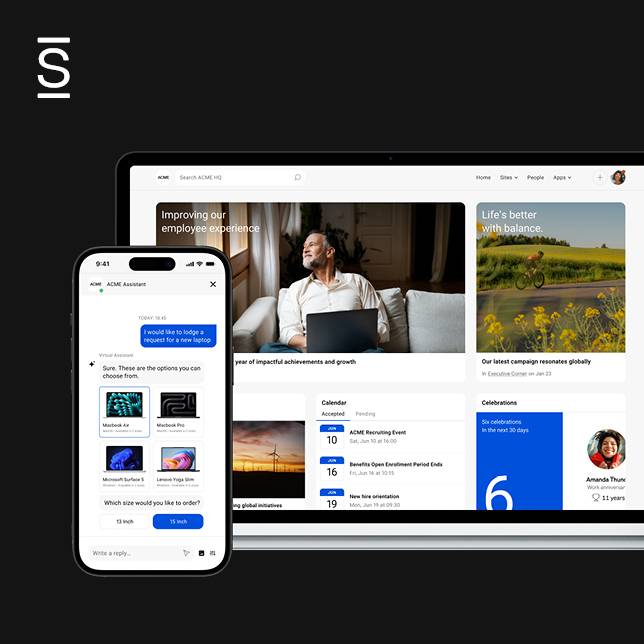
Simpplr’s AI-powered employee experience platform was purpose-built to solve employee experience fragmentation without creating new IT complexity. The platform delivers core capabilities out of the box, not through bolted-together acquisitions or heavy customization.
Key capabilities include:
- App tiles that centralize access to HR, IT, and business systems
- Extensibility Center for secure custom integrations and workflows
- Service desk integration that lets employees submit and track support requests from one place
- Enterprise search with AI-powered semantic discovery across connected systems and repositories
- Integrated recognition and rewards to support engagement without adding another platform
- Role-based access controls that simplify provisioning and deprovisioning
- Mobile-first access so employees can access the unified experience anywhere
This approach lets IT leaders fulfill their expanded strategic mandate. Instead of integrating disparate tools or customizing platforms to do what they weren’t designed for, you deploy a solution built specifically for the employee experience layer — with faster implementation, lower maintenance burden, and more capacity for strategic innovation.
Download Consolidating employee experience technology: a strategic guide for IT leaders for the complete framework and implementation guidance.
Want to see how Simpplr delivers a unified employee experience? Request a personalized demo today.
Watch a 5-minute demo
See how the Simpplr employee experience platform connects, engages and empowers your workforce.
- #1 Leader in the Gartner Magic Quadrant™
- 90%+ Employee adoption rate











![[Webinar Recap] Transform your Employee Experience with a Digital Workplace](https://www.simpplr.com/wp-content/uploads/2021/02/simpplr-blog-Webinar-Recap-Transform-your-Employee-Experience-with-a-Digital-Workplace.png)