


Today’s workplace is currently defined by a paradox of progress. We are deploying the most sophisticated productivity tools in human history, yet the people expected to lead this transformation are more disconnected than ever. Organizations are pouring billions into AI, but they are often neglecting the most critical node in the system: the manager.

Why manager enablement is key to successful AI initiatives
Why manager enablement is key to successful AI initiatives
Table of contents
- 1 Managers drive engagement and performance
- 2 Managers determine whether change is adopted
- 3 The manager role has expanded faster than support
- 4 Managers lack the context to lead clearly
- 5 Training gaps are slowing AI adoption
- 6 Manager enablement requires systems
- 7 Organizations are scaling technology faster than enablement
- 8 How Simpplr helps HR and IC enable managers
The reality is that manager enablement is the primary lever for organizational success. When organizations scale technology without scaling the support systems for the people who manage the work, they don’t just risk poor ROI — they risk systemic breakdown of engagement and performance.
It isn’t a binary choice between organization efficiency and organizational effectiveness. AI can help enable the former, but human intervention fuels the latter. Now more than ever we need managers to lean in and in doing so, find the support they — and their teams — need to thrive.

Managers drive engagement and performance
According to Gallup’s State of the Global Workplace 2026 Report, manager engagement has plummeted to 22% globally, a staggering drop from 31% just four years ago. The engagement premium managers used to have over their teams has nearly disappeared. In other words, the people we rely on to translate strategy, support employees, coach performance, and carry culture are running on fumes.
That matters because engagement goes beyond how people feel at work. Gallup defines it as the emotional commitment and involvement employees have with their work and workplace.
When you look at the Gallup Q12 hierarchy, the basics are very, well, basic:
- Do I know what’s expected of me?
- Do I have what I need?
- Does my manager care about me?
- Do I feel recognized?
- Am I growing?
These questions are the foundation for performance. We can’t keep asking managers to be the connective tissue of the organization without giving them better systems, better support, and fewer administrative burdens.
This isn’t just a “middle management” problem. It’s a performance risk of the highest order. Gallup research consistently shows that managers account for at least 70% of the variance in team-level engagement.
When manager engagement falls, the ripple effect is immediate:
- Performance stalls: Disengaged managers lack the energy to push teams toward ambitious goals
- Attrition risk rises: Employees are more likely to leave the company if their manager is unsupportive
- Strategic alignment drifts: Teams lose sight of the broader corporate mission without an engaged manager to anchor them
If managers are breaking down, it’s no surprise that engagement and performance follows.
Managers determine whether change is adopted
It’s impossible to discuss AI adoption without first addressing the importance of the manager role in leading change.
Change of any sort is hard. We’ve all heard stats about the alarmingly high percentage of transformation efforts that fail. AI adoption doesn’t just happen naturally and certainly not with the ROI the hype promotes. Paradoxically, most organizations are ready to spend on AI but not as ready to act.
McKinsey’s State of AI in 2025 research found that 88% of organizations are now using AI in at least one business function. However, 86% of leaders feel their organizations are not prepared to adopt AI in day-to-day operations. This reflects an enablement gap.
Consider two scenarios:
Scenario A: An organization sends a companywide email announcing a new AI coding assistant. The manager, overwhelmed and out of the loop, tells their team, “I’m not sure how this affects our deadlines, so just keep doing what you’re doing for now.”
Scenario B: The same announcement goes out, but the manager has been enabled with a clear rubric — a manager toolkit issued ahead of time. Their leaders gave them context via a personalized manager communication channel and training with their particular team in mind.
This time, the manager says to their team, “We’re using this tool to automate more of our development so we can free up time to focus on product innovation. Here’s how you’ll be supported to learn and here’s how this will enable us to work better.”
The clarity gap is an important one to bridge. EY’s study on the human side of AI adoption underscores this:
- 92% of employees report productivity gains when the AI strategy is clearly communicated
- 87% of employees express enthusiasm about AI when leaders provide clear direction
- 66% of employees will actively use AI tools when the strategy is transparently shared, compared to significantly lower rates in “black box” environments
It’s the translation that makes the difference. AI adoption happens through clarification, reinforcement, and day-to-day guidance. At the core, employees rely on their managers to answer three fundamental questions: Why does it matter? How do I use this? What is expected of me? If the manager cannot answer these, the technology remains shelfware.
Managers aren’t just the communication layer but also the translation layer between strategy and execution.
The manager role has expanded faster than support
Why is manager engagement cratering? Because the role has fundamentally changed while the support systems have remained frozen in time. It’s the equivalent of trying to function in today’s world with only dial-up internet. While all around you AI offers new possibilities, your modem is unreliable.
Organizations have been flattening management structures for a while, leading to larger team sizes. Gallup research confirms that manager engagement tends to decline as team sizes grow. In the age of AI and hybrid work, the “span of control” has continued to widen, and expectations of managers have shifted again. We have asked managers to be change leaders, career coaches, and AI subject matter experts simultaneously.
This isn’t a narrative of individual burnout but of structural failure. Organizations have added layers of responsibility — mandated to lead digital transformation, build high-performing distributed teams, and be a player-coach — without redesigning the infrastructure required to help them succeed.
Managers who spend more than 40% of their time on individual contributor work (often called “player-coaches”) see their engagement decline significantly as their span of control increases (Gallup).
Peter Drucker is credited with saying “Management is doing things right; leadership is doing the right things.” He used this distinction to emphasize the difference between efficiency (doing things right) and effectiveness (doing the right things).
He argued that there is nothing quite so useless as doing with great efficiency something that should not be done at all. His words from the 1980s were prescient to what we’re seeing now. AI promises the potential for so much efficiency, yet misdirected and unsupported efforts risk so much harm.
We need managers to be leaders as well, of course. But they need to be equipped to do both.
In this AI era of disruption and transformation, we have gaps to bridge:
- The management gap: Organizations are often too focused on management, the technical rollout, the procurement, and the “doing things right” phase. They are ensuring AI is being used, but to what end?
- The leadership gap: What’s missing is leadership, the “doing the right things” phase. This is where managers help their teams understand why they are using AI, what tasks they should stop doing, and how to pivot their strategy.
We need to support managers to build their own efficiency and effectiveness, as we ask them to bring their teams along. When managers aren’t supported to put on their oxygen masks first, then how can we expect them to thrive and help their teams do the same?

Managers lack the context to lead clearly
A primary reason managers struggle to lead change is that they are often treated as only a distribution channel rather than as a major conduit for change and a distinct audience. Communications planning needs to equip managers as both a distinct audience with specific preferences and needs, and as a critical distribution channel.
Too often managers receive information exactly like their direct reports — at best a beat earlier — and via fragmented systems. This leaves them struggling to find that buried email or random direct message or to go on a scavenger hunt on the company intranet. This sets up a number of problems, not the least of which is making it unnecessarily harder for managers to be fully informed and current with the latest context.
But it also creates translation friction where the manager is expected to champion a strategy they don’t fully understand nor have the time or context to fully absorb. Managers’ failure to lead change well can be a competency issue, but I think more often it is a capacity and support issue.
Without full context behind decisions or clarity on shifting priorities, the manager’s messaging becomes inconsistent and quickly out of date. When the “middle” of the organization is confused, the frontline becomes paralyzed. Clarity is a prerequisite for execution.
If we equip our managers better with context and clarity, they are better able to translate this into practical change support to their teams.
Training gaps are slowing AI adoption
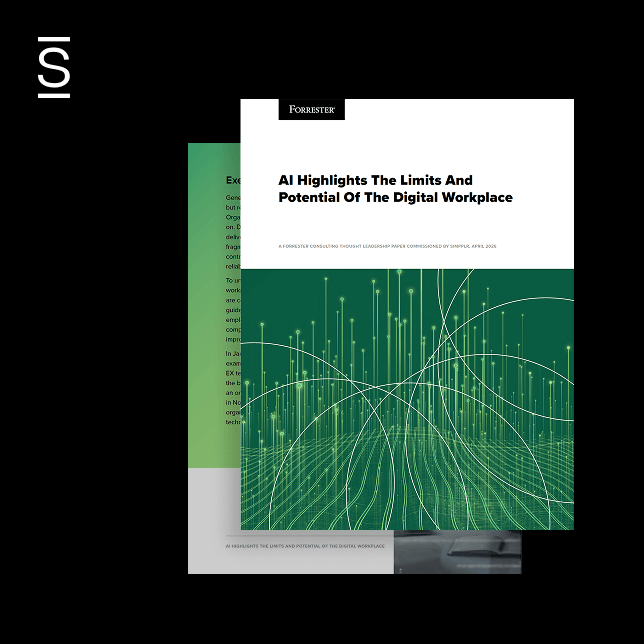
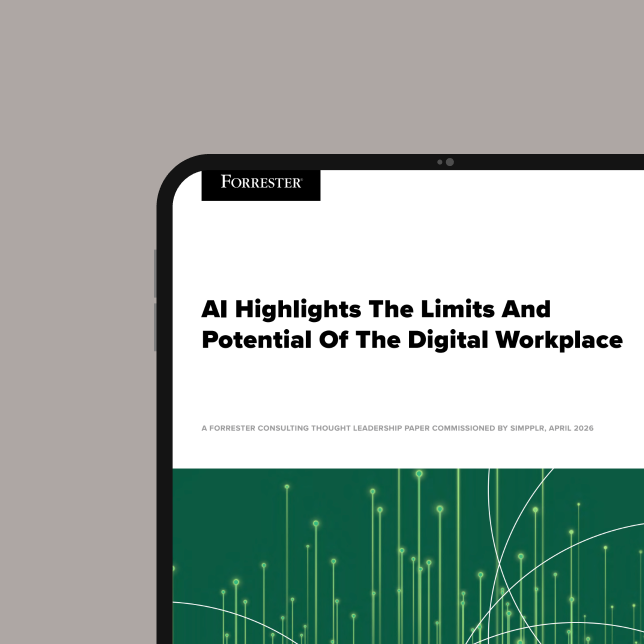
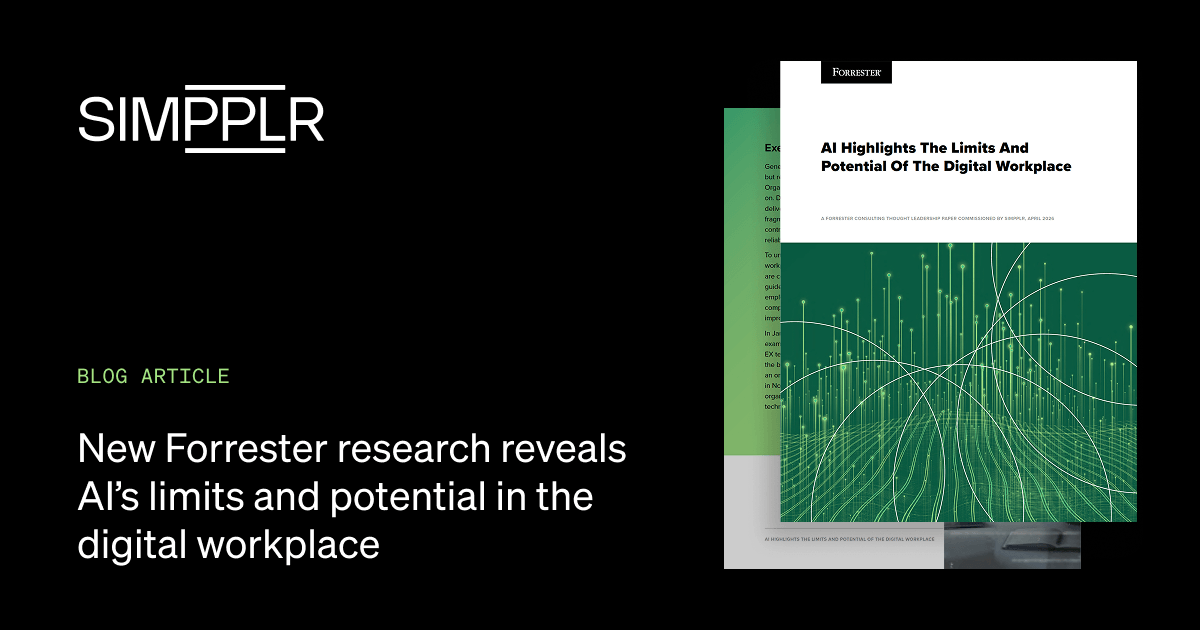
The speed of AI deployment is currently outstripping the speed of human learning. A recent commissioned study conducted by Forrester Consulting on behalf of Simpplr found that while 87% of leaders believe employees need more training to use AI tools, only 29% of organizations have established communities of practice to support that learning.
This creates a structural gap. Organizations are deploying “the what” (AI tools) without “the how” (shared practice).
Here’s why that matters:
- Peer learning vs. theory: Most employees learn best through observation and peer interaction, not a one-time webinar. When they hear and see their leaders saying “do as I do,” not just “do as I say,” they are encouraged to dive in and put the learning into practice.
- Normalization: New behaviors only become “the way we work” when they are regularly reinforced by the manager, when progress is celebrated and, importantly, when taking reasonable risks and learning from failure is encouraged.
When learning, sharing of knowledge, and the reinforcement of recognition remains fragmented, managers are left scrambling to bridge the gap themselves, often learning the tools alongside their teams rather than leading the way.
Manager enablement requires systems
Effective manager enablement is not a one-time workshop. It’s an ongoing process of building repeatable habits, with a well-planned system of support over a period of time.
You cannot train your way out of a broken system. Real enablement requires a holistic approach and rethinking our change management rubrics for the AI era.
Many of the familiar change imperatives hold true. We just need to think about them a little differently.
Here are essential components of supportive AI adoption change enablement:
- Transparency and trust: AI adoption triggers deep-seated job security fears. Supportive managers navigate this reality by being human-first empathetic leaders.
- Proper context: Connect AI use-cases to real business outcomes that matter to the organization and to the productivity, skill-building, and impact of the people in it.
- Psychological safety: Explicitly grant permission to fail. Employees need to know they won’t be penalized for appropriate AI experimentation but will be celebrated for taking sensible risks and sharing what works and what doesn’t.
- Clear guardrails: Keep updating and sharing your AI policy. Sanctioned tools, data integrity, security protection, human review, and controls are evolving at a rapid pace. Have a means to communicate to everyone, target when needed, and keep the policies current and discoverable.
- Measurement that matters: Stop measuring logins and start measuring value-added outcomes and impact. Keep an eye on token burn, as there’s real cost and consequence if AI use isn’t channelled experimentation and application.
- Recognition: Reward people when they share a prompt or workflow improvement, not just the use of the tool. Spread knowledge, celebrate breakthroughs, and embrace the learning that comes from rapid prototyping, failure, and adaptation.
Managers need to experience these for themselves so they in turn can create the optimal conditions for their teams. Many organizations are still operating in fragmented environments. If a manager cannot access reliable context, they cannot communicate it. Clarity is a product of the systems surrounding the leader.
Organizations are scaling technology faster than enablement
Organizations are scaling AI, workflows, and expectations, but they are stalling on manager enablement. The result of this imbalance risks delivering the opposite of what most organizations are aiming for. Namely, speed of execution, with real impact. Without the right manager support in place, pace inevitably slows down, efforts are unfocused, and results are diluted.
There’s irony in the fact that AI can also be our best friend in creating just-in-time communications, training, feedback loops, and more, that can help us scale manager support at the right pace.
Transformation is realized through people. Managers are mainstays in bringing change to life. Supporting them is the most direct path to a successful future.
How Simpplr helps HR and IC enable managers
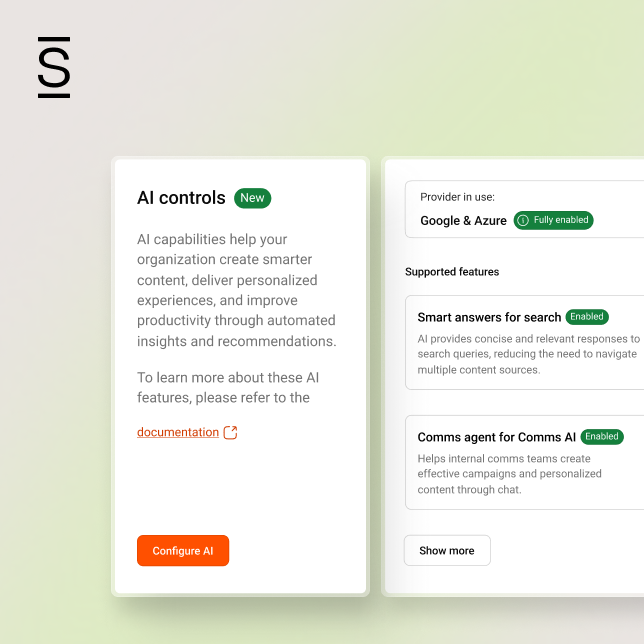
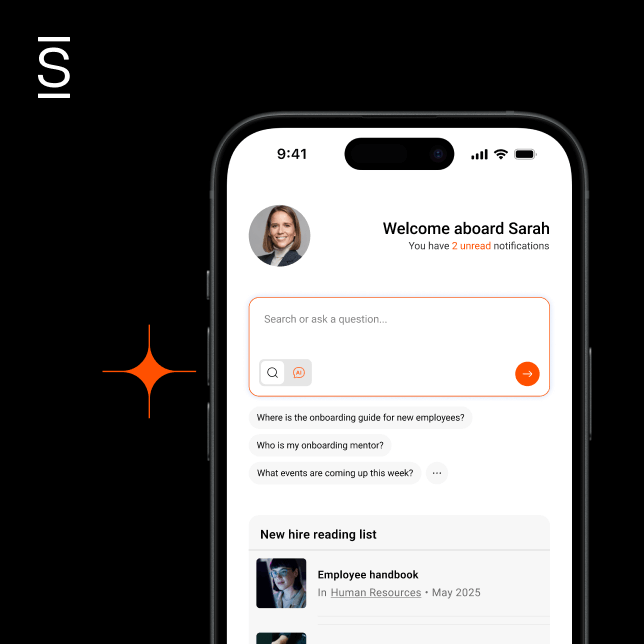
To support managers at scale, organizations need to move beyond ad hoc emails and toward a discipline of manager enablement that is coherent, contextualized, and connected. Platforms like Simpplr empower HR and Internal Communication teams to turn managers into the transformation leaders they need to be.
The AI-powered intranet platform provides:
- Centralized knowledge: Simpplr creates a single source of truth so managers aren’t piecing together strategy from three different systems, with AI search built in.
- Targeted communication: Not every manager needs every update. Simpplr allows you to deliver role-relevant information, ensuring that managers see only what is critical to their specific team and priorities.
- Feedback loops: Enablement isn’t a one-way street. Simpplr provides the tools to surface sentiment and questions in real-time, allowing leadership to adjust strategies before disengagement sets in.
- Actionable analytics: With Simpplr, teams can see exactly which messages are reaching managers and where alignment is lagging.
- Recognition and rewards: When recognition is easy to give, share, and celebrate, reinforcing behavior change is simple, repeatable, and scalable.
By providing the right visibility and tools, Simpplr supports manager enablement into the AI age with ease.
Ready to find out how Simpplr can help you enable your managers? Request a demo today.
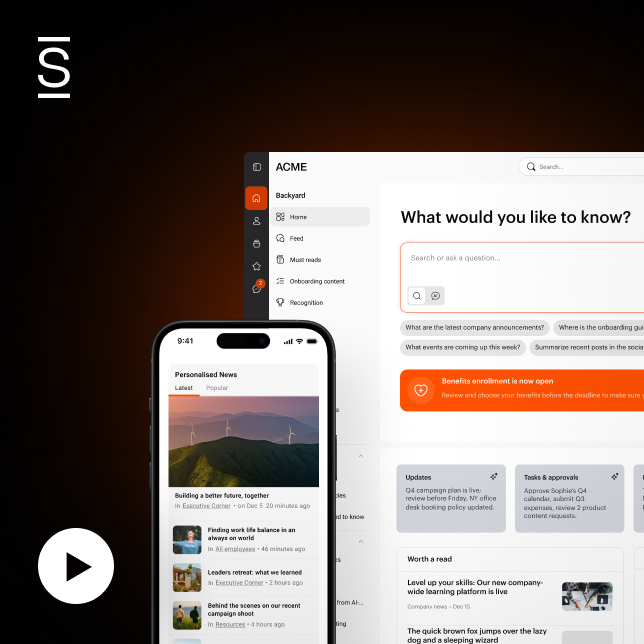
Watch a 5-minute demo
See how the Simpplr employee experience platform connects, engages and empowers your workforce.
- #1 Leader in the Gartner Magic Quadrant™
- 90%+ Employee adoption rate