



Enterprise AI pilots are stalling in every industry I work with, and the buyers themselves can tell you why. They aren’t buying AI capability. They’re buying organizational trust at scale, with the least possible integration debt. The vendors still selling capability to IT leaders are losing deals to the vendors selling trust.
What CIOs are buying when they buy enterprise AI
What CIOs are buying when they buy enterprise AI
Gartner now predicts more than 40% of agentic AI projects will be canceled by the end of 2027, citing escalating costs, unclear business value, and inadequate risk controls. Each of those causes showed up, almost word for word, in recent conversations with business leaders.
Over the past few months I sat down with CIOs, IT leaders, and the security, operations, and HR executives who work alongside them. They came from technology, financial services, construction, and manufacturing. All of them had recently evaluated, deployed, or scoped enterprise search and AI agent platforms. What struck me wasn’t the differences between their industries. It was how similar the underlying decision logic turned out to be.
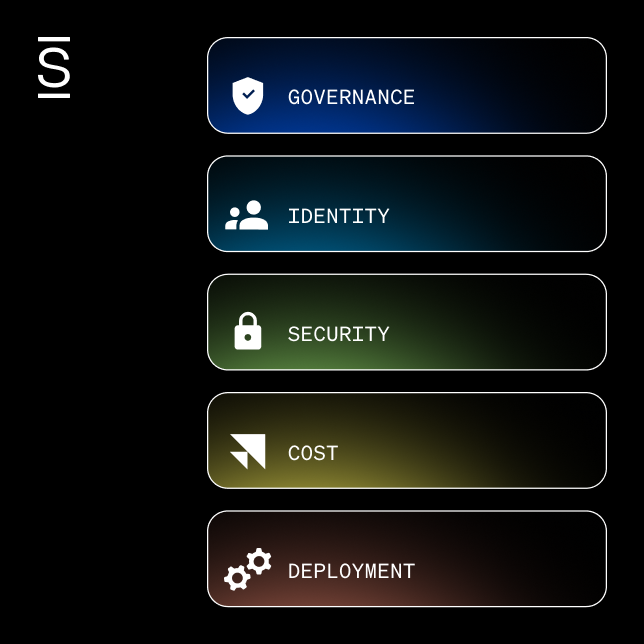
Strip away the vertical-specific language and three factors separated the deals that closed from the evaluations that died: governance, cost predictability, and deployment process. Each one deserves to be unpacked because each one overturns an assumption most vendors still carry into the room. Then I’ll share the tension that sits underneath every one of these deals.

Governance comes before capability
Every conversation eventually arrived at the same place, and most even started there. A data and platform leader at a digital bank ended his evaluation of one of the most hyped enterprise search vendors in the market over a single contract clause. The vendor could not guarantee that his customer data would stay out of their model training. Legal flagged it, the evaluation stopped, and no amount of product quality could restart the conversation.
He wasn’t an outlier. A chief digital officer at a large U.S. consumer financial services firm ran 10 weighted evaluation criteria. Security and permissioning came first — ahead of search quality, integration breadth, and AI capability itself.
“Governance of AI is more important than capability of AI. As long as a tool meets a certain performance threshold, governance wins.” — CIO, commercial construction company
That performance bar covers more than accuracy. The digital bank leader grades what a platform knows to refuse as carefully as what it outputs. In his words, “We care as much about what it knows not to answer as what it can answer.” In a regulated environment, a confidently wrong answer is worse than no answer at all.
Every agent needs its own identity
Governance concerns don’t stop at the contract. In a working session at an industrial manufacturer, the conversation turned to what happens when an agent starts working inside a help desk.
The manufacturer’s IT infrastructure and security leader framed it as an identity problem: “You have to treat the agent as a human user and make sure that you provide the least required amount of access.” An agent that inherits broader permissions than any single employee would ever hold is an audit finding waiting to happen.
Buyers grade connectors on depth, not breadth
Permission awareness is also changing how buyers read a vendor’s integration slide. The logo wall used to close deals. Now it invites a harder question. The digital bank leader described exactly what his team grades instead.
“We care less about the connector logo count and more about whether a connector captures permission metadata, comments, versions, ownership, and fresh information.” — Data and platform leader, digital bank
A connector that skips that metadata doesn’t just underdeliver. “A shallow connector creates a hallucination risk, which for us is a regulatory risk,” he said.
None of this shows up in a sales demo, which runs on curated data with clean permissions — the one environment where a shallow connector or an over-permissioned agent looks exactly like a deep one. The buyers who avoided regret in this group stopped treating the demo as evidence at all. They pushed finalists onto their own content, their own permission model, their own service workflows, before anyone signed anything. That’s where a governance gap shows itself. It’s not in the pitch, but in what breaks when the tool meets your real mess.
The deepest governance advantage belongs to the incumbent. When the construction CIO gave a standalone search platform a look, security never came up as the blocker. His organization had already consolidated data, identity, and access into one Microsoft architecture. Adding a parallel destination meant governing everything twice.
He also saw no reason to send employees somewhere new when search already lived inside their flow of work. “It would have taken something monumental to move us away,” he said. The takeaway is structural. A new platform earns its seat by bridging into the identity and data architecture you already trust.
Cost predictability beats cost
Nearly every buyer who had moved past a pilot raised the same fear, unprompted. Consumption-based pricing was creeping beyond anything their finance teams could forecast. A VP at a technology company had watched a year-one discount mask his platform’s true run rate. Once the discount expires, he expects costs to move well into the millions, with no ability to renegotiate for two years.
The evaluation question has shifted accordingly. Buyers used to ask whether the product works. Now they ask whether a CFO can model it three years out. The digital bank leader was the most specific about what passes that test. He wants a platform base fee, connector bundles, and capped token consumption.
“Pure token-based pricing is a nonstarter for our finance team.” — Data and platform leader, digital bank
The construction CIO has taken the same logic a step further. He licensed his entire company on a single platform partly to learn how to govern token usage before consumption pricing hardens across the industry. He noted that per-seat pricing is budgetable. By contrast, there is no reliable way to model or forecast consumption pricing.
The ROI question has moved from search to agents
Underneath the pricing anxiety sits a maturity split I heard in every conversation. Nobody builds a business case for enterprise search anymore. If employees find trusted information faster, the value is assumed, so buyers track adoption instead of ROI. Agents are held to a different standard. Buyers want a hard number, and the number they’ve settled on is ticket containment — the percentage of requests an agent resolves without any human involvement.
A ticket resolved by an IT or HR employee costs roughly $6 to $15 in fully loaded labor. A ticket contained by an agent runs around 50 cents.
One technology company in this group measured containment of 78% to 80% after deployment. At that spread, the agent business case writes itself. The open question is whether the pricing model lets you keep the savings.
That’s why buyers now expect and accept six-figure annual spend once a platform moves past the pilot stage. That’s what organizations should plan for. Expensive vendors still win deals in this market. Unforecastable ones tend to lose them.
Deployment is where AI projects live or die
The third pillar surprised me the least and matters the most. Once governance clears and the pricing pencils out, the remaining risk lives inside the buying organization. Who builds the agents, who owns them, and whether the workforce will use them are what decide everything from there. Change management matters.
Most organizations aren’t builders, and they know it
Vendors keep shipping self-serve agent studios that assume a builder persona on the other end. For most of the buyers I spoke with, that persona doesn’t exist yet. The security leader at the manufacturer answered the build question without hesitating.
“We’re certainly not going to build them from scratch. We don’t have the capability. So we’re going to end up either doing a buy or a stack.” — IT infrastructure and security leader, manufacturing company
The technology company VP reached the same conclusion from the opposite starting point. His company has the talent, and it still prefers prebuilt. “They know it better than us,” he said. “It gives us speed to value.” Both paths lead to the same expectation. Buyers want vendors who deploy alongside them and teach as they go.
Where builders exist, they sit in the business
The most AI-mature organization in this group proves the point from the other direction. Its top tier of certified agent builders sit in the business, write the agent logic, and design the workflows. The company runs three certification tiers that scope a builder’s reach to individual, department, or corporate data, so authority grows with demonstrated skill.
IT keeps three jobs: making the data connection, reviewing security and identity, and pushing to production. The construction CIO described the payoff in plain math: “If 80 to 90% of the work is done at the business level, and my team just handles governance and data, that’s a massive force multiplier.”
The workforce needs as much onboarding as the platform
Even a well-built agent fails if nobody engages with it. A banking CIO described the barrier as his employees would: “How do I even use AI? Where do I start? What do I do?” That learning curve sits upstream of any tool selection. The consumer financial services CDO has a name for this readiness gap — the AI adoption quotient — and a prescription that applies at every company size.
“The best approach, regardless of size, is to start with a pilot. Try it in a specific business unit, learn from it, then move to a more commercial standing.” — Chief digital officer, U.S. consumer financial services
I’d take his advice one step further. A pilot is the first rep of your change management program. The team that runs it becomes the internal proof that a new way of working is safe, and what it reveals tells you exactly where the workforce needs help before you scale. The buyers in this group who avoided becoming a failure statistic treated deployment that way from their first evaluation conversation.
The question underneath every AI deal
One remark from these conversations explains more of this market than any analyst framework. A CIO is paid to manage risk and keep the organization safe. The business functions down the hall live under the opposite mandate. They’re measured on capability. Every enterprise AI deal is a negotiation between those two job descriptions.
Organizations that pretend the tension doesn’t exist end up on one of two bad paths. Either the business routes around IT and shadow AI blooms, or IT wins every argument and the platform becomes shelfware. The healthy pattern showed up in every mature organization I spoke with: IT holds the rails of identity, data, and governance, while the business function owns the use case and the outcome.
So when a vendor walks into your building promising intelligence, hold them to the three questions this market is now asking. Can you prove, contractually, that you’ll govern my data the way I need you to? Can my finance team forecast what this costs in year three? And once the contract is signed, will you show up for the deployment?
None of these questions are about AI capability, and that’s the point. Enterprise AI in 2026 is a procurement and trust story. AI is just the subject matter.
Ready to find out how Simpplr AI can help you improve your employee experience? Request a demo today.
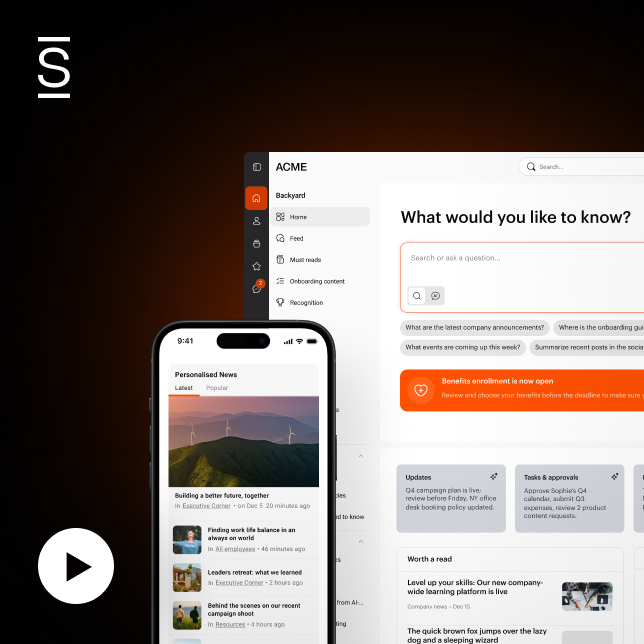
Watch a 5-minute demo
See how the Simpplr employee experience platform connects, engages and empowers your workforce.
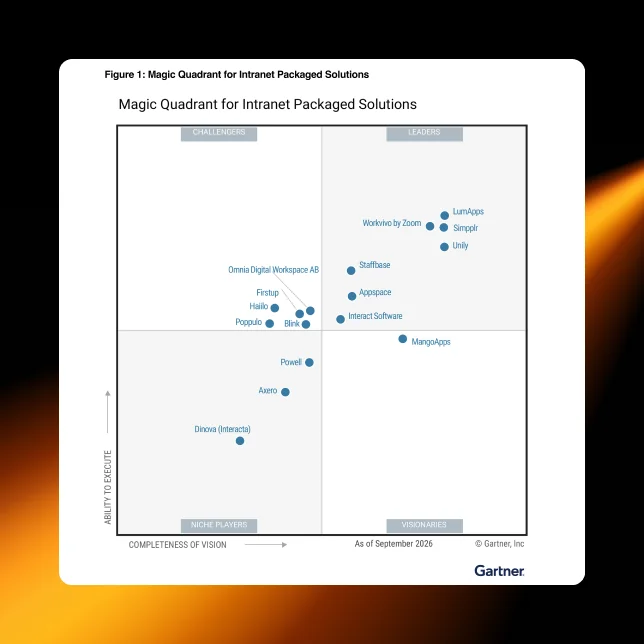
- #1 Leader in the Gartner Magic Quadrant™
- 90%+ Employee adoption rate