




Recent Forrester data shows healthcare leads every industry in workplace AI adoption, yet it’s the sector least likely to call that adoption a success. It has moved fast on deployment but still trails on the outcomes leaders care about most: productivity, trust, and measurable ROI.

Why healthcare leads industries in AI adoption but still struggles to prove ROI
Why healthcare leads industries in AI adoption but still struggles to prove ROI
Table of contents
- 1 Healthcare is the most mature vertical in AI adoption
- 2 Healthcare optimizes for people and productivity
- 3 The most important metrics are the hardest to improve
- 4 Compliance and security are the real bottleneck
- 5 What healthcare leaders want next from AI
- 6 Six priorities for healthcare leaders
- 7 Healthcare’s window to turn its AI lead into results
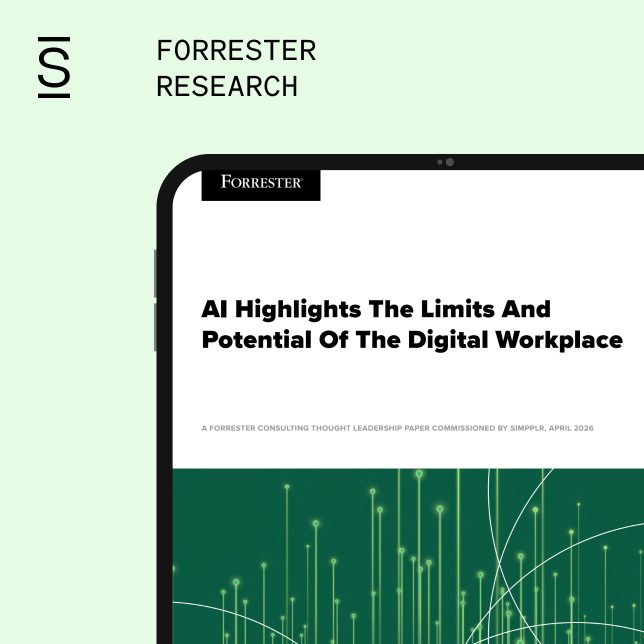
The problem isn’t the AI. Instead, it’s the foundation underneath it. A commissioned study conducted by Forrester Consulting on behalf of Simpplr, AI Highlights the Limits and Potential of the Digital Workplace, found the same pattern across every industry surveyed. AI performs only as well as the workplace systems that support it.
In healthcare, that pattern is especially stark. Fragmented knowledge, complex workflows, and a heavy compliance burden leave AI without the reliable context it needs to act on.
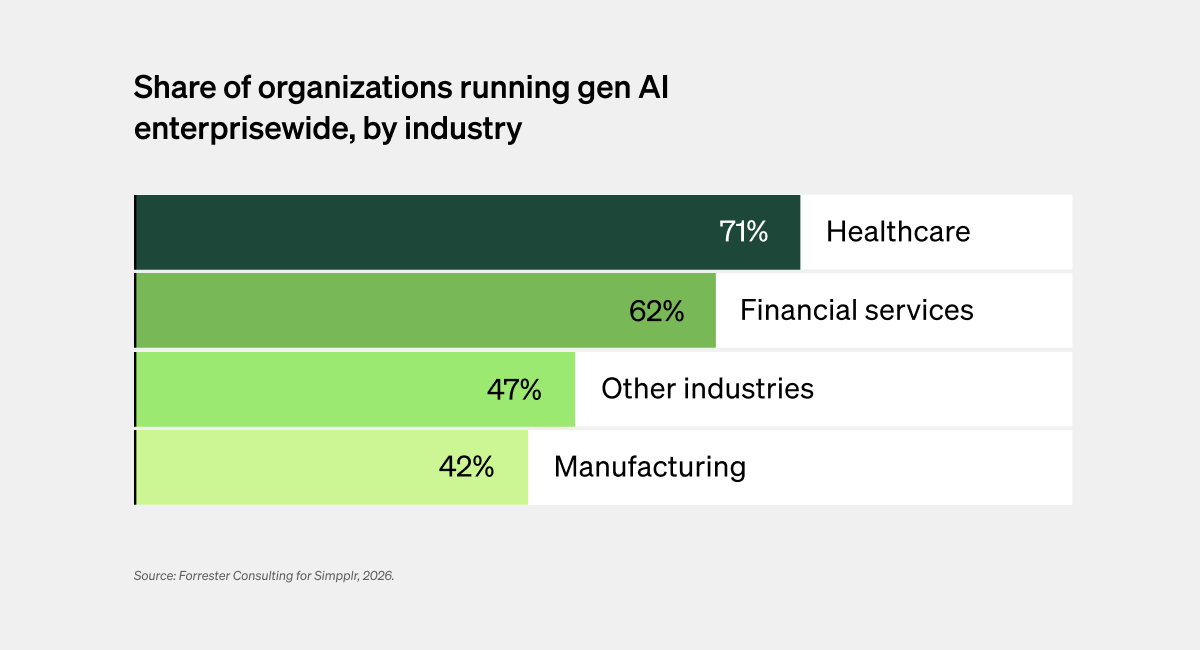
Generative AI runs enterprisewide in 71% of healthcare organizations, the highest share of any industry, according to the Forrester survey data.
Forrester surveyed 310 senior IT leaders across North America and the UK, all at director level or higher. Each leads digital workplace, employee experience, or AI strategy at an organization of 1,500 or more employees. The analysis that follows draws on the healthcare leaders within that group.
Healthcare is the most mature vertical in AI adoption
Healthcare’s maturity shows up across nearly every measure in the study, and the sector is now moving into the harder phase that follows, which is turning broad rollout into measurable impact. The data breaks down into three areas — how far generative and agentic AI have scaled, how widely unified platforms have been adopted, and what healthcare expects next.
Generative and agentic AI lead every sector
Generative AI now runs enterprisewide in more healthcare organizations than in any other industry. Healthcare has moved past the pilot stage entirely while other sectors are still building toward it.
Here’s how the enterprisewide adoption rates compare:
- Healthcare: 71%
- Financial services: 62%
- Other industries: 47%
- Manufacturing: 42%
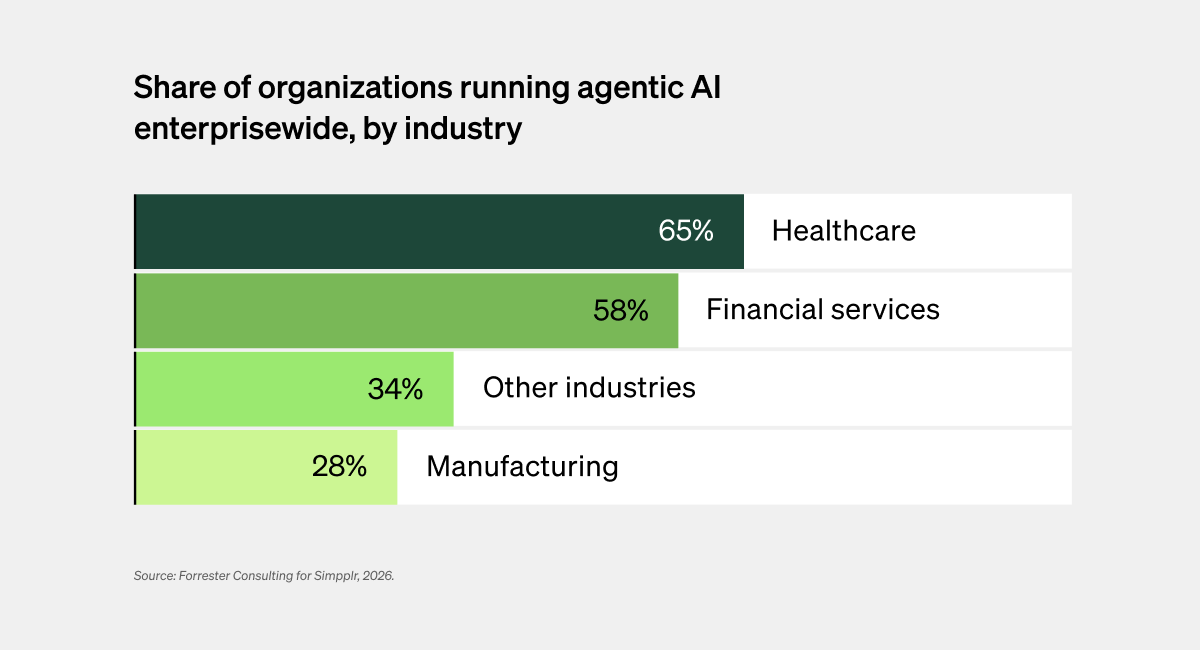
The lead widens further on agentic AI, the newer and harder frontier. Healthcare reaches 65% enterprisewide adoption here, a full 37 percentage points clear of manufacturing — the widest gap anywhere in the data.
The same industry ranking holds, just further apart:
- Healthcare: 65%
- Financial services: 58%
- Other industries: 34%
- Manufacturing: 28%
AI platform adoption is already widespread
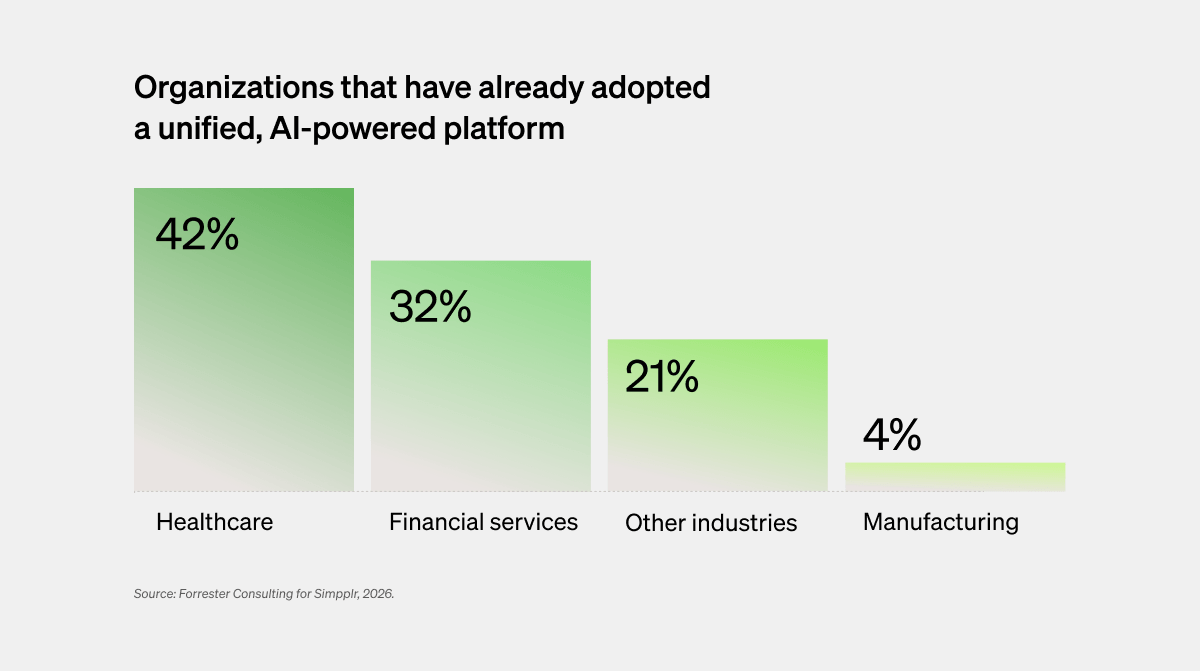
The same pattern appears in platform adoption, where healthcare has moved further than any other industry in adopting AI-powered platforms that unify people, knowledge, apps, and workflows. Adoption has reached 42% in healthcare, compared with a 24% all-industry average.
Here’s how that compares across the other industries surveyed:
- Healthcare: 42%
- Financial services: 32%
- Other industries: 21%
- Manufacturing: 4%
Demand for these platforms is nearly universal. Every healthcare respondent is either interested in one or already using one, with 44% very interested, 13% interested, and 42% already on board.
But healthcare is not preparing for another surge in deployment. Only 13% expect deployments to grow more than 20% over the next 12 to 24 months, compared with 30% in manufacturing. This is a sign that healthcare has already scaled and is now entering a phase of consolidation and optimization rather than rapid expansion.
Healthcare optimizes for people and productivity
Healthcare’s AI investment follows a clear hierarchy: improve the experience of patients and employees, make information easier to access, and help staff work more effectively.
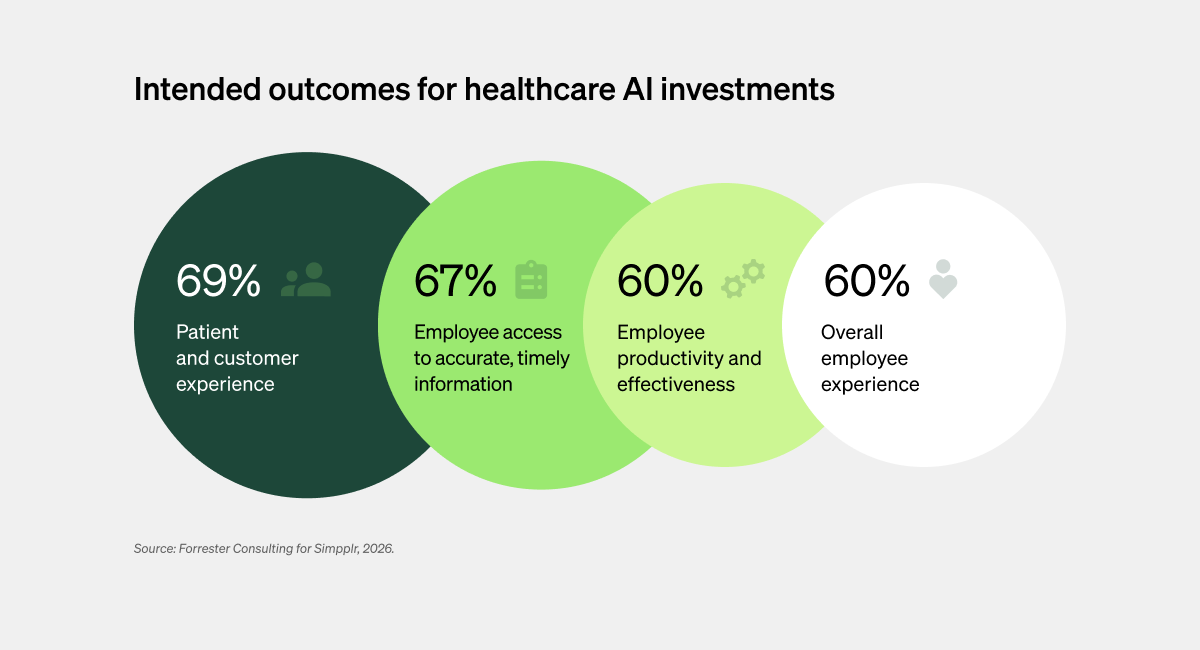
The top drivers are centered on people, productivity, and information:
- Improving patient and customer experience: 69%
- Increasing employee access to accurate, timely information: 67%
- Increasing employee productivity and effectiveness: 60%
- Improving overall employee experience: 60%
Two findings make the pattern especially clear. Healthcare places unusually high value on getting accurate information to its staff, while placing far less emphasis on using AI to grow revenue.
Here’s how each one breaks down:
- Information access: At 67%, healthcare prioritizes it well above the all-industry average of 60%. This is a clear signal of a sector where clinicians and staff are buried under fragmented, hard-to-reach knowledge.
- Revenue: Only 27% of healthcare leaders cite increasing revenue as a driver, the lowest of any industry and well below financial services (38%), manufacturing (40%), and other industries (52%). Revenue is treated as a downstream byproduct of doing the work well rather than being the main goal.
No sector reflects Forrester’s finding more plainly. In healthcare, workplace AI is being funded to improve operations, strengthen employee and patient experience, and help people work with better information rather than chasing revenue directly.
The most important metrics are the hardest to improve
Healthcare measures the human side of AI success more rigorously than any other sector. The trouble is that those same measures are the ones it finds hardest to improve.
Utilization leads what healthcare watches, monitored by 73% of its leaders, the highest share of any industry and well above the 64% all-industry average. Time spent finding answers, adoption and usage rates, and satisfaction with AI quality each follow at 58%, while dollars saved register with just 10%.
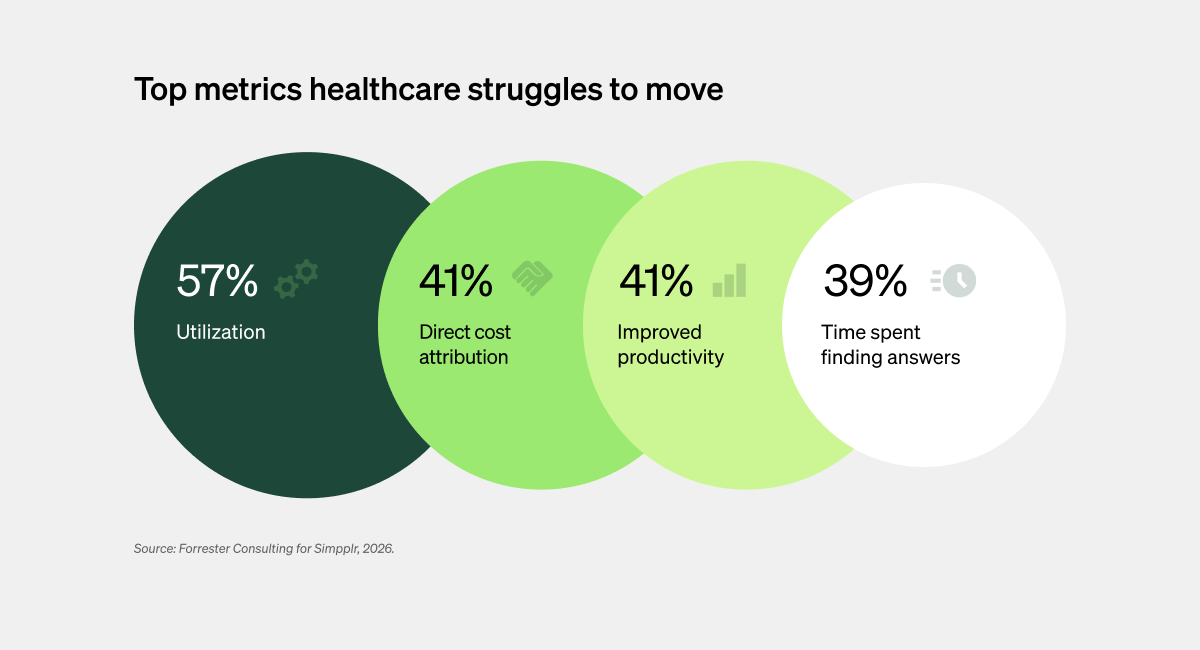
The same measures account for healthcare’s sharpest shortfalls. Utilization is the clearest case: 57% of leaders report difficulty with it, against 40% in financial services, 37% in manufacturing, and 27% in other industries.
Metrics healthcare struggles to move:
- Utilization: 57%
- Direct cost attribution: 41%
- Improved productivity: 41%
- Time spent finding answers: 39%
The shortfall carries particular weight because adoption is how healthcare defines success. It’s the only industry where adoption and usage rates rank among the foremost success criteria, cited by 65% of leaders, where other sectors lead with productivity.
Demonstrating return proves harder still. Sixty-two percent of leaders cannot yet quantify the ROI of their AI-enabled tools, leaving the technology in place but its value unproven.
Compliance and security are the real bottleneck
Healthcare’s barriers look different from the rest of the study. Where most sectors are slowed by fragmented data, healthcare is held back by the demands of trust and compliance.
Regulation is the defining challenge
Regulatory restrictions weigh on 40% of leaders, and 35% place them among their top three barriers, the highest share of any industry and well ahead of financial services and other industries at 24% and manufacturing at 19%. No sector feels the weight of regulation as acutely.
Security is a board-level concern
Nearly half of leaders (48%) point to AI security and access-control risks, and 40% rank them among their leading technical concerns. That tracks the study’s broader finding that security is the most widely shared challenge across every respondent. With 80% calling for stronger security frameworks before they can scale AI safely, the issue reaches the board.
Complexity is not healthcare’s problem
What healthcare doesn’t share is the sense of complexity overwhelming everyone else. IT complexity (47%) and missing organizational context (45% all-industry) weigh far heavier on other sectors than they do here. Healthcare’s bottleneck is trust and compliance, a different problem from the data fragmentation the broader study sets out to solve.
What healthcare leaders want next from AI
Healthcare has already adopted unified platforms faster than any other industry. The open question is what it expects those platforms to deliver going forward. The answer lines up almost exactly with where the sector is still struggling.
Reduced time searching for information
Sixty-two percent of healthcare leaders say AI that dramatically cuts time spent searching for information would most improve employee experience. This is the highest share of any industry and well above the 50% all-industry average.
Fifty-four percent want AI that automates employee services end to end, also above the all-industry rate. Both point back to the same root issue raised earlier — clinicians and staff buried in fragmented knowledge.
Higher employee productivity
Asked about the benefits of a centralized, AI-powered platform, healthcare leaders set a clear order of priority. Productivity tops the list, with information access and employee experience close behind. Revenue lands near the bottom again, consistent with the pattern identified in this piece.
Here’s the full ranking:
- Increased employee productivity: 75%, above the 68% all-industry rate and the top expected benefit
- Easier access to accurate insights and knowledge: 62%
- Improved employee experience: 56%
- Increased revenue: 40%, consistent with the sector’s pattern throughout
The fit is close to exact. What healthcare says it wants from a platform — productivity, findable knowledge, better EX — is the same list of things it’s currently investing in and currently struggling to prove out. A platform that unifies knowledge, guides workflows, and makes information findable addresses the specific gap between healthcare’s adoption, which is high, and its outcomes, which are still catching up.
Six priorities for healthcare leaders
For healthcare leaders, the findings translate into a clear agenda. Six priorities stand out, each aimed at closing a gap the data has exposed.
1. Unify what is already deployed
Information access is one of healthcare’s top two AI drivers, and reducing search time is the single biggest employee-experience win identified. That puts the payoff squarely in trusted, unified knowledge.
2. Build governance for regulatory load
Healthcare carries the heaviest regulatory and security burden of any industry in the study. Governance frameworks should define how AI agents authenticate, access sensitive data, and operate across systems from the outset, before deployment scales further.
3. Close the people gap on purpose
The 21% communities-of-practice rate is the clearest fixable cause of healthcare’s utilization problem. Standing up enablement and literacy programs as core infrastructure would give employees the mechanism they’re currently missing.
4. Turn utilization data into proof of ROI
Healthcare already tracks utilization more closely than any other industry. Pairing that data with workflow analytics and employee feedback is what turns tracking into the proof of return that 62% of leaders say still eludes them.
5. Consolidate platforms before adding new ones
Healthcare has already moved past the ramp-up phase. Only 13% expect deployments to grow more than 20% over the next two years, the lowest of any industry. The next step is unifying what’s already been deployed rather than adding more point tools.
6. Set adoption as the definitive success metric
Healthcare already leads every industry in treating adoption and usage rates as a top success criterion. Making that the explicit north star, rather than one metric among many, keeps the rest of the organization focused on what actually predicts results.
Healthcare’s window to turn its AI lead into results
Healthcare has reached the uncomfortable middle of AI maturity: past experimentation, but not yet at routine dependence. The next measure of progress won’t be how many AI tools are available, but whether those tools become part of how decisions are made, questions are answered, and work moves between teams.
That gives healthcare a chance to set the standard for every other sector. If AI can work here — high stakes, complex workflows, strict regulation, fragmented information — it can work almost anywhere. The organizations that make that shift will have AI that clinicians and staff trust enough to use every day, creating the kind of efficiency and confidence that helps drive revenue forward.
For more research behind this analysis, download AI Highlights the Limits and Potential of the Digital Workplace.
Ready to find out how Simpplr AI can help you improve your employee experience? Request a demo today.
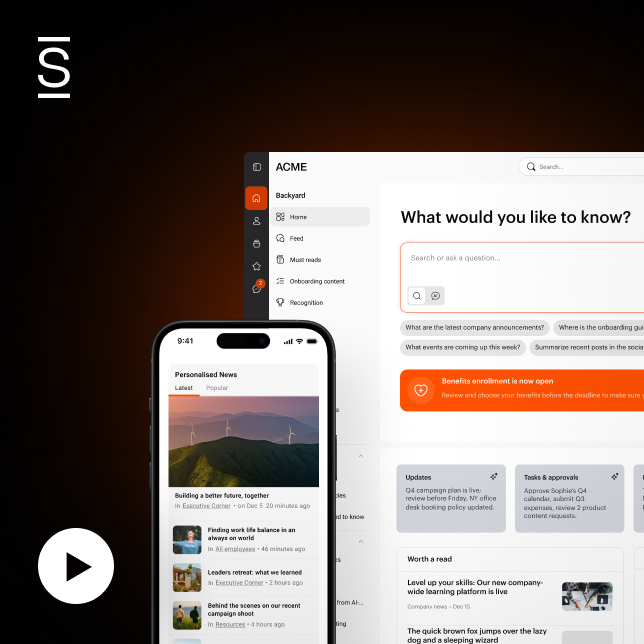
Watch a 5-minute demo
See how the Simpplr employee experience platform connects, engages and empowers your workforce.
- #1 Leader in the Gartner Magic Quadrant™
- 90%+ Employee adoption rate