



Internal communications teams are being pulled into enterprise AI strategy at a scale the org chart doesn’t reflect. They’re shaping rollout plans, building adoption workstreams, and managing the human side of AI implementation — on top of their existing responsibilities.

Why internal communications is becoming the critical function in your AI rollout
Why internal communications is becoming the critical function in your AI rollout
This is a natural fit for a function built on change communication, audience segmentation, and trust. But it’s also an unsustainable one if organizations don’t recognize what they’re asking of IC and resource it accordingly.
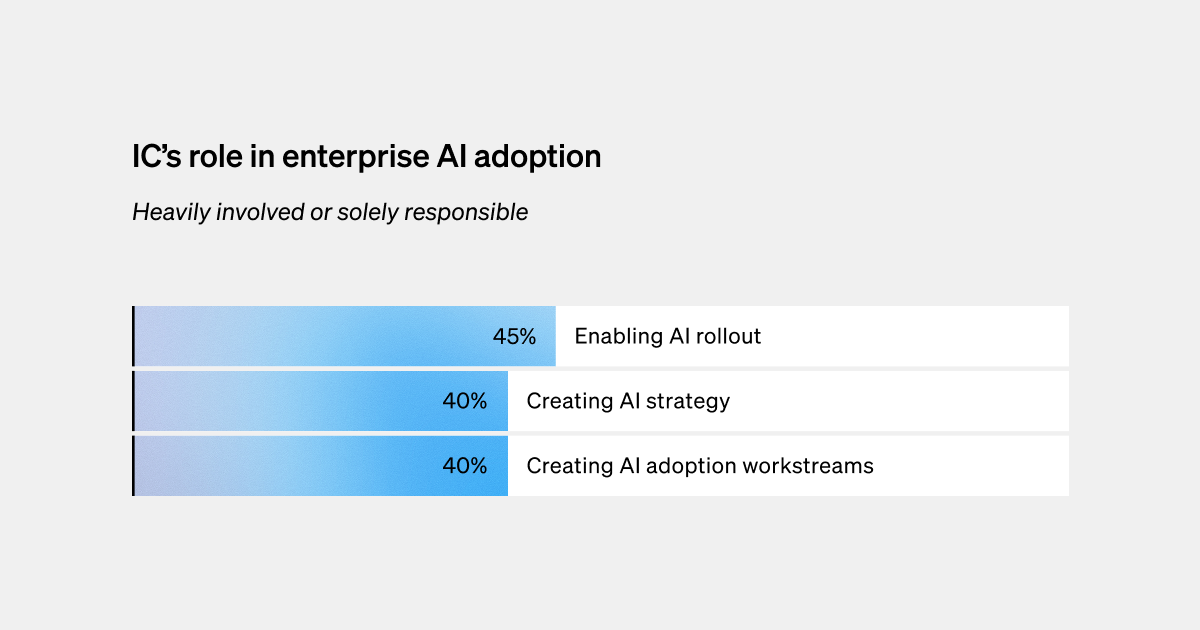
Simpplr’s 2026 State of Internal Communications report puts numbers to this shift. For communicating and supporting AI rollouts, 45% of IC teams are heavily or solely involved, and 40% are heavily or solely responsible for both AI strategy creation and AI adoption.
IC’s position as both AI user and AI enabler is a genuine strategic advantage but only if the authority matches the responsibility. That dual role is what this post explores: what IC leading AI adoption looks like in practice, why IC teams are better positioned for it than most organizations realize, and what needs to change for it to be sustainable rather than a fast track to burnout.
AI adoption is partly a communication problem
It seems obvious that most organizational AI rollouts are planned around technology readiness: getting the infrastructure, tools, integration and security nailed down so adoption rates and ROI are high. All these elements are necessary. They’re not, however, sufficient to ensure a successful rollout.
The failure modes for enterprise AI adoption are often human. Employees don’t understand what the tools do, especially those in nontechnical functions. Or they don’t trust them, so they’re reluctant to use them fully. They may not see the relevance to their daily work because they lack training or experience in using the tools.
Or perhaps they aren’t given enough guidance to meaningfully change their workflows and see the promised gains from using AI. Even if the technology is integrated perfectly into business systems, without proper guidance, employees can’t integrate the tools into their workflows.
These are communication problems. They’re change management problems. They’re audience segmentation problems. They’re exactly the problems IC teams solve every day for every other organizational initiative.
And that’s precisely why IC isn’t, and shouldn’t be, an afterthought in AI adoption. The organizations that treat AI rollout as solely a tech initiative are the ones most likely to see low adoption, confused employees, and wasted investment.
The data shows IC is already in the room
IC is already involved in communicating and supporting AI rollouts in 45% of companies. That involvement isn’t accidental. IC professionals are routine, effective users of AI themselves and broadly optimistic about its potential to benefit their organizations.
IC practitioners are regular AI users:
- More than half (52%) use AI at least weekly
- A majority (53%) report a high or very high impact on their efficiency
- Nearly three-quarters (72%) agree that AI is or will become an important organizational resource
It’s worth noting that the teams most involved in enterprise AI strategy are often using the tools primarily for research and drafting, while more strategic applications haven’t caught up yet. For example, lower on survey respondents’ list was using AI for creating strategic plans (35%) and for help with communications plans (28%). That’s most likely a habits gap rather than a skills gap.
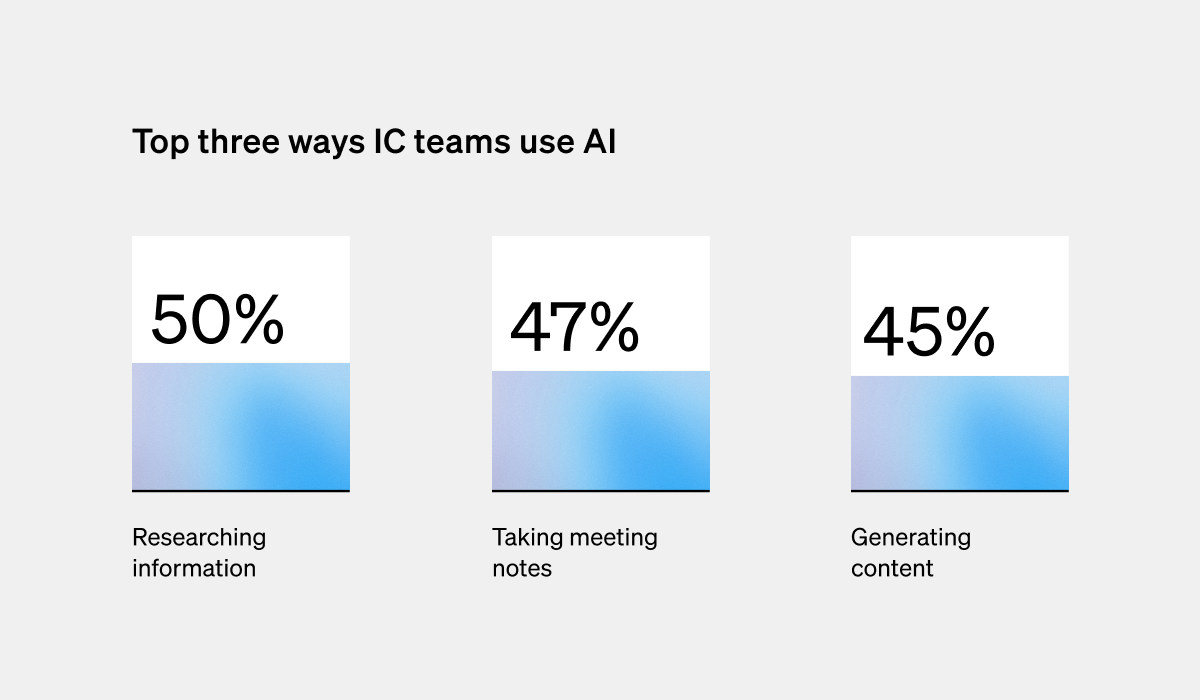
This combination — hands-on familiarity with the tools and deep expertise in the challenges of organizational change — is why IC keeps getting pulled into AI rollouts.
Simpplr survey respondents who rated their IC function highly were significantly more likely to play a role in AI implementation. This suggests that organizations with more mature IC operations are more likely to involve them in strategic initiatives.
But involved doesn’t always mean empowered. There’s a difference between being brought into the room to draw up a comms plan for a finished AI strategy and being a part of designing that strategy from the start. When IC is handed responsibility without the corresponding authority, it creates both execution gaps and increased risk of burnout.
Why IC teams are perfectly positioned for this
IC teams, particularly high-performing ones, already have the skills that map directly to successful AI adoption. What’s often underappreciated is how precisely those skills align with the specific challenges that stall AI rollouts — the day-to-day execution problems that determine whether employees change how they work.
Change communication at scale
IC teams have been rolling out organizational changes for decades: new systems, new policies, restructurings, and M&A integrations, to name just a few. AI adoption is a change initiative in addition to a technical one. The playbook isn’t identical, but the muscles are the same.
What makes AI rollouts different is volume and speed. Organizations often deploy multiple tools across multiple teams simultaneously, which means IC teams need to orchestrate messaging across channels and track whether each audience received and understood the update. That’s hard to do well with disconnected tools.
Audience segmentation and targeting
Effective AI rollout requires different messaging for different audiences. Executives need the strategic case. Managers need enablement tools. Frontline workers need clarity on what changes and what doesn’t.
IC teams already think in audience segments. The 51% of survey respondents who target specific audiences are doing this daily. The constraint is usually operational. When segmentation requires manual list-building or an IT request for every send, the precision IC teams are capable of gets bottlenecked by the tools they’re working with.
Trust and tone calibration
AI adoption triggers anxiety among employees. Only 22% of workers worldwide strongly agree their job is safe from elimination, according to a recent ADP study. IC professionals understand how to communicate change in ways that acknowledge uncertainty without fueling panic.
The same AI writing assistant that excites a marketing team might alarm a legal team worried about compliance and liability. Whether the rollout message leads with “efficiency gains” or “quality safeguards” can determine whether adoption sticks or stalls.
What helps is visibility into how messages are landing — whether a communication reassures people or raises more questions — so teams can adjust before anxiety hardens into resistance.
Two-way feedback infrastructure
The executives in the 2026 State of Internal Communications report see two-way feedback as an area for IC improvement. This is exactly what AI rollouts need — a feedback loop that identifies what’s working, what’s confusing, and where there is resistance.
IC already owns (or should own) those channels. The difference between having a feedback strategy and having feedback infrastructure is whether those signals are captured somewhere leaders can analyze and act on them or whether they are scattered across email threads and ad hoc conversations.
Cultural translation
AI tools don’t land the same way in every part of an organization. A finance team’s relationship to AI automation is different from a creative team’s. IC professionals are well-versed in translating enterprisewide initiatives into language and framing that resonates with specific groups. But doing that at scale, without writing 15 versions of every announcement, is where personalization and platform capabilities start to matter.
So why are most of these critical skills that are so integral to the IC skill set invisible in many AI strategy conversations? They’re coded as comms skills rather than strategic ones.
More than a quarter (27%) of executives still see IC primarily as an administrative or support function. And 26% of practitioner respondents said this perception was one of their greatest frustrations with the work.
That gap means IC teams doing strategic AI work often lack the organizational backing to execute it fully. It adds pressure to a function already facing flat staffing levels and potential burnout. And when the infrastructure doesn’t match the ambition, the manual overhead makes it worse.
The tension that comes with the territory
IC professionals are straddling a fine line these days. They’re enabling AI adoption while simultaneously being told that AI may reduce the need for their roles. That’s an uncomfortable position, and the data reflects that unease. Those closest to AI adoption are the most anxious about their job security because of expanded AI use.
36% of survey respondents cited reliance on AI as a reason for planned headcount reductions in IC, so IC’s AI anxiety comes from a very real place.
Highly-rated IC functions are more likely to use AI and more likely to report AI-related job anxiety, so functional excellence isn’t saving anyone a sleepless night either.
While the anxiety here is rational, it also points to an opportunity. The IC teams that move from using AI for task execution — drafting comms or summarizing documents — to using it for strategic work — campaign planning, adoption strategy, and stakeholder enablement — are the ones most likely to make themselves indispensable rather than replaceable.
If AI is used more for deepening strategic insight or managing risk instead of just accelerating the production of content, there’s a big opportunity for the IC function to thrive as AI use and capabilities grow. But their expanded role isn’t sustainable without structural support and the authority needed to support that strategic position in the organization. Organizations that want IC to drive AI adoption need to give the function adequate resources and authority alongside responsibility.

What this means for IC professionals and their orgs
It’s abundantly clear from the data that IC teams are already doing the critical strategic work that helps AI rollouts succeed. And IC isn’t merely useful here. Organizations are structurally dependent on core IC capabilities to make their AI adoption efforts successful.
The biggest question right now is if those organizations recognize that dependency and give their IC functions the authority and resources in addition to the behind-the-scenes responsibility.
The capabilities this post describes — multichannel orchestration, audience targeting, feedback infrastructure, real-time analytics — aren’t independent features. They’re what it looks like when IC has the infrastructure to operate as the strategic function organizations are increasingly depending on it to be, especially in AI adoption.
Simpplr’s AI-powered employee experience platform brings those capabilities together in one unified environment. This allows IC teams to take on expanded roles like AI enablement without the manual overhead that turns strategic work into unsustainable work.
Want to see how Simpplr can support your IC team’s role in AI adoption? Request a demo today.
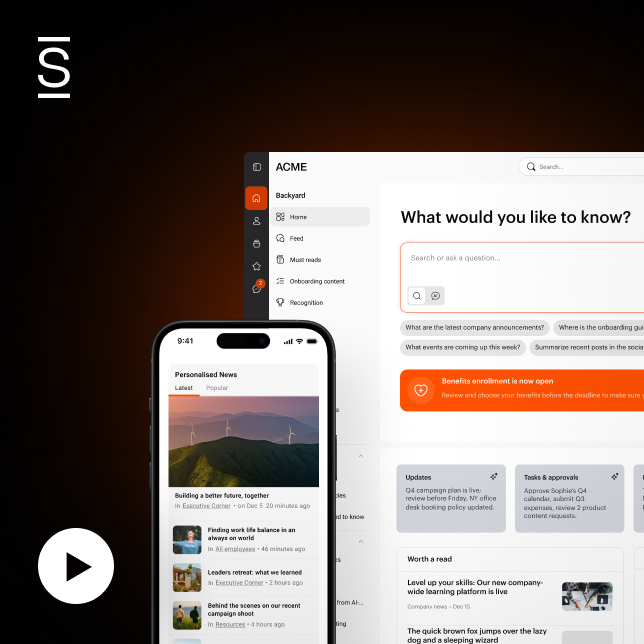
Watch a 5-minute demo
See how the Simpplr employee experience platform connects, engages and empowers your workforce.
- #1 Leader in the Gartner Magic Quadrant™
- 90%+ Employee adoption rate