




The average enterprise runs dozens of digital workplace tools. Employees navigate between them constantly, and so does information. It bounces across platforms, loses context, and reaches some people while missing others. The cumulative cost of that fragmentation rarely shows up in a single metric. But it shows up everywhere else.

The hidden productivity cost of a fragmented digital workplace
The hidden productivity cost of a fragmented digital workplace
Fragmentation is the default state of most digital workplaces — not because organizations made bad decisions but because they made a lot of separate good ones. A collaboration tool here, an HR portal there, a communications platform layered on top. Each solved a problem. Together, they created new ones: harder to find information, harder to reach the full workforce, harder to know whether any of it is working.
A modern intranet doesn’t just add another layer to that stack. When it’s purpose-built and properly implemented, it functions as a unifying experience — reducing the friction employees absorb every day and giving communications and IT teams the visibility they’ve been missing.
That’s how fragmentation stops being a productivity problem no one can name and starts being one organizations can start to solve.

Why fragmentation is a drag on productivity
Many digital workplace problems get diagnosed as communication problems — the wrong message, the wrong channel, the wrong timing. But often the underlying issue is structural. When employees rely on disconnected tools, completing even routine tasks requires navigating multiple systems.
Context switching is the invisible workflow tax
A manager reads a policy update on the intranet, checks a chat tool for related discussion, opens a document management system for the actual policy, then visits an HR portal to submit the relevant form. No single step is broken. The workflow is. That kind of context switching is invisible in any one system’s analytics, but it’s happening constantly, across every role and department.
Information uncertainty slows every decision
Employees waste time validating whether what they found is current. Is this the latest version of the document? Did that policy change after the announcement? Which form is still active? Those questions slow decisions — not dramatically, but consistently — and the cost compounds at scale.
47% of digital workers report struggling to find the information they need to do their jobs effectively (Gartner).
Communication blind spots undermine reach
When messages go out through multiple channels with no unified view of reach or engagement, teams can’t confirm whether the workforce actually received critical information. They can see open rates. They can see page views. What they can’t see is whether the right people got the right message at the right time — or what happened when they didn’t.
Search failure erodes trust in the whole system
When content lives across disconnected systems — the intranet, SharePoint, an HRIS, a shared drive — each maintains its own index. An intranet search returns only what the intranet knows about. Employees who don’t know where a document lives have to guess which system to search first. When they guess wrong, they may find an outdated version or nothing at all.
Over time, most stop trusting search entirely and default to asking a colleague, submitting a ticket, or re-creating documents. For large organizations, this becomes a daily tax on every person in the workforce.
Together these patterns add up to something that never shows up in a productivity report but shows up everywhere in how work gets done.
What fragmentation costs and why it’s hard to see
Fragmentation is easy to rationalize when each tool is evaluated in isolation. The collaboration suite has good adoption numbers. The HR portal gets traffic during open enrollment. The intranet has decent page views.
But those metrics measure individual platforms, not the experience of moving between them — and that’s where the cost accumulates.
Decisions get made without full context
Fragmented environments don’t just slow information retrieval — they distort it. A conversation about a project happens in a chat tool. The relevant document lives in SharePoint. The decision gets made in a meeting, and the outcome lands in an email. No single system holds the full picture, which means employees routinely act on partial information.
For managers and leaders, this is the default condition. Decisions take longer, require more follow-up, and carry more risk than they should.
Content becomes irrelevant and untrustworthy
When knowledge is distributed across multiple systems, ownership becomes unclear. Teams update one version of a document while older copies remain accessible elsewhere. There’s no governance mechanism that spans the full stack, so outdated content accumulates alongside current content — and employees have no reliable way to tell the difference.
Over time, the system loses credibility. Employees work around it rather than through it. Institutional knowledge migrates to informal channels where it’s even harder to find and impossible to measure.
Impact you can’t see or measure
When analytics are siloed across platforms, IC and IT teams can only report on what happened inside each tool. The fuller picture — whether the right people got the right information, whether it was current, whether it changed how they worked — stays out of reach. Organizations with modern intranets rate their internal communications as excellent at more than twice the rate of those without — 30% versus 13%. The measurement gap is a significant part of why that divide exists. When you can’t measure reach, relevance, or impact, improvement is mostly guesswork.

When an intranet becomes the experience layer
The goal of a modern intranet isn’t to replace every tool in the stack. Most organizations will continue running a content management system, an HRIS, communications tools, and other business systems. The question is whether employees experience them as a coherent whole or as another set of places to check.
Search that works across systems
Search failure doesn’t start with bad technology — it starts with fragmented indexes. A modern intranet addresses this with permission-aware enterprise search that spans connected systems. Intelligent search returns results from across the digital workplace without exposing content employees shouldn’t see.
Personalization prioritizes that further, ordering what’s relevant by role, location, and behavior. Employees stop guessing which system to search and start trusting that search works.
Governance that keeps content trustworthy
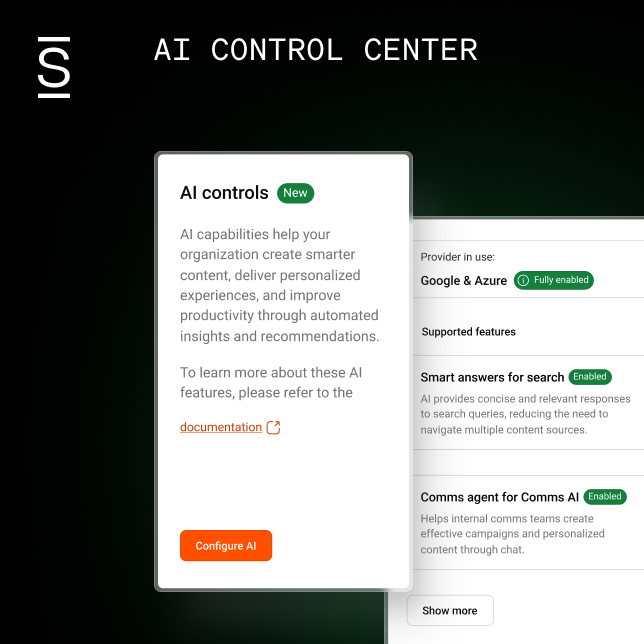
When content ownership or content authority is unclear, outdated material accumulates faster than anyone can manage it manually. A modern intranet addresses this by making governance a built-in function rather than an afterthought — automating review schedules and flagging stale content before it erodes trust. The result is a system employees can rely on rather than work around.
Analytics that close the loop
Fragmented tools produce fragmented signals. IC teams end up with email open rates in one dashboard, intranet page views in another, and no way to connect either to actual behavior or outcomes.
A modern intranet consolidates those signals — content engagement, reach, sentiment, adoption patterns — into a view that reflects the actual employee experience rather than the performance of individual tools. For the first time, teams can see not just what went out but also what landed.
Integrations that unify the tech stack
A modern intranet earns its place in the stack by making the rest of it more usable through integrations. That means pulling relevant content from connected systems into a single experience, pushing communications to employees wherever they’re working, and reducing the context-switching between business systems that makes fragmented environments so costly.
For organizations running SharePoint as a system of record, for example, the intranet functions as the experience layer on top — improving findability and reach without requiring a rip-and-replace.
How to evaluate platforms for productivity impact
Reducing fragmentation is the right goal, but not all intranets get there the same way. Platforms that look similar on a feature sheet can differ significantly in how deeply they integrate with your existing stack, how much visibility they give IC and IT teams, and whether they’re designed to sustain adoption over time.
The evaluation questions worth asking go beyond capabilities. They focus on whether a platform is architected to function as a genuine experience layer.
When evaluating platforms, these are the conditions worth testing for:
- Permission-aware search across connected systems: Can employees find content from SharePoint, your HRIS, and other tools in a single query without finding what they shouldn’t see?
- Role-based personalization: Does the platform prioritize relevant content automatically, or does relevance depend on employees knowing where to look?
- Unified analytics: Can IC and IT teams see content reach, engagement, and adoption in one place, or are those signals still split across dashboards?
- Governance by design: Does the platform make it easy to assign content ownership, set review schedules, and maintain accuracy at scale without heavy IT involvement?
- Integration depth: Does it connect to the tools your organization already has, or does it require workarounds to function as an experience layer?
- Adoption support: Does the vendor have a track record of sustained adoption, not just successful launches?
Most vendors will have an answer to every question on this list. The evaluation is in how specific those answers are, and whether they hold up when you push back.
How Simpplr closes the productivity gap
Fragmentation rarely shows up as a line item in a productivity report. It shows up as slower decisions, duplicated effort, and employees who’ve learned to work around the tools meant to support them. Fixing that isn’t a matter of adding better software to a fragmented stack. It requires a platform designed from the start to function as the experience layer those systems are missing.
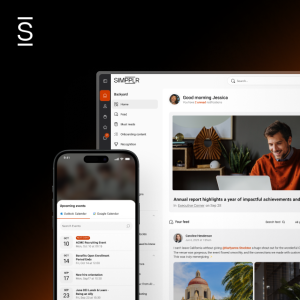
That’s the architectural problem Simpplr is built to solve. Simpplr’s AI intranet is the experience layer that makes the rest of the stack more coherent and the workforce more reachable.
Choosing the right platform requires more than a feature comparison. Simpplr’s 2026 Intranet Buyer’s Guide walks software selection committees through the full evaluation process — from capability scoring to vendor questions — so you can make the call with confidence.
Ready to see how Simpplr improves productivity and employee experience? Request a demo today.
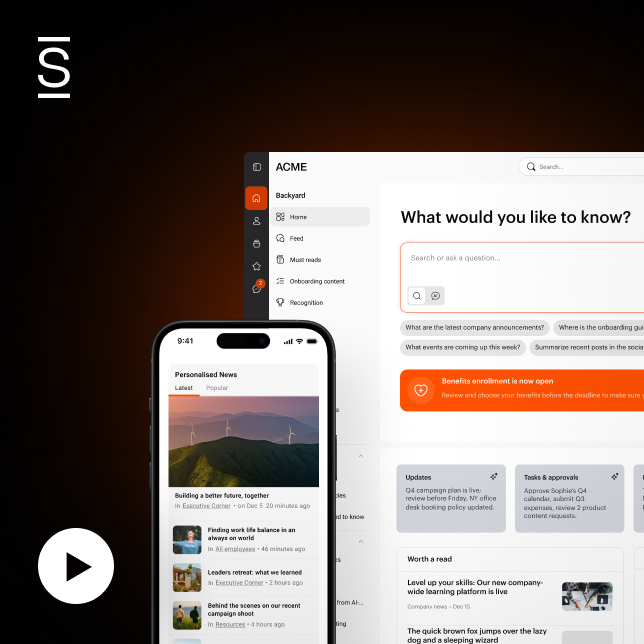
Watch a 5-minute demo
See how the Simpplr employee experience platform connects, engages and empowers your workforce.
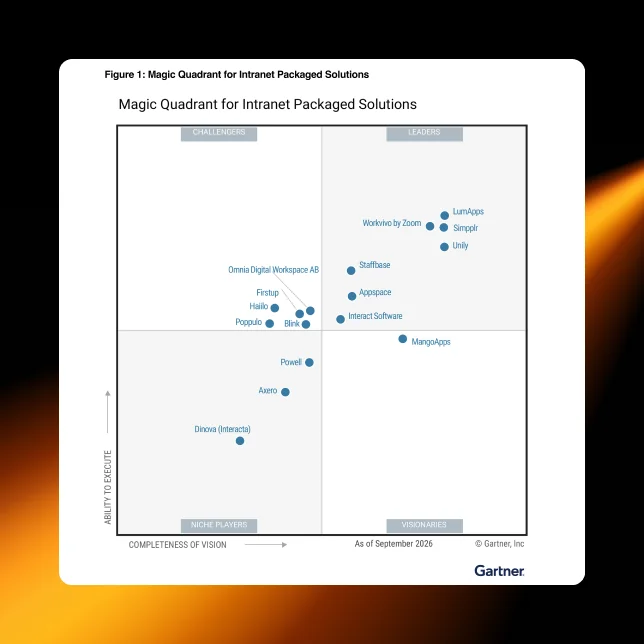
- #1 Leader in the Gartner Magic Quadrant™
- 90%+ Employee adoption rate