




A developer with the right AI tools can now build in days what used to take a quarter. So a lot of CIOs are asking a fair question: Why buy an enterprise platform when my team can spin something up in a sprint? The answer depends on what you think you’re replacing.
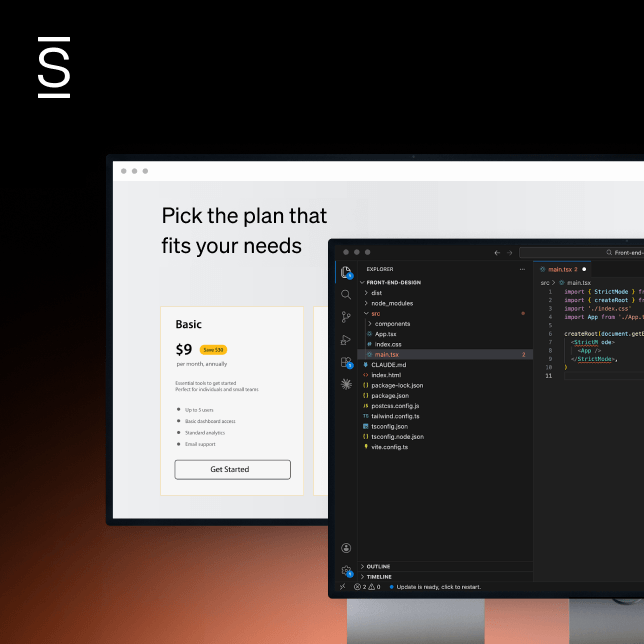
AI changes what you can build, but not what you should buy
AI changes what you can build, but not what you should buy
For most of the past 20 years, the default answer for IT leaders was to buy — first as on-premise licenses, then as SaaS subscriptions. Off-the-shelf software meant accepting a product that fit imperfectly, but the cost of building something custom was prohibitive enough that the compromise made sense. AI-assisted development has genuinely broken that math. Build timelines have compressed from quarters to weeks, and people who couldn’t write software six months ago are now shipping working applications.
But the shift isn’t uniform, and that’s where a lot of the current panic goes wrong. For simple applications and highly bespoke internal workflows, building in-house is often now the better call. For mission-critical platforms — the ones built on years of accumulated domain expertise — the calculus has moved far less than the headlines suggest.
That’s the distinction this piece is about. AI has lowered the cost of building software, but it has not lowered the cost of expertise or testing. Successful software was never just the code.

Where the build vs. buy line has moved
AI coding agents have shifted the build vs. buy calculus more in two years than anything in the previous two decades. But easier initial builds don’t make building the new default. The shift is concentrated in specific categories, and knowing which ones is the whole game.
Gartner projects $234 billion in enterprise application spend will be exposed to agentic AI through 2030. But at the same time, the analyst firm describes what’s coming as “less an apocalypse and more of a metamorphosis.” SaaS isn’t dying. It’s re-sorting.
Where in-house builds now make sense
The clearest case is unique internal workflows. A CIO used to buy a standardized product knowing it would fit some of the company’s work poorly because a custom build was too expensive to justify. That compromise no longer holds, and teams are increasingly building their own solutions for exactly these gaps.
Other categories now ripe for in-house builds:
- Department-specific apps that were never available off the shelf
- Simple portals and team dashboards with little underlying complexity
- Short-lived solutions where a procurement cycle costs more than the tool is worth
Where buying is still the right call
Mission-critical platforms are the first category, including ERP, accounting, inventory management, and tax systems. These are complex, deterministic, expensive to maintain, and tested at enterprise scale. Because the business depends on them functioning every day, replacing them carries risk that no build-cost savings offset.
The second category is where buy wins for a less obvious reason: products whose value is deep, specialized domain knowledge. That expertise takes years to accumulate and can’t be generated on demand. Many of these platforms also carry complex integrations with other systems, partners, and vendors — connections involving sensitive data, refined over years of detailed operational knowledge.
You’re not buying a codebase
This is the distinction that should reframe the whole question. When you buy an enterprise platform, the code is the least of what you’re paying for. You’re buying years of expertly targeted development, user testing, customer feedback, enterprise-grade evaluations, security compliance architecture, and operational knowledge. AI can re-create parts of the code, but it can’t generate any of the rest.
Can a team vibe code a news feed or an employee profile page? Sure. Can they re-create years of personalization research, governance workflows, accessibility compliance, and integration depth? Most likely not because that’s a very different project, but it’s the project you’re signing up for when you build.
Vibe coding accelerates governance gaps
Computer scientist Andrej Karpathy first introduced vibe coding — using AI tools and natural-language prompts to generate working software. The term implied weekend projects where you “give in to the vibes” and don’t much care whether the code is elegant. That origin matters because the practice has migrated somewhere it was never designed for. Tools built for throwaway prototypes are now producing applications that run in production, touch corporate data, and serve real business processes.
The problems that follow aren’t new. They’re the same failure patterns that sink formal enterprise software initiatives. Vibe coding just removes the organizational guardrails that used to uncover them early.
The gaps that were already there include:
- Data quality: A vibe-coded app inherits whatever data mess already exists. AI generates the interface, but it doesn’t clean up master data or assign ownership.
- Organizational maturity: A tool built by one person in one department hits a wall the moment other stakeholders need it to work differently. Good software is designed for an organization, not a workflow.
- Use-case drift: A project starts as “build us an employee recognition app” and ends as a platform evaluation with no clear owner and no outcome criteria.
These patterns predate AI entirely. They show up in $2 million enterprise initiatives with professional engineering teams. The difference is that formal processes force the problems into the open before the money is gone. Vibe coding doesn’t.
The visibility problem is measurable
Tech leaders can see this happening, and the numbers say they can’t see enough of it. The security exposure is no longer hypothetical either.
Among CTOs, CIOs, and CISOs, 93% are concerned about vibe-coded tools running in production, and only 5% are very confident they have full visibility into what’s really running within their own environments.
An analysis of 5,000 vibe-coded web applications found that 40% exposed sensitive corporate or personal data on the open web (Wired).
Costs spiral before anyone sees them
Ungoverned usage has a budget signature, and it’s showing up at companies with far more engineering discipline than a typical vibe-coding shop. Two examples from this year made the point at scale.
Meta burned through 60.2 trillion tokens in 30 days — an estimated $100 million-plus — after internal leaderboards turned AI usage into a competition. Uber’s CTO burned through the company’s full-year AI budget in under four months.
Both companies eventually killed their leaderboards. But this isn’t a problem you can wait out. SaaS vendors themselves are moving to usage-based pricing, such as GitHub shifting to token-based charging in June. Per-seat costs were easy to forecast. Token burn is not, and ungoverned building multiplies it.
The budget consequence is the part that stings. By the time a vibe-coded initiative visibly fails, the AI budget is often spent, and a packaged solution is off the table until the next cycle.
The appeal is obvious. A business analyst who couldn’t build software six months ago suddenly can. The problem is that software isn’t the code. The code is the easy part. The governance gaps that sink a $2 million enterprise AI initiative will sink a vibe-coded app too — just faster, with less visibility, and usually after the money is already gone.
Employee experience tests the codebase argument
Employee experience (EX) platforms are a clean test case for the build vs. buy line because the category looks deceptively buildable. The surfaces are simple — feeds, profiles, search — and that’s exactly what makes the build path tempting. But EX is a category where the product is the accumulated expertise, while the code is just how it’s delivered.
What a team could reasonably build
Be honest about this part first because pretending otherwise costs credibility. An IT team with AI tools could absolutely vibe code a news feed, employee profiles, standardized recognition posts, or a basic search bar. Those are the visible surfaces of an intranet, and they’re genuinely not hard anymore. What they can’t build is everything underneath those surfaces.
These are layers a build can’t replicate:
- Personalization: Models trained and tuned on years of customer data and usage patterns, and the same goes for predictive analytics.
- Governance workflows: Compliance requirements vary by industry and company, take years to encode well, and shift every time regulations change.
- Content lifecycle management: Someone has to continuously review content for accuracy and expiration, control access, enforce security, and maintain audit trails and version control.
- Integration depth: Bespoke connections into HR systems and ERPs demand precise engineering and strong security.
These layers were honed across thousands of customer deployments over years. That’s the part of the product a coding sprint can’t produce.
Why the rebuild argument breaks here
The strongest counterargument comes from Block, where engineering leadership has suggested cheap rebuilds change the maintenance question entirely. If a tool starts misbehaving, just regenerate it tomorrow. For a single-user utility, that logic holds.
It breaks for anything organizational. You can rebuild code in a day. You can’t rebuild adoption, migrated content, trained users, permission structures, and integration contracts in a day, and an EX platform is mostly those things. The rebuild argument assumes the software has no accumulated state. Enterprise platforms are nothing but accumulated state.
Studies consistently find maintenance — not initial development — dominates software lifecycle cost. And that’s before counting security reviews, stakeholder management, and the engineering time diverted from things that differentiate your business.
I hear a version of the same story from IT prospects who took the build route. The tool their team built worked. Everything around it didn’t — governance, adoption, content management, integrations. That’s the part nobody budgeted for.
The real question for IT leaders was never whether your team can build something that looks like an intranet. It’s whether you want to own one indefinitely and everything that ownership costs.
How to compound AI investment
The pattern across everything above points to a simple allocation principle: AI creates the most value as a layer on top of proven infrastructure, not as a replacement for it. Agents that help people navigate and act across existing systems compound value.
Ripping out essential infrastructure to replace it with a generated alternative creates new maintenance debt with the same governance gaps that sink ungoverned builds, now load-bearing. That distinction sounds abstract until you look at where embedded AI is delivering.
Where embedded AI agents earn their keep:
- Workflow optimization: Agents connect disparate systems and break down data silos without anyone replatforming.
- Enterprise search: Employees find what they need regardless of which system it lives in.
- Orchestration: Common operations surface in a single interface, cutting the system sprawl employees otherwise navigate by hand.
What these have in common is that each one touches daily employee behavior. That’s the tell.
AI that changes daily work compounds fastest
AI investment pays back fastest when it helps employees do their actual daily tasks better, not when it runs parallel to existing workflows as a separate destination. Often there’s nothing fundamentally wrong with the existing software. It’s just unwieldy or full of bottlenecks that people route around.
This points to where your team’s AI capability is genuinely most valuable — not re-creating a platform someone else spent a decade building, but building on top of one to complement it. That includes the org-specific workflows, approval chains, and connections into your own systems that make a platform work for your particular organization. No vendor can prebuild that layer because it’s yours by definition, and it’s exactly the kind of building AI has made cheap.

Expertise is what makes AI work at scale
Simpplr’s AI capabilities sit on top of a foundation that already solves the hard problems this piece has been describing — governance, permissions, personalization, integrations, and content lifecycle management. That foundation is what makes the AI trustworthy at scale.
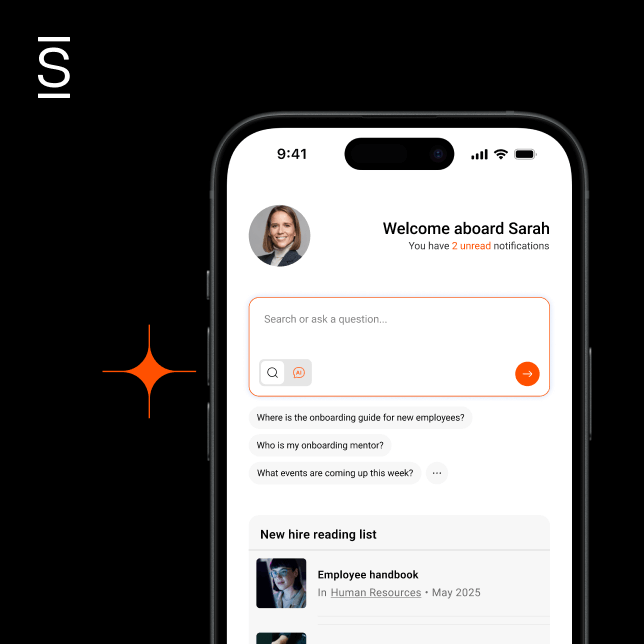
When an employee asks a question, they get answers grounded in verified company content they’re permissioned to see. Workflows connect HR, IT, and business systems that would otherwise take custom builds to integrate. Years of usage data power the personalization and analytics a build from scratch simply has no data to train on.
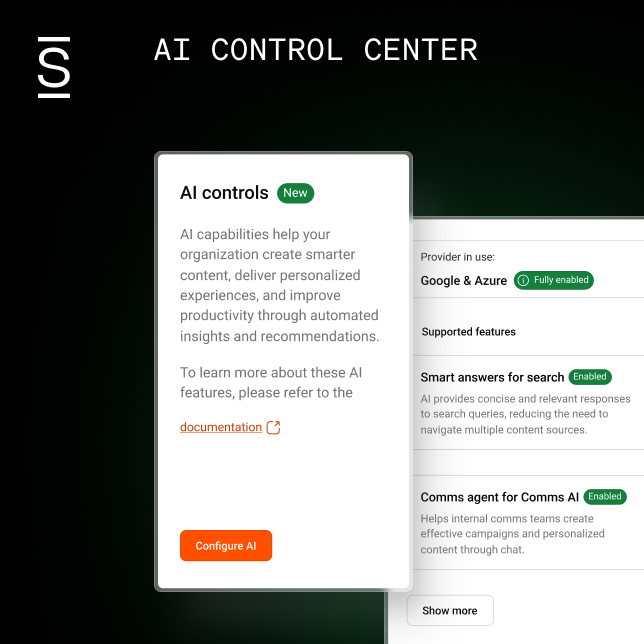
The governance argument runs all the way down. Simpplr’s AI Control Center gives IT one console to govern every AI feature and provider on the platform. Admins can enable or disable individual capabilities, choose validated LLM providers, or route through corporate accounts, with every change captured in an audit log. That’s the opposite of the vibe-coded pattern. It’s AI you can see, control, and account for.
Organizations that build their own EX platform aren’t just writing code. They’re taking on years of accumulated customer learning, compliance architecture, and domain expertise as a side project. The strongest AI outcomes come from combining new capabilities with proven expertise and knowing where AI creates leverage and where experience still matters most.
Ready to find out how Simpplr AI can help you improve your employee experience? Request a demo today.
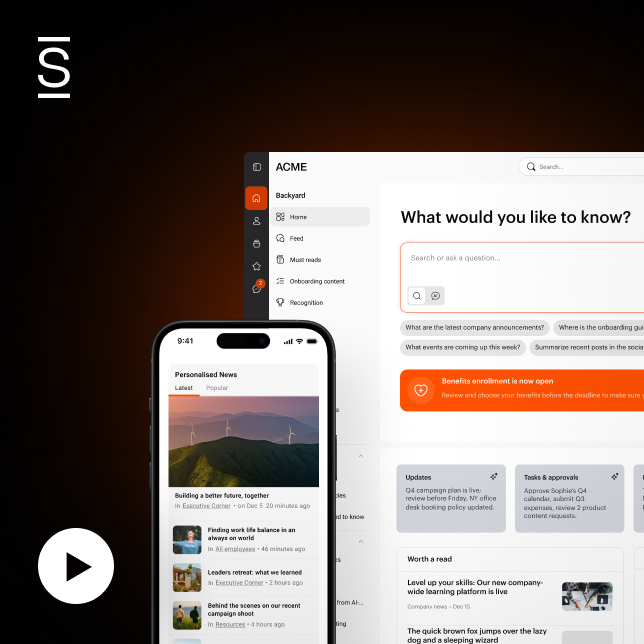
Watch a 5-minute demo
See how the Simpplr employee experience platform connects, engages and empowers your workforce.
- #1 Leader in the Gartner Magic Quadrant™
- 90%+ Employee adoption rate