




Internal communicators don’t need more tools. We need fewer handoffs, less chaos, and more space to do the work that requires our superpowers of context, clarity, and judgment.
Introducing Comms AI: your new favorite and most helpful teammate
Introducing Comms AI: your new favorite and most helpful teammate
IC pros know what it feels like to manage chaos on a daily basis. Three comms campaigns running at once. A leadership transition announcement. A hybrid work policy update. The quarterly town hall prep.
Each piece lives in a different spreadsheet. Drafts are scattered across docs. Approvals? Somewhere in your inbox between the urgent Slack pings and the calendar invite for yet another alignment meeting.
By noon, you’ve spent four hours on logistics and haven’t written a single sentence that will land with employees. You’ve been so buried in admin tasks that you haven’t dug into the context so that you can weave it into every interaction, communication, and plan.
Sound familiar?
What if the help we need isn’t just another AI tool that drafts content faster? What if it’s something that takes the coordination work off our plate so we can focus on the part of the job that requires our judgment?
That’s what we built with Comms AI.
I’ve spent my career doing comms inside fast-moving companies during leadership changes, policy shifts, and moments where trust was fragile. The hardest part was never the writing. It was the coordination around it.
I watched smart, thoughtful communicators burn time managing spreadsheets, chasing approvals, and reconciling feedback across tools. All while trying to be present for employees and make the right calls in complex moments.
That’s the problem we set out to solve with Comms AI. Not by replacing communicators but by protecting their judgment and giving them their time back.
The problem isn’t writing — it’s everything else
The bottleneck in modern internal communications isn’t creativity. It’s coordination.
Every campaign requires someone to build the timeline and assign owners. Track deliverables across teams. Route approvals and monitor feedback. Reconcile conflicting edits across versions. Coordinate delivery across channels.
And every handoff loses context.
Planning lives in spreadsheets. Drafting happens in docs. Approvals get chased through email threads. Publishing is split across the intranet, email, Slack, or Teams — with no clear view of what’s planned, what’s in progress, or what’s already live.
This fragmentation can’t be solved by working harder. Or by adding another point solution to an already fragmented stack. The problem is structural.
What internal communications needs isn’t another tool. It’s an operating model designed for how this work actually happens.
What Comms AI is
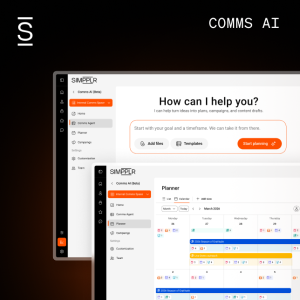
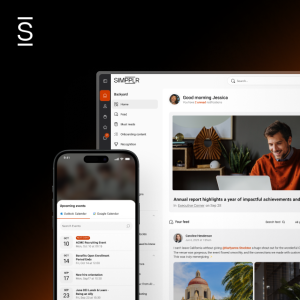
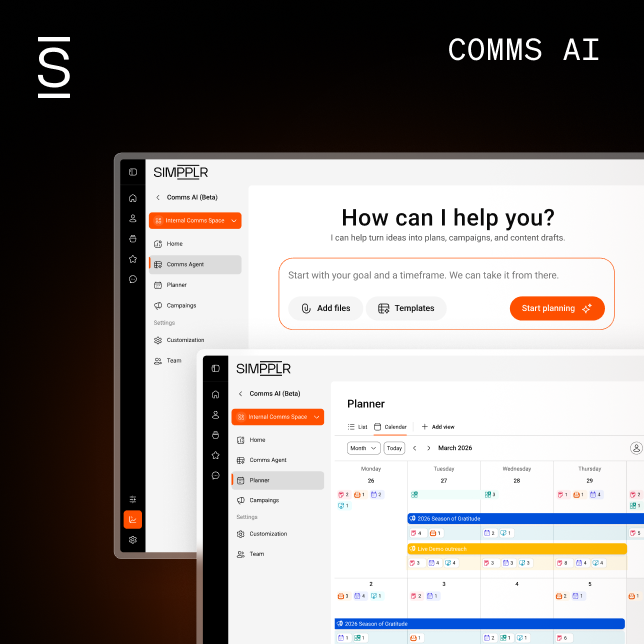
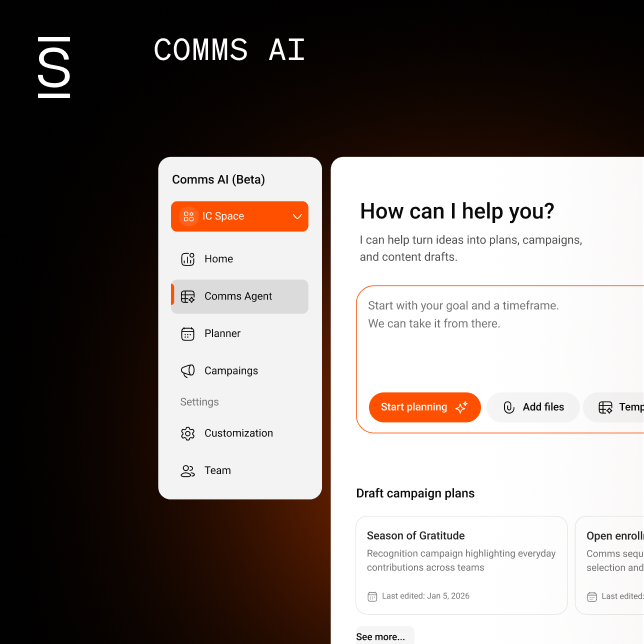
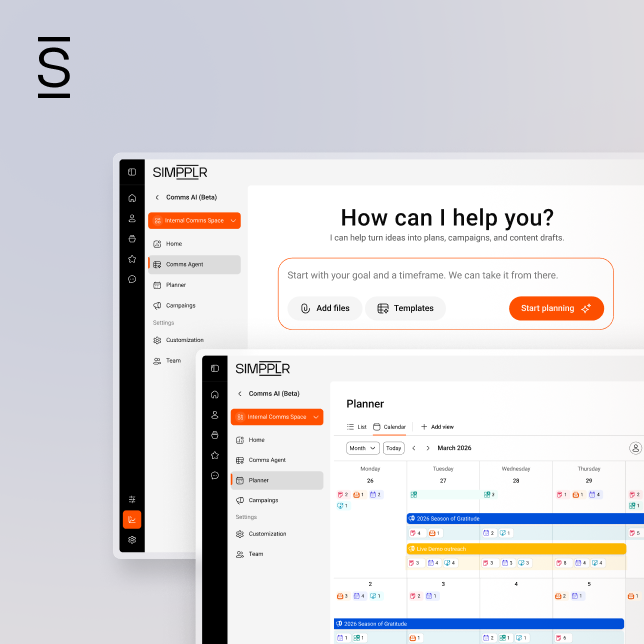
Comms AI is a workspace for internal communications built into the Simpplr platform. Not another place to draft content — a place where campaigns get planned, crafted, approved, and delivered without scattering work across tools.
Most AI tools help us work faster on individual tasks. Write the email. Draft the post. Generate the FAQ. And then we’re back to manually routing everything through approvals. Tracking feedback across platforms. Reformatting for different channels. Coordinating delivery ourselves.
Comms AI handles the coordination layer — the part of work that bogs everything down.
This is what makes Comms AI different: Intelligence isn’t bolted onto one task. It’s built into the full workflow — planning, creating, coordinating, and publishing. So context carries all the way through. AI is embedded in the workflow. Helping structure campaigns. Drafting content that matches a sender’s voice. Keeping approvals moving. Coordinating delivery across channels.
Context stays connected because it all happens in one place instead of getting lost in handoffs between tools.
And because Comms AI lives inside Simpplr, we’re not adding another platform to manage. We’re enhancing what’s already there — where content lives and where employees already go for information.
One thing Comms AI will never do is make decisions for you. Judgment remains with humans. Accountability stays with communicators. Your built-in comms agent handles structure, scale, and coordination. This lets comms people (and our friends like office managers, chiefs of staff, divisional comms people) focus on nuance, trust, timing, and context.
How Comms AI works
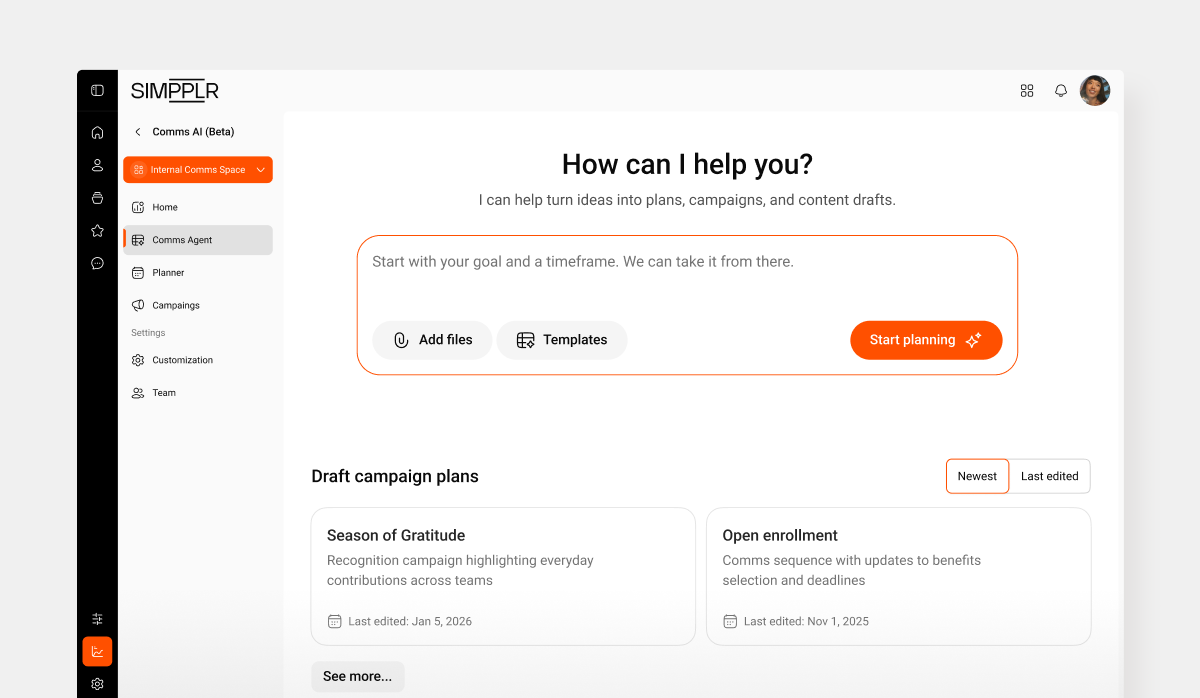
At its core, Comms AI combines two things: structure that keeps work aligned and intelligence that reduces manual effort without taking away human judgment.
Comms AI is purpose-built for IC workflows grounded in decades of experience and best practices.
Here’s how Comms AI helps plan campaigns that span channels, craft messages that need the right tone, gather feedback and herd sign-offs, and publish where employees will actually read what we send.
Plan: Structure without the spreadsheet
Someone from leadership emails: “We need to communicate the new remote work guidelines. Can you handle this?”
In most setups, we’re opening a blank spreadsheet. Mentally mapping audiences. Trying to remember who needs to review what and timing for when everything needs to go out.
With Comms AI, we describe what we’re trying to accomplish. We drop in the email thread and meeting notes or choose from an existing template. The workspace helps build the campaign structure: which employee segments need messaging, what channels make sense, what a realistic timeline looks like.
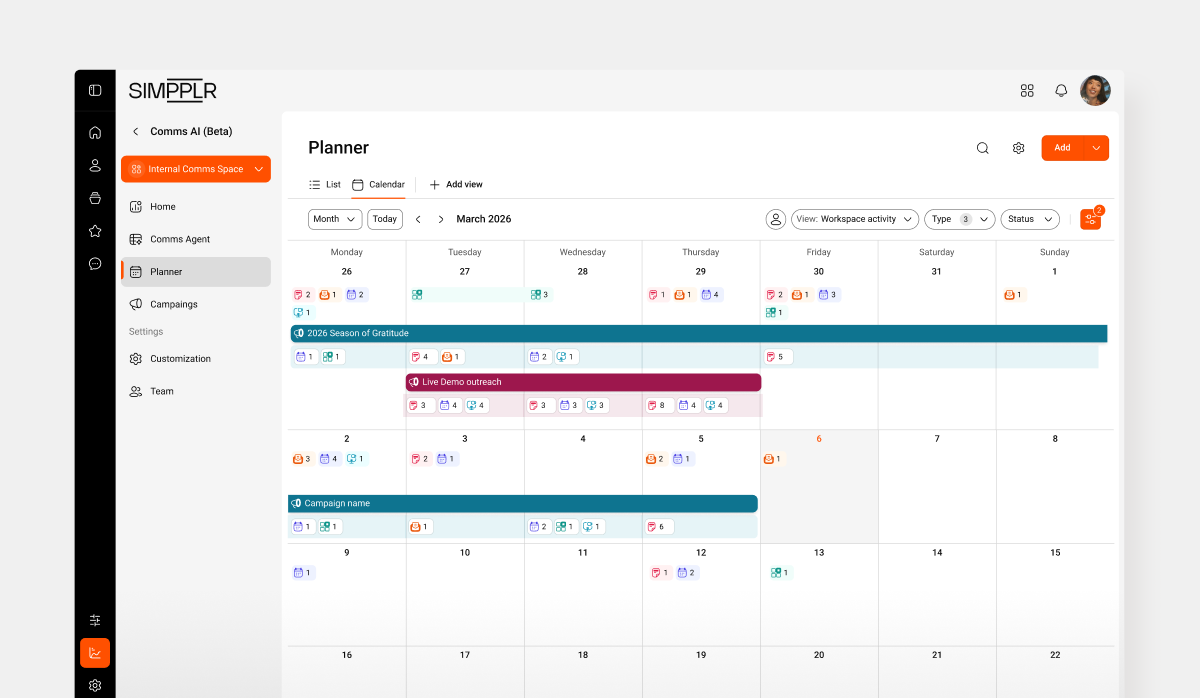
Everything becomes visible in one place. You can see this new campaign alongside the two already scheduled for next week. You spot the conflicts early, like HR planning a benefits reminder on the same day. You adjust now, before employees complain about message overload later.
Fewer surprises. Better timing.
Create: Content that fits the context
Now we need drafts. Email to managers. Intranet article with full policy details. Slack reminder for remote employees. Digital signage language for the frontline crew.
Comms AI understands this is a policy communication from HR leadership, not a celebratory culture moment. It knows the difference between what works in a 1,200-word intranet article versus a 200-character Slack post.
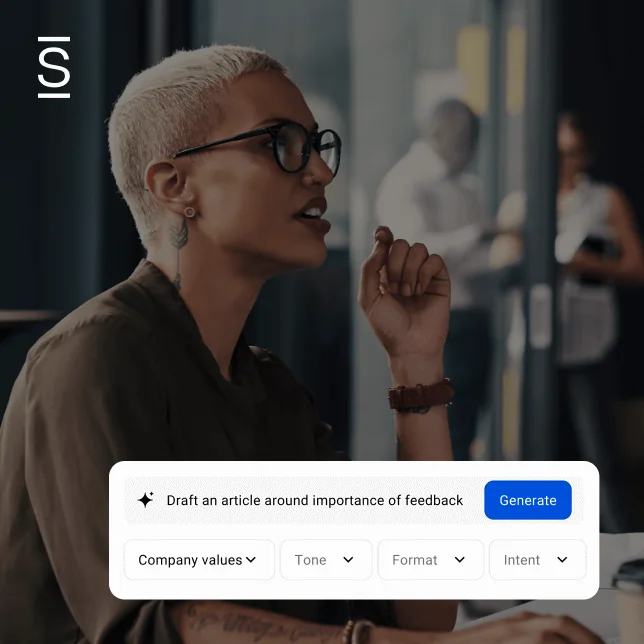
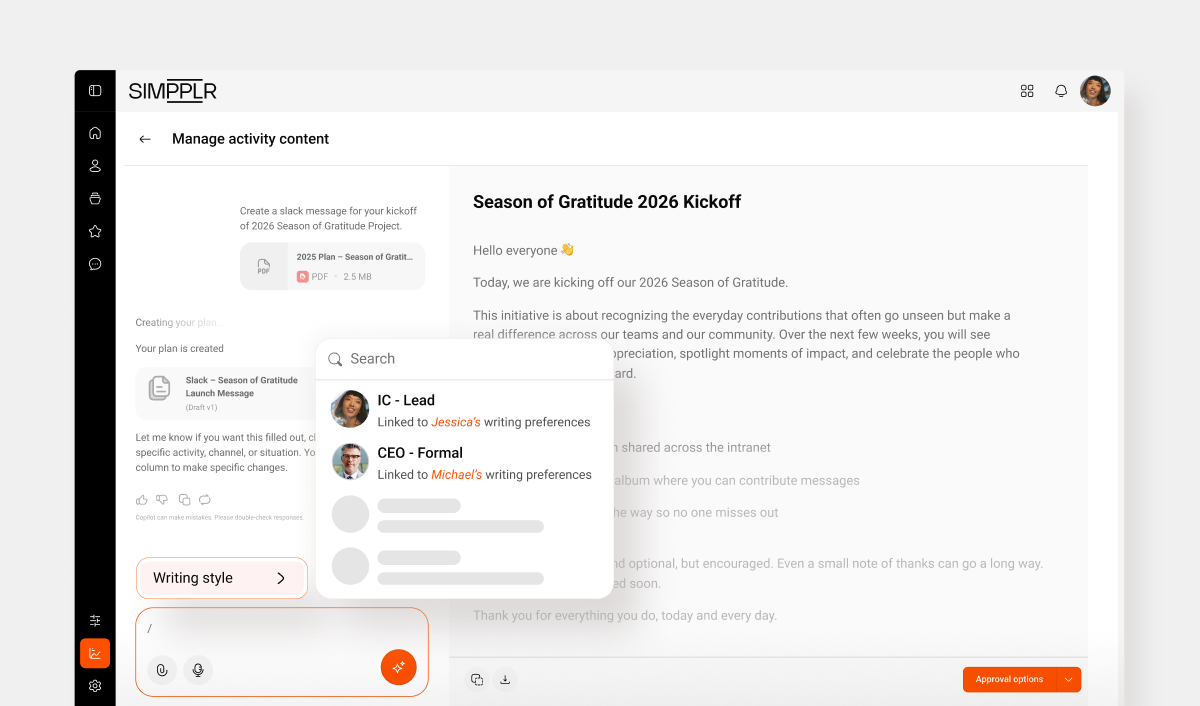
We can create personalized writing profiles for different senders. Comms AI knows tone and voice matter. With the right guidance, Comms AI recognizes which executive prefers a formal tone and which likes to be clever.
We’re not feeding separate prompts into ChatGPT for each piece, then copying everything back into different tools. The workspace knows the full campaign context so you aren’t starting from zero every time.
We’re still making the calls that matter. Does this framing respect what employees already know? Does the tone acknowledge tension or gloss over it? Should this be direct or softer? The AI handles structure and consistency. We bring judgment about what this specific moment requires.
Coordinate: Approvals that don’t vanish into email
The CHRO wants changes. Legal needs to verify policy language. The CEO wants the final review. In the old workflow, that’s three separate email threads. Conflicting versions. Playing detective trying to figure out which edits are current.
Comms AI lets us track feedback without inbox archaeology.
Campaigns that need multiple reviewers can work in parallel instead of serial handoffs. Everyone sees the same version. Feedback gets captured in one place.
The workspace shows what’s waiting on feedback, what’s approved, what’s ready to schedule.
The chaos is finally contained.
Publish: One setup for every channel
Everything’s approved. Now we need to format the intranet article, schedule the email, post the Slack message in three different channels, update Teams, and somehow make sure it all goes live in the right order.
Or we schedule it once in Comms AI.
The intranet post publishes with proper formatting. The email sends to the right segments. Slack or Teams messages go out timed appropriately for each platform. We set it up correctly once instead of re-creating the same content across four different tools.
No more copying and pasting between platforms. No more reformatting the same message five times. No more hoping we remembered to update the Slack version when the CEO’s office requested last-minute changes.
That’s the workflow. The question people often ask next is, how is this different from using ChatGPT?
What makes it different from ChatGPT
A writing tool helps us draft. Then we’re back to manually doing everything else.
Comms AI does what ChatGPT does — drafts content, refines messaging, adapts tone — and much more. But unlike ChatGPT, the intelligent workspace sees the entire campaign, not just the individual asset.
When you’re drafting that second email to managers, Comms AI already knows what the first announcement said, who it went to, and which policy language Legal approved. You’re not reconstructing context from memory or hunting through old docs.
Writing faster isn’t enough. Comms AI helps us communicate better.
And because Comms AI lives inside Simpplr, it’s built for enterprise trust from the start. Comms AI runs on private, enterprise-grade infrastructure. Customer data stays logically separated by organization and is never used to train shared AI models. Your work stays inside your environment.
Comms AI lets us get back to what matters
Internal comms is hard enough. We’re translating uncertainty, absorbing frustration, smoothing over decisions we didn’t make. We’re reading the room, timing the message, protecting trust.
That’s the work that requires judgment, empathy, and an understanding of organizational dynamics no AI will ever replicate.
Comms AI doesn’t replace that. It clears the space for it.
What’s left is the real job: shaping narratives that land with employees. Reading organizational dynamics and knowing when to speak up. Building trust through clarity, not managing logistics through spreadsheets.
Comms AI lives in Simpplr
Most employee experience platforms are publishing destinations. You create campaigns and content in other apps, then use the platform to distribute it. We took a different approach.
If the intranet is where employees get information, why shouldn’t it also be where communicators plan and create that information? Why maintain separate tools for planning, drafting, approvals, and publishing when those workflows are fundamentally connected?
Comms AI transforms Simpplr from a place where messages get published into the workspace where communication gets designed and delivered.
Because it lives inside the platform, the AI already knows your organizational context. Your org structure. Role hierarchies. How different departments communicate. Who needs to approve what. Which channels reach which employees.
The intelligence works better when it’s embedded in the foundation, not bolted on afterward. That foundation also means governance, permissions, and data protection are already in place. So Comms AI can support communication quality without compromising trust.
Standalone AI tools can’t see your permissions, respect your governance model, or adapt to your organizational voice the way Comms AI can. Every plan, draft, and delivery happens in an environment that already understands your company — and protects your brand, voice, and data.
As a result, Simpplr becomes not just where employees consume information but also where communication quality gets created, aligned, and protected — without losing humanity.
Ready to see how Comms AI can transform your internal comms workflow? Request a demotoday.
Watch a 5-minute demo
See how the Simpplr employee experience platform connects, engages and empowers your workforce.
- #1 Leader in the Gartner Magic Quadrant™
- 90%+ Employee adoption rate