



Internal communications teams face a familiar problem: They’re drowning in execution while starving for strategy. Hours disappear into drafting announcements, chasing approvals, and coordinating rollouts. Meanwhile, employees ignore most messages, engagement drops, and leadership wants to see proof of IC’s business impact.
Beyond content creation: 10 ways to use AI for internal communications
Beyond content creation: 10 ways to use AI for internal communications
Table of contents
- 1 The shift from faster to smarter
- 2 Top 10 use cases for AI in internal communications
- 3 Personalize communications at scale
- 4 Predict engagement before you hit send
- 5 Monitor sentiment in real time
- 6 Find information instantly with AI search
- 7 Answer employee questions with conversational AI
- 8 Automate workflows to free up time
- 9 Prioritize what matters with AI-powered insights
- 10 Respond to crises more effectively
- 11 Prove IC’s business impact with ROI measurement
- 12 Optimize campaigns with real-time insights
- 13 Making AI work for internal communications
The instinct is to produce faster. Assistive AI tools like ChatGPT, Claude, and Copilot can certainly help — drafting memos, summarizing documents, generating email copy. But speed isn’t the solution. In fact, 38% of employees already say they receive “excessive” volumes of communication, and 47% feel what they receive has little to do with their day-to-day work, according to a Gartner survey. More content at higher velocity just amplifies the noise.
The top uses of AI in IC are research (49%), summarizing content (45%), and content generation (42%) — all focused on content speed, none on strategy (Simpplr’s 2025 State of IC and Intranet Technology Report).
The real problem isn’t content production — it’s strategic intelligence. IC teams need AI-powered systems that understand what employees care about, predict what will resonate, measure actual impact, and close the feedback loop. That requires AI embedded in platforms where employee data, communication channels, and engagement metrics already live — not standalone prompts in a browser tab. When AI becomes a tool for audience intelligence, message testing, behavioral prediction, and outcome measurement, IC shifts from execution to influence.

The shift from faster to smarter
Employees are overwhelmed by information. Each new channel adds complexity, forcing employees to tune out the very messages meant to guide, support, and engage them. The real challenge is creating meaning and connection in a complex, distracted workplace, rather than producing more messages to increase productivity.
Here’s what changes when you move beyond content generation to strategic application:
- Instead of writing one message faster, you’re personalizing it for 12 different audience segments at scale
- Instead of hoping an announcement lands well, you’re predicting engagement before you hit send
- Instead of waiting for annual surveys to tell you morale is tanking, you’re monitoring sentiment in real time
- Instead of chasing approvals through email chains, workflows route themselves
- Instead of employees hunting through six platforms for information, AI surfaces exactly what they need
AI acts as connective intelligence, filtering signals, interpreting context, and sequencing delivery so the right message reaches the right people at the right moment. Communication becomes coherent and measurable again. Employees stay informed without feeling overwhelmed. Leaders gain visibility into what resonates. And every message strengthens clarity, alignment, and performance.
Let’s explore the top 10 use cases of AI for internal communications that move beyond content creation. These capabilities span predictive analytics for decision-making and intelligent automation for workflows — working together to position internal comms teams as a strategic force driving employee experience, organizational alignment, and business performance.
Top 10 use cases for AI in internal communications
Internal comms teams face a familiar challenge: too much tactical work, not enough strategic planning. While IC professionals spend hours crafting messages, manually segmenting audiences, and coordinating approvals, they don’t have enough time to consider whether communications actually drive engagement or business impact. Here are 10 ways AI transforms internal comms from execution to strategy.
1. Personalize communications at scale
Remember when personalization meant adding someone’s first name to an email? We can do better.
Your employees are juggling competing priorities. Most company communications land as noise. When everything feels like a broadcast, nothing feels personal. And when nothing feels personal, engagement drops.
Here’s how AI personalizes employee communication at scale:
- Trigger timely messages based on employee journeys, including role changes, transfers, or project assignments
- Share new hire onboarding materials and key contacts when someone joins a team
- Send check-ins or surface resources when engagement drops so people get support before disengagement becomes a pattern
- Filter out irrelevant messages so employees only see what applies to their role, location, and interests
Employees stop tuning out because the noise disappears. They see messages that actually matter to them, delivered when they need them.
2. Predict engagement before you hit send
Most internal communicators send messages and hope for the best. And if we’re being honest, that’s not a strategy.
Basic analytics track views and clicks. But they don’t help you assess before you launch why some messages resonate while others fall flat. We’re left making decisions based on intuition rather than insight. Should this be a video or a written update? Will Thursday at 10 a.m. outperform Monday morning? These questions shouldn’t be guesswork.
Predictive analytics help internal communicators make these decisions before launch by learning from historical performance, audience behavior, and peer benchmarks.
Here’s how predictive analytics guide prelaunch decisions:
- Test message clarity with purpose-built surveys before rolling out to the full organization
- Compare format options to see whether video, text, or interactive content will drive higher engagement for your audience
- Optimize timing and frequency based on when similar messages have performed best
- Identify which segments need different approaches so you’re not sending one-size-fits-all communications
- Benchmark against peer performance to set realistic engagement targets
These insights shape messages, formats, and timing before employees ever see them — turning intuition into evidence-based planning.
3. Monitor sentiment in real time
You can’t manage what you can’t measure. And employee sentiment is no exception.
Traditional sentiment tracking happens once or twice a year through surveys. But sentiment shifts daily — sometimes hourly — based on what’s happening in people’s lives. By the time you collect feedback, analyze it, and plan a response, the moment has passed.
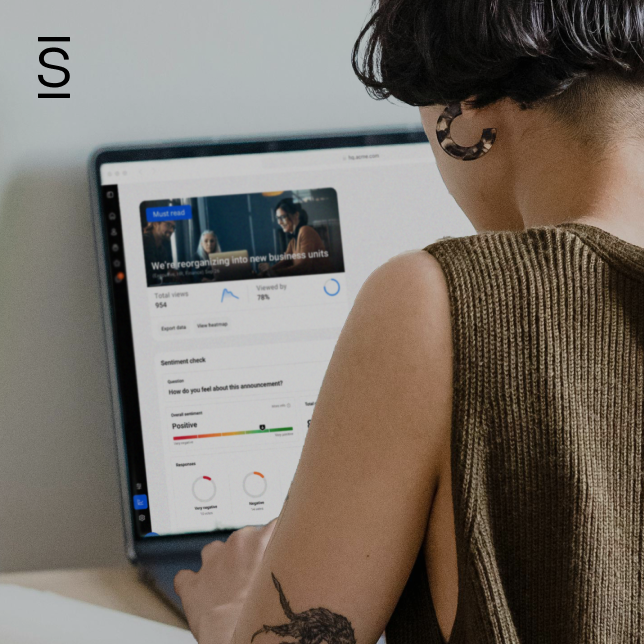
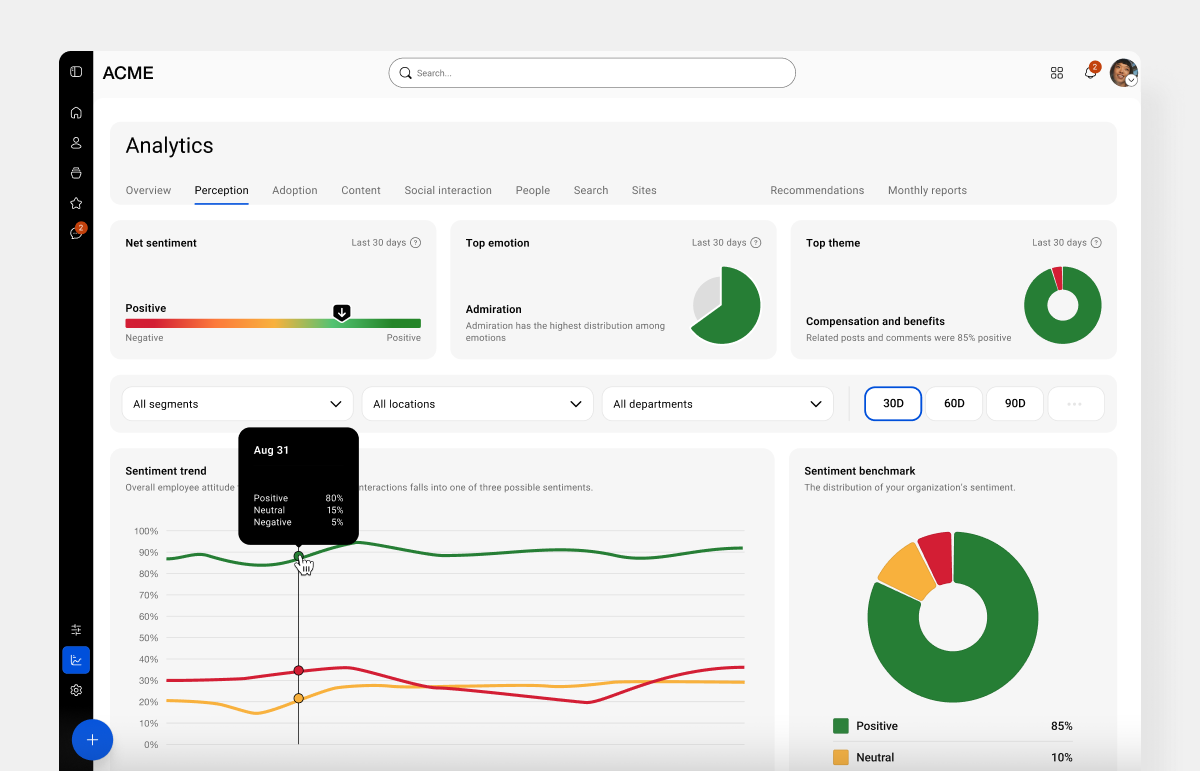
AI gathers and analyzes employee signals across the platform — surveys, sentiment checks, intranet comments, and town hall reactions — to give a clearer view of employee sentiment.
Here’s how AI tracks sentiment without survey fatigue:
- Analyze tone and emotion in real-time conversations to detect anxiety, confusion, or frustration around specific topics like leadership changes or process updates
- Surface enthusiasm and excitement so you can lean into what’s resonating and build momentum where it matters
- Flag disengagement patterns in specific teams or locations before small concerns become big problems
- Give IC teams actionable insights so you can respond with empathy in the moment, not months later
Instead of waiting for annual surveys to tell you morale is dropping, you have a pulse on what’s working and what needs attention right now.
4. Find information instantly with AI search
Important knowledge often gets buried in documents, chats, and project spaces in traditional intranets and knowledge bases. Employees waste time searching for information that exists somewhere, but it feels impossible to find.
They try different search terms. They ask colleagues. They dig through folder after folder. Eventually, they either give up or re-create work that already exists. It’s frustrating. It’s inefficient. And it undermines the knowledge bases IC teams have worked so hard to build.
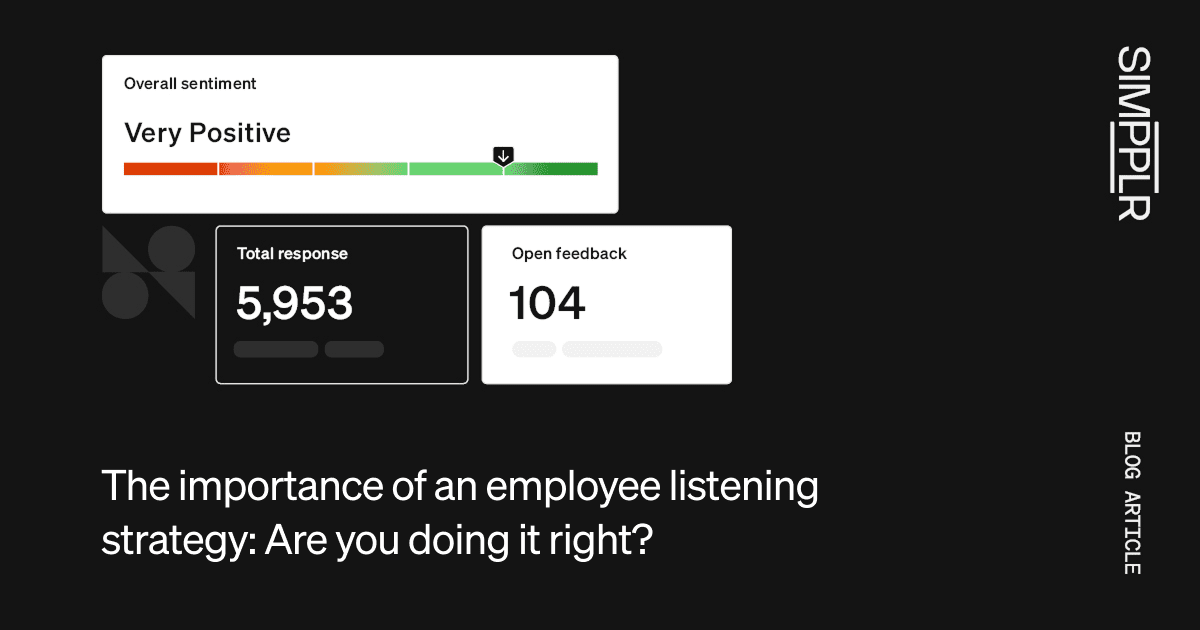
AI-powered enterprise search changes this by retrieving information from multiple internal and external sources through a unified interface.
Here’s what makes AI search different:
- Understands intent, not just keywords so employees find what they’re looking for, even with imprecise queries
- Delivers precise summaries with suggested next steps so employees can act on what they find without reading entire documents
- Personalizes results based on role, location, access permissions, and behavior
- Connects across platforms like Google Drive, Confluence, and Jira so employees aren’t switching between tools
Employees find what they need on the first try. IC teams stop getting requests to “send that link again” or duplicate content that’s already published. Knowledge systems become trusted resources instead of frustrating dead ends.
5. Answer employee questions with conversational AI
Employees have questions, and they need answers immediately: Where’s the updated org chart? How do I submit an expense report? What’s the policy on remote work? These questions flood HR, IT, and internal comms teams daily. Most are straightforward. But answering them individually takes time.
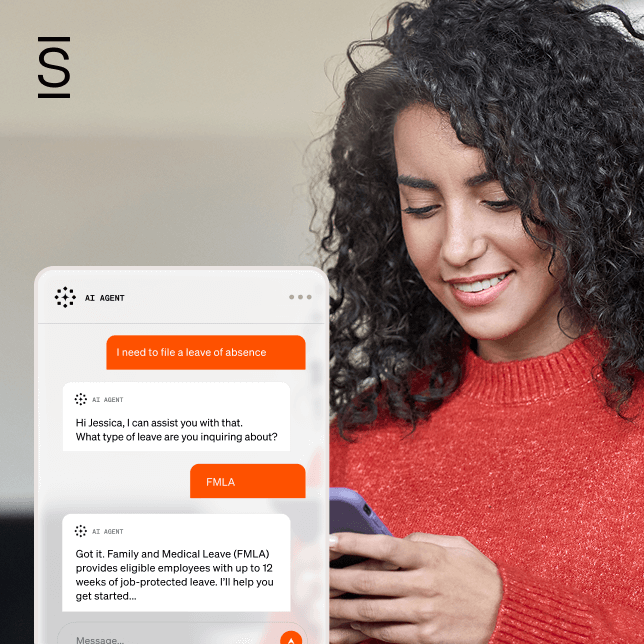
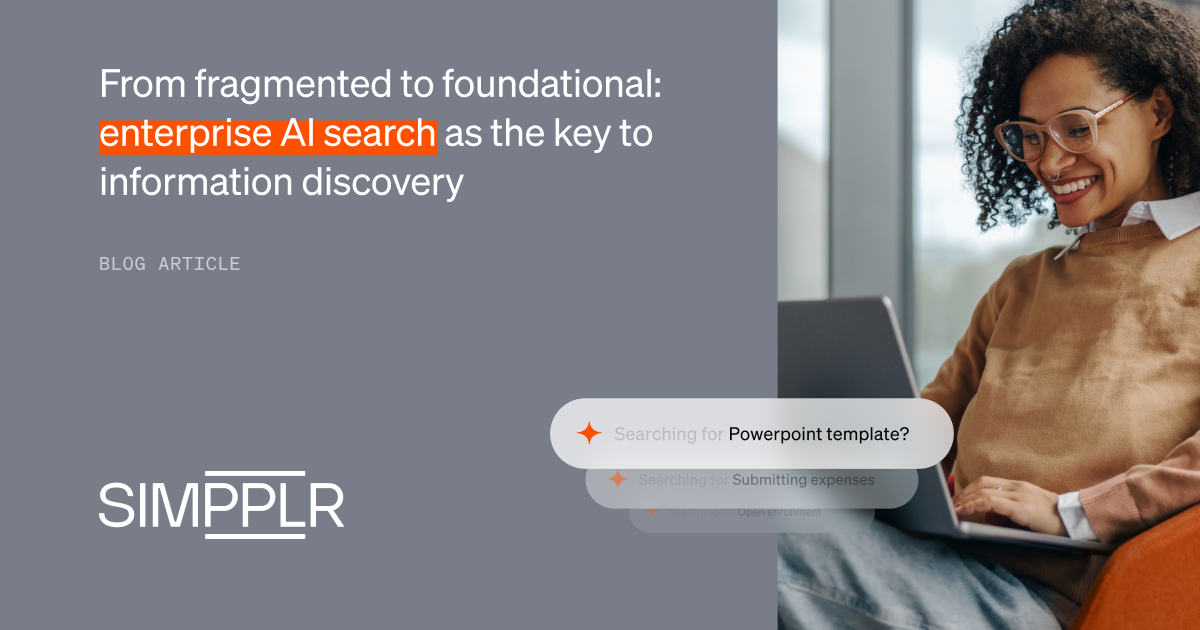
Conversational AI assistants handle these routine questions instantly — giving employees the answers they need while freeing up your team for work that requires human judgment.
Here’s what conversational AI does:
- Answers questions in natural language so employees don’t need to know exact keywords or where information lives
- Guides employees through workflows like submitting requests, finding forms, or completing common tasks
- Pulls information from multiple sources including HR systems, knowledge bases, and enterprise apps
- Provides personalized responses based on role, location, and permissions
- Maintains security and privacy so sensitive information stays protected
Employees get instant answers. Your team stops fielding the same questions repeatedly. Everyone focuses on work that actually needs a human touch.
6. Automate workflows to free up time
You became an IC professional to craft compelling messages, coach leaders, and build authentic employee connections. Instead, you’re sending reminder emails. Tracking down approvals. Managing cross-functional collaboration that moves at a glacial pace.
The solution is to automate repetitive tasks so that you can actually focus on what matters.
Here’s how workflow automation supports IC teams:
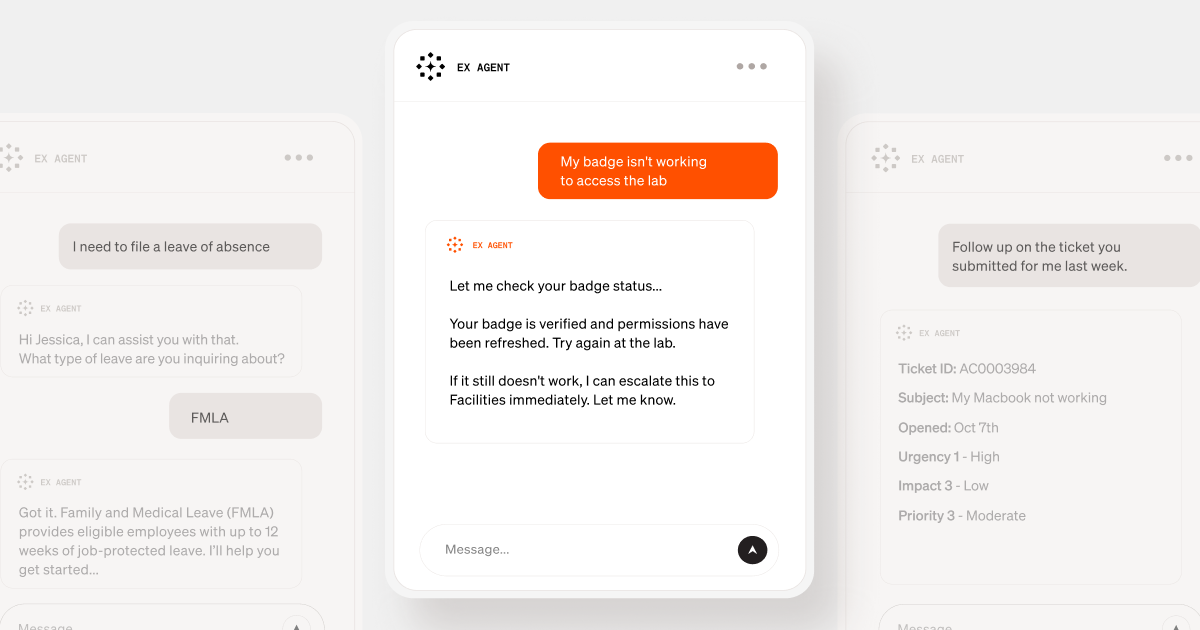
- Automatically route drafts to legal, HR, or other reviewers when campaigns need approval — no more manual coordination
- Send reminders to reviewers and track real-time progress so nothing sits waiting for someone who forgot
- Trigger follow-up messages or alerts based on employee signals to ensure required actions or acknowledgements aren’t missed
- Schedule publication and distribution across multiple channels without manual coordination
AI handles the logistics. Your expertise ensures the messages stay clear, empathetic, and aligned with company culture. That’s the human touch automation can’t replace.
7. Prioritize what matters with AI-powered insights
IC leaders don’t just need data — they need focus. When you’re managing multiple campaigns, stakeholder requests, and shifting priorities, the real question isn’t “what’s happening?” It’s “what deserves my attention right now?”
AI helps you answer that question by surfacing patterns, gaps, and opportunities automatically — so you’re not digging through dashboards trying to find what matters before it’s time to adjust or optimize campaigns.
Here’s how AI helps IC leaders prioritize:
- Spot underperforming content before it becomes a pattern — low engagement, declining views, or drop-off across specific audiences
- Identify audience blind spots where teams, roles, or locations consistently show lower engagement or different needs
- Flag channel and format mismatches so you know when video outperforms text or when timing kills reach
- Surface sentiment shifts around specific topics before they show up in annual surveys
- Highlight operational bottlenecks in approvals, publishing workflows, or campaign coordination that slow execution
Simpplr’s analytics surface these signals through role-based dashboards, trend lines, and peer benchmarks — not buried in raw data exports. You still apply judgment and business context. But instead of hunting for problems or waiting for crises, you’re working from intelligence that tells you where to look first.
8. Respond to crises more effectively
When something goes wrong, every second counts. A safety incident. A PR crisis. A sudden organizational change. In those moments, internal crisis communication becomes critical for keeping people safe, informed, and connected to the company.
For IC teams, this means processing difficult information while drafting updates under pressure — often with incomplete context, shifting details, and leaders who need guidance in real time. AI gives you the structure to balance clarity with empathy and consistency with rapidly evolving facts.
Here’s how AI can help you better respond to a crisis:
- Monitor internal chatter and external signals for early warning signs so you can detect potential issues before they escalate into full-blown crises
- Support response planning with recommended tone, timing, and audience segmentation so you’re not starting from scratch when things go sideways
- Automate multitiered rollout once approved across all channels to maintain consistent messaging at scale
You maintain control over messaging and empathy. AI handles the speed and coordination that crises demand.
9. Prove IC’s business impact with ROI measurement
Organizations know IC is important. But many IC teams still can’t prove it.
When it’s time to discuss budgets or justify headcount, IC professionals end up showing open rates and survey responses. These metrics don’t tell the story of impact. They don’t connect communication to business outcomes. And they certainly don’t prove that IC deserves a seat at the strategy table.
Here’s how AI helps IC prove strategic value:
- Connect communication efforts directly to business outcomes by tracking whether safety messages reduced incidents, product updates boosted sales, or culture campaigns improved retention
- Uncover patterns that show what truly drives change versus what just happened to correlate with other business factors
- Run automated cost-benefit analysis that compares effort and resources with results achieved, showing which messages, channels, and formats deliver the best return
When budget discussions come around, you’re not defending IC with vanity metrics. You’re proving how communication investments drive measurable business success.
10. Optimize campaigns with real-time insights
Strategic campaigns are where IC shines. You’re coordinating with HR, IT, Legal, and a dozen other stakeholders. You’re planning email sequences, intranet content, manager toolkits, and town hall scripts.
While traditional planning relies heavily on intuition and static strategies, AI transforms campaign planning into a living, learning process.
Here’s what AI does during campaign execution:
- Track which messages resonate with different audiences so you can emphasize what’s working and adjust what’s not
- Identify which channels perform best for specific content types and employee segments
- Surface mid-campaign improvements based on engagement patterns, timing, and format performance
- Keep stakeholders aligned with shared dashboards showing real-time progress across all initiatives
You’re not guessing what worked after the campaign ended. You’re learning and adapting while it’s still running, making every message more effective.
Making AI work for internal communications
AI has become a critical competitive differentiator for internal communicators. It’s no longer just another technology choice or productivity enhancer — it’s transforming how organizations connect and communicate from the inside out. In a world where we’re not all working together in the same physical space day in and day out, it’s crucial to choose an employee experience platform that truly serves as a strategic partner.
How Simpplr can help
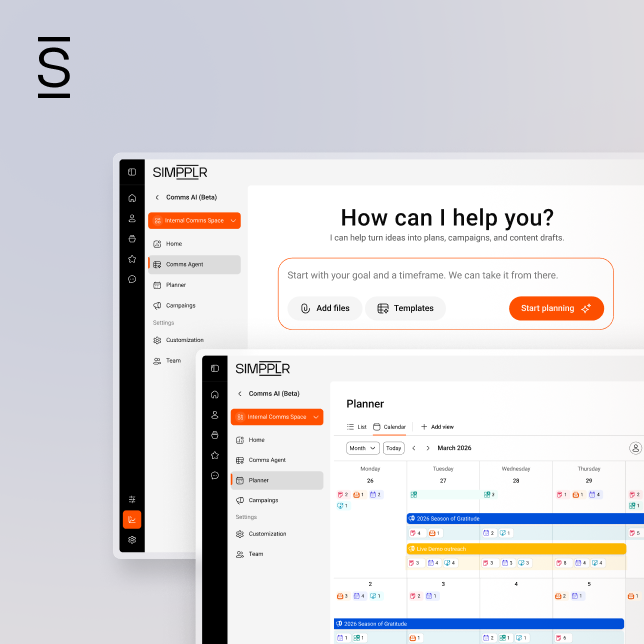
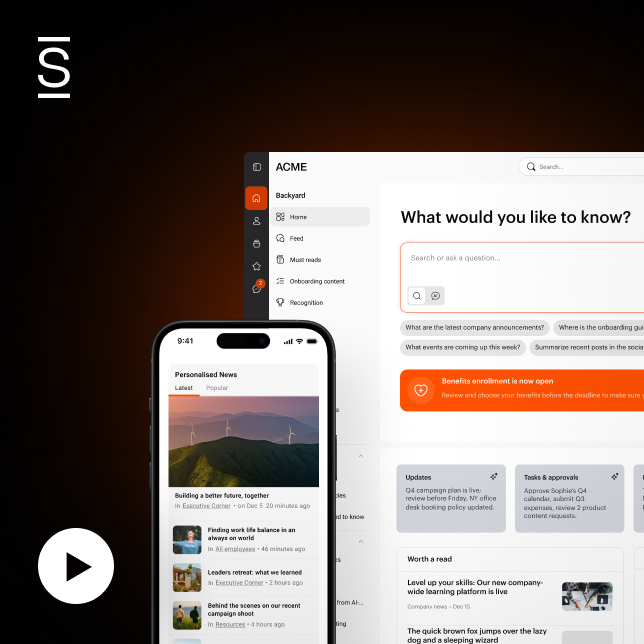
Simpplr’s AI-powered employee experience platform brings these capabilities together in one unified interface.
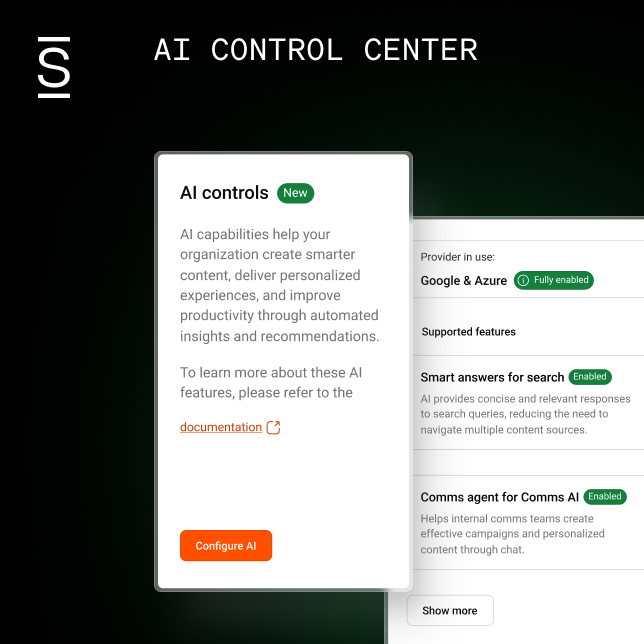
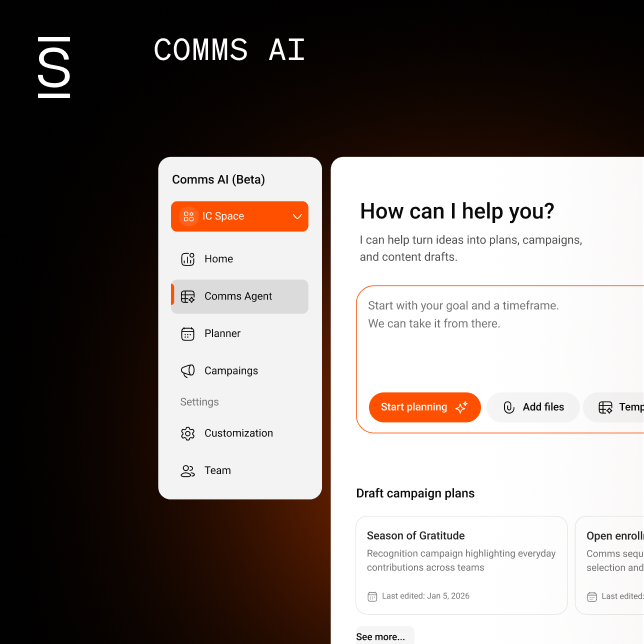
AI-powered search and a conversational assistant help employees find answers instantly. Personalized content delivery ensures the right messages reach the right people at the right time. Prescriptive analytics surface insights before launch and optimize campaigns in flight. Sentiment analysis tracks employee engagement continuously. And intelligent workflow automation handles approvals and coordination.
We built the Simpplr platform for internal communicators who need to move beyond tactical execution and prove strategic value. Every AI capability is designed to amplify your expertise, not replace it.
Discover how Simpplr AI empowers internal communicators. Request a personalized demo today.
Watch a 5-minute demo
See how the Simpplr employee experience platform connects, engages and empowers your workforce.
- #1 Leader in the Gartner Magic Quadrant™
- 90%+ Employee adoption rate