




Your people are working hard and so are the teams supporting them. Many organizations have expanded benefits, added mental health resources, and introduced flexible options. Those efforts matter.

How to build an employee well-being strategy that works
How to build an employee well-being strategy that works
Yet even with the right perks, well-being can slip when the day-to-day experience, such as workload, clarity, manager support, and ways of working, doesn’t keep pace. A real employee well-being strategy has to address everything that makes work sustainable: physical health, mental and emotional well-being, financial security, social connection, and a sense of purpose.
This guide gives you a practical framework for doing that, from diagnosing root causes to building an approach that supports people and performance and holds up over time — without putting HR on the hook for fixing everything alone.

Understanding employee well-being
Most organizations default to physical health when they think about well-being, but that’s only part of the picture. Understanding the full scope helps you build something comprehensive and long-lasting.
What employee well-being includes
Employee well-being is the holistic state of employees’ physical, mental, emotional, financial, and social health. Rather than stopping at illness prevention or stress management, well-being includes creating an environment where people can excel without burnout, isolation, or external worries.
Most frameworks organize well-being across five dimensions. Each of these address a distinct aspect of what makes work sustainable.
Five dimensions of employee well-being:
- Physical well-being: Health, energy levels, and the ability to manage the physical demands of work
- Mental and emotional well-being: Stress management, resilience, psychological safety, and sustainable workloads
- Financial well-being: Financial security, reduced money-related stress, and the ability to meet basic obligations
- Social well-being: Meaningful relationships, a sense of belonging, and genuine connection with colleagues
- Purpose well-being: Meaningful work, alignment with personal values, and opportunities to grow
Addressing only one or two creates temporary relief without solving the underlying conditions. Working on all five helps improve productivity at work and employee engagement.
Employee well-being vs. employee health
Employee health programs typically focus on physical wellness: medical benefits, health screenings, preventive care, and fitness initiatives. Employee health is critical but doesn’t cover the full spectrum.
Employee well-being includes health and builds from that foundation. Someone can have excellent medical coverage and still be burning out from chronic stress, struggling under financial pressure, or feeling disconnected from their team. A well-being strategy ensures all areas of wellness are taken care of so employees can perform their best.
Why well-being strategy matters more than ever
The nature of work has changed in ways that make well-being harder to maintain and easier to ignore. Virtual workspaces and remote work setups offer flexibility, but they’ve also made it difficult to fully disconnect. When Slack notifications pop up on your phone, the workday doesn’t have a fixed end.
In today’s climate, as AI reshapes roles and headlines announce mass layoffs, anxiety is rippling through organizations. Employees aren’t just tired. Many are uncertain about their futures, and that kind of stress infiltrates their personal and professional lives.
Employee well-being has been declining since its peak in 2022 (Gallup’s State of the Global Workplace).
Older managers saw a 5% decline over the past year, and female managers experienced a 7% drop. Individual contributor scores improved slightly, which points to a specific and growing pressure on the people responsible for holding teams together. When manager well-being erodes, everything downstream follows.

The business case for an employee well-being strategy
Employee well-being, or the lack thereof, shows up in hard numbers. When people are healthy and energized, you see lower turnover, higher output, stronger manager retention, and fewer costly mistakes.
What a deteriorating well-being costs
When well-being declines, costs compound, from productivity losses to manager burnout and costly attrition. Whole teams are affected by reduced capacity and declining manager engagement.
Employee burnout can cost employers 0.2 to 2.9 times the average cost of health insurance, and 3.3 to 17.1 times the cost of training per employee (American Journal of Preventive Medicine).
Manager burnout deserves specific attention. As Gallup’s data showed, managers are absorbing disproportionate pressure right now. When a manager burns out, it rarely stays contained. Performance slips, team dynamics deteriorate, and the people they lead start looking for the exit. Replacing a single manager, factoring in recruitment, onboarding, and lost productivity, is a significant expense. Multiply that across a few teams and the cost of neglecting well-being becomes very concrete.
Well-being as a recruitment differentiator
Culture-fit conversations that once gave employers a chance to pitch their benefits have shifted. Prospective employees now use those same conversations to probe whether well-being programs are genuine, flexible, and built around real needs or just a slide in an onboarding deck.
Glassdoor reviews, LinkedIn posts, and word-of-mouth shape your employer brand in ways your careers web page can’t fully offset. Organizations that treat well-being as a genuine priority build reputations that attract talent before an open role is even posted.
A Forbes survey revealed employees who felt cared for by their employer were 56% more engaged at work, around a third were more likely to stay, and 37% were less likely to feel burned out.
Who owns well-being and why it keeps falling apart
Well-being programs aren’t something HR should manage alone. When it’s siloed to one team, efforts may become episodic, misaligned, and easy to deprioritize. Real, durable well-being emerges when executives set direction, managers shape daily experience, teams reinforce healthy norms, and operations embed supportive systems. This section clarifies who owns what at each layer and how coordinated ownership prevents initiatives from falling apart.
Who owns what:
- HR builds the strategy: Develops initiatives, tracks outcomes, and ensures well-being is woven into the employee lifecycle from onboarding through offboarding.
- Managers deliver it daily: Set the tone for employee experience at work, model healthy boundaries, and notice when someone is struggling before it becomes a crisis.
- Leadership makes it real: Provides budget, removes systemic barriers, and signals through their own behavior whether well-being is a genuine priority.
- Employees sustain the culture: Engage with available resources, communicate their needs, and contribute to a culture where asking for support is normalized.
When these roles are clear and each layer is accountable, well-being stops being an HR program and starts becoming part of how work operates. When they’re murky, even well-funded initiatives stall.
How to build an employee well-being strategy that works
The steps below offer a practical sequence to build a great employee well-being program. Pick one focus area, set a baseline, launch a low-lift pilot, and build simple guardrails so you can ship value in weeks rather than months.
Step 1: Assess your current state and employee well-being needs
Before deciding what to fix, you need a clear picture of where employees are struggling, which programs already exist, and whether any of them are working.
Five ways to assess where you stand:
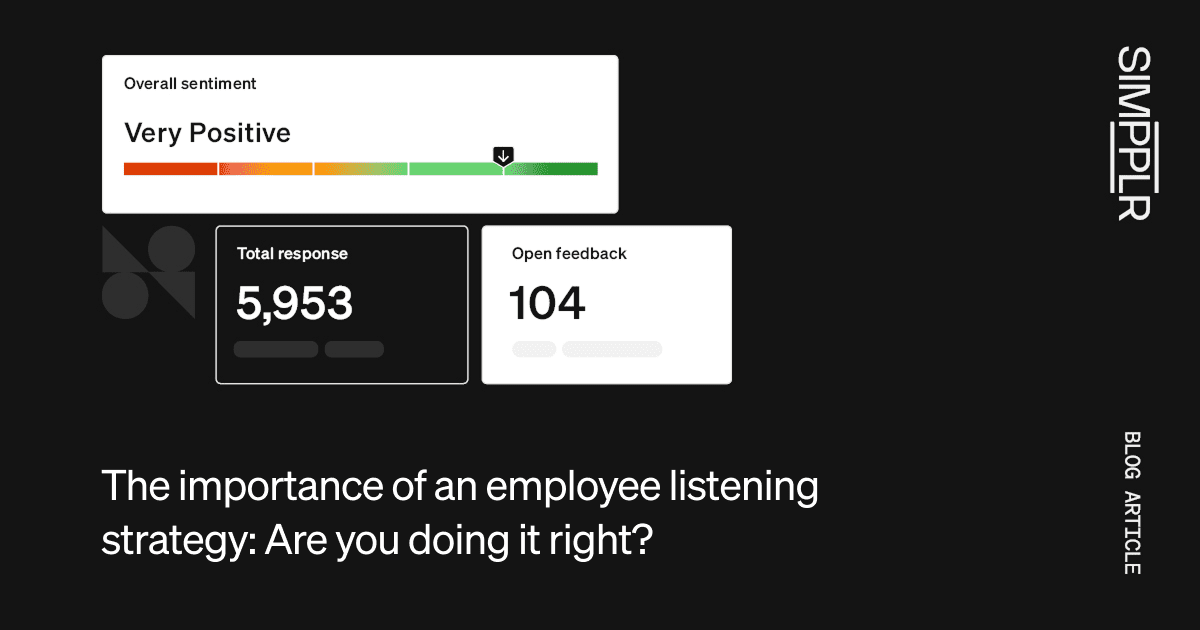
- Survey across all five dimensions: Use a structured employee pulse survey that goes beyond benefits satisfaction. Ask directly about stress levels, workload manageability, financial confidence, sense of belonging, and whether work feels meaningful.
- Audit existing program utilization: Pull data on EAP usage, PTO uptake, mental health benefit claims, and participation in current wellness initiatives. Low utilization often signals awareness gaps or cultural barriers, not lack of need.
- Mine data you already have: Look for clusters across specific teams, roles, tenure groups, or locations where signals are consistently worse. Voluntary turnover rates, absenteeism patterns, engagement survey trends, and exit interview themes can shed light on the problems.
- Hold listening sessions: Bring together a small group of six to eight employees and managers and focus on understanding the “why” behind what the data shows. Listening sessions should help uncover problems and not validate assumptions.
- Map gaps against dimensions: Plot findings against the five dimensions of well-being to identify where the largest gaps sit between what employees need and what currently exists.
Step 2: Identify and diagnose root causes
Many well-being strategies fail because they jump to solutions before understanding what’s driving the problem. High stress triggers a mindfulness app; low engagement triggers recognition programs. These can help, but they’re often just treating symptoms.
How to find the real problem:
- Ask why three times: Run a root cause analysis on your top three pain points. For each one, ask why at least three times before landing on a solution. The third or fourth answer is usually where the real problem lives.
- Separate programs from systemic fixes: A financial well-being workshop helps employees manage money better, but it won’t fix salaries that haven’t kept pace with inflation. Be explicit about which category each root cause falls into.
- Talk to managers directly: Structure one-on-one conversations with managers to understand their daily reality. People managers often have clearer insight into root causes compared to employees and leadership.
- Look for demographic patterns: Burnout showing up disproportionately in one department often points to a specific workload, leadership, or resourcing issue rather than an organizationwide culture problem.
Once you understand why problems happen, you can turn insight into action and assign ownership. Pair each root cause with a matching intervention (e.g., workload → prioritization rules and capacity planning; recognition gap → manager enablement and standards) and assign accountability.
Step 3: Build your well-being strategy framework
With your assessment complete and root causes identified, you’re ready to build. A strategy that holds up over time works on three levels at once. Start at the foundation before adding programs, and get the culture right before expecting either layer to deliver results.
The three layers of your well-being strategy:
- Foundation — policies and benefits: Competitive benefits and mental health coverage, clear and usable PTO policies, flexibility options, and financial resources. Audit this layer first as employees may not know what exists, and awareness gaps are cheaper to fix than benefit gaps.
- Programs — initiatives and resources: Mental health support, physical well-being programs, social connection opportunities, learning and development. These matter, but only once the foundation is solid. Before adding new programs, check whether existing ones are being used.
- Culture — how work feels: Manager training, norms around after-hours communication, psychological safety, and workload expectations. These reflect what people can sustain. This is the hardest layer to build and the easiest to neglect, but it determines whether the other two layers have any real impact.
An organization can offer excellent benefits and run thoughtful wellness programs while a culture of chronic overwork cancels both out. Employees notice the difference between what’s offered and what’s acceptable.
Step 4: Prioritize based on impact and feasibility
Not every organization has the budget or bandwidth to address everything at once, and trying to do so usually means nothing gets done well. The goal here is a focused shortlist that builds momentum rather than a comprehensive plan that stalls before it starts.
How to build your priority list:
- Score on two axes: Rate each initiative on employee impact and implementation feasibility. High impact, high feasibility items go first. High impact, low feasibility items go on a longer-term roadmap with a clear owner and timeline.
- Find two or three quick wins: Steps 2 and 3 may have given you a list of easy to implement ideas. Manager training on well-being conversations, clarifying PTO expectations, or consolidating resources into a single accessible location are reliable starting points.
- Protect structural fixes: Quick wins build momentum but don’t replace root cause solutions. Keep quick wins and priority fixes on the roadmap and be explicit about timelines for each.
- Get manager input: Managers know which initiatives will land with their teams and which will be ignored. Involve them during prioritization to find out exactly what employees need.
Step 5: Integrate well-being into existing systems
A well-being strategy that requires employees to seek out a separate portal, remember a different login, or proactively hunt for resources will underperform. Friction kills utilization. The goal is to meet employees where they are.
How to embed well-being into daily work:
- Add it to one-on-ones: A single question about workload manageability or stress levels takes 60 seconds and gives managers early warning signals before situations escalate
- Fold it into existing surveys: Include specific questions around well-being in engagement surveys rather than running separate well-being surveys employees have to opt into
- Centralize in familiar platforms: Put resources in the platforms employees already use daily for communications, updates, and recognition, such as an intranet
- Connect to performance conversations: Get a full picture and note whether targets were met and if project timelines and resource allocation were realistic
- Train managers to normalize it: Equip managers to weave well-being into team meetings naturally rather thana formal agenda item that feels clinical
When well-being resources live in the same environment where employees work, the barrier to accessing support drops significantly. Integration removes the opt-in requirement and well-being becomes visible by default.
Your roadmap to employee well-being that lasts
If you want well-being to endure, treat it as an operating system instead of a bundle of perks. Start by clarifying ownership. Stand up a cross-functional council with HR, IC, Operations, Finance, and Legal to set priorities, control budget, and review progress on a quarterly basis. Give this group decision rights and make their mandate public so employees know who is accountable and how to escalate issues.
Fix capacity before you add care. No program can outrun chronic overload, unclear priorities, or understaffing. Translate your strategy into practical rules for workload, resourcing, and trade-offs so people aren’t relying on personal resilience to survive the week.
Managers make or break daily experience. Equip them with training and give them time to use those skills.
Well-being programs last when they are owned, measured, and operationalized. They are a success when the way your company works makes healthy, sustainable performance standards. Personalize the guardrails to your rhythms, empower managers to lead them, and keep tightening the loop from signal to action. That’s how benefits and well-being programs stop being noise and start creating lasting lift.
How Simpplr supports employee well-being strategy
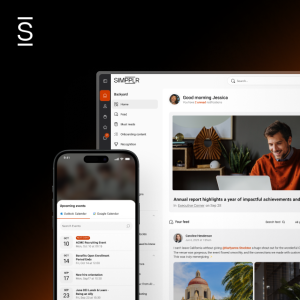
Simpplr AI intranet brings the key elements of your well-being strategy into one platform. This ensures resources can be easily found, communications reach the right people, and manager support is practical enough to use.
Here’s what that looks like in practice:
- Centralized, easy-to-find resources: Policies, benefits, and well-being programs are accessible through a single enterprise search bar so employees can quickly find what they need
- Targeted, high-visibility communication: Share well-being initiatives, updates, and resources through personalized communications that reach the right employees at the right time
- Manager enablement: Equip managers with the information and content they need to support team well-being, directly within the flow of work
- Built-in recognition and connection: Foster social and purpose well-being through peer recognition, employee storytelling, and community spaces like ERGs and interest groups
- Insights that inform action: Track engagement with content and resources to understand what’s working, where gaps exist, and how to evolve your strategy
By embedding well-being resources and communication into the same platform employees use to stay informed, connected, and aligned, Simpplr helps organizations move from disconnected initiatives to a cohesive, scalable well-being strategy.
Ready to bring your well-being strategy to where employees work? See how Simpplr can help. Request a demo today.
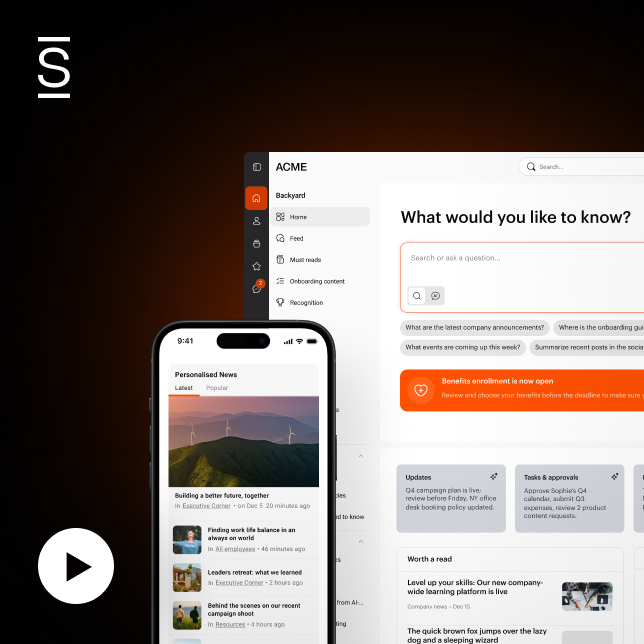
Watch a 5-minute demo
See how the Simpplr employee experience platform connects, engages and empowers your workforce.
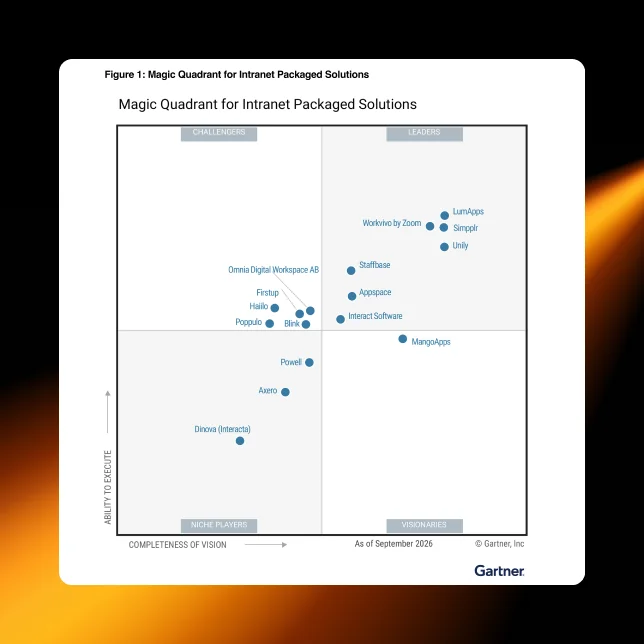
- #1 Leader in the Gartner Magic Quadrant™
- 90%+ Employee adoption rate